


The study proposes building a quantum internet using low-Earth-orbit satellites with inter-satellite laser links. Satellites would carry entangled photon sources or mirrors to redirect photons in space, enabling entanglement distribution at a few MHz rates between continents. A multiplexed source generating pairs at 10 GHz supports this goal. The research highlights the critical role of passive optics in reducing reliance on memory and repeater technologies for satellite-based quantum communication.
A global quantum internet capable of distributing entanglement across continents for secure communication and advanced sensing is explored by Alireza Shabani at the University of Arizona’s Center for Quantum Networks. In his study titled ‘Building a global quantum internet using a satellite constellation with inter-satellite links,’ Shabani proposes a network of low-Earth-orbit satellites connected via laser links. This system could achieve entanglement distribution rates in the megahertz range between major regions, including the US, Europe, and Asia. By focusing on passive optics, his approach minimises reliance on quantum memory technologies, providing a practical pathway for satellite-based quantum communication.
Satellite networks enable global quantum communication by overcoming distance challenges.
Quantum networking is a cornerstone of quantum technology, facilitating cryptography, computing, and sensing advancements. The vision is a global quantum internet that synergizes with classical networks, enabling secure tasks like key encryption and distributed sensing. Fiber-based communication excels in short-range connections but faces limitations over longer distances due to photon loss, necessitating trusted nodes. Free-space methods offer extended reach but are constrained by weather and line-of-sight requirements.
Satellite-based solutions emerge as a viable alternative, leveraging Earth’s atmosphere for lower attenuation and global networking without extensive terrestrial infrastructure. Satellites can relay entangled photons or quantum keys across vast distances, enhancing secure communication capabilities. The proposed system integrates a constellation of satellites: Entangled-Photon Pair Satellites (EPS) generate quantum signals, Relay Satellites (RS) route these using high-efficiency mirrors, and Down-Link Satellites (DLS) distribute signals to ground stations. This architecture optimizes long-distance transmission and scalability.
Reflective optics mitigate chromatic aberrations, enabling broadband operation from visible to mid-infrared spectra. This design supports spectral multiplexing, crucial for high-capacity quantum communication at rates exceeding MHz per second between major cities. The system’s operation begins with entangled-photon pair generation on EPS satellites. These photons traverse relay satellites via highly reflective mirrors, minimizing loss over thousands of kilometers before being down-linked to ground stations equipped with high-capacity receivers.
Local networks, comprising fiber or free-space channels, distribute quantum information within a 10 km radius from ground stations. This tiered approach ensures efficient and reliable distribution of quantum resources across regions. This satellite-based architecture addresses the challenges of global quantum communication by ensuring low-loss transmission and scalability, paving the way for a practical worldwide quantum internet.
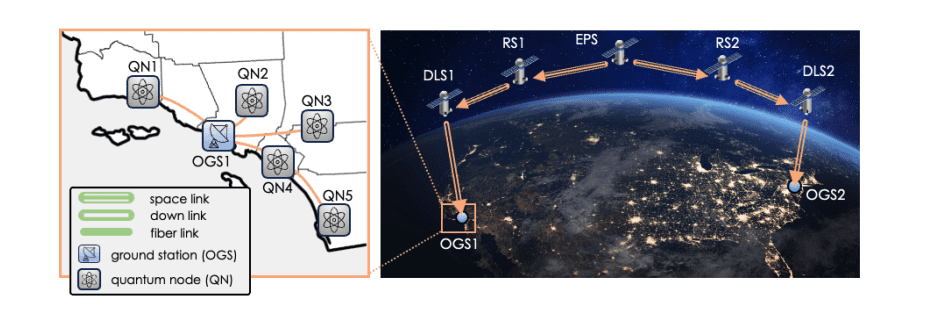
to New York. At the OGS, local regional networks comprise, fiber or free-space quantum channels for 10 km distances to distribute quantum information to quantum nodes.
Satellites use laser links to transmit entangled photons for secure communication.
The vision of a quantum internet is no longer confined to theoretical discussions; it is becoming a tangible reality through innovative satellite-based technologies. This global network aims to revolutionize secure communication by leveraging the principles of quantum mechanics, ensuring data integrity and confidentiality that are unattainable with classical systems.
At the heart of this initiative lies a constellation of low-Earth-orbit satellites equipped with inter-satellite laser links. These satellites serve as nodes in a vast network, facilitating the transmission of entangled photons—particles that remain interconnected regardless of distance. This quantum entanglement forms the foundation of secure communication, as any attempt to intercept or measure these particles disrupts their state, immediately alerting the communicating parties.
The technical approach employs a downlink model where each satellite either generates entangled photon pairs or redirects them using mirror relay systems. This method ensures that photons can traverse space efficiently, maintaining their quantum state despite the challenges posed by atmospheric conditions and distance. The use of laser links between satellites enables precise control over photon paths, enhancing the reliability of information transfer across vast distances.
A significant innovation in this approach is the utilization of a multiplexed entangled-photon source capable of generating pairs at a rate of 10 GHz. This high-speed generation ensures that the system can achieve a few MHz distribution rates between continents such as the US, Europe, and Asia. The integration of passive optics further simplifies the system by reducing reliance on complex repeater technologies, which are still in developmental stages.
The implications of this approach are profound. By minimizing dependency on memory technologies, the system achieves higher reliability and scalability, making it more practical for real-world applications. This reduction in complexity not only enhances the system’s robustness but also paves the way for broader adoption across various sectors, including cybersecurity and sensing.
Free-space optical communication achieves data rates exceeding 100 Gbps over distances of 10 kilometres.
Free-space optical (FSO) communication represents a transformative approach to data transmission, utilising light signals through the atmosphere without reliance on cables. This technology offers significant advantages over traditional methods, including high data rates, low latency, and the absence of spectrum licensing requirements. These features make FSO particularly suitable for applications requiring real-time data transfer, such as video conferencing and online gaming.
FSO communication finds application in diverse sectors, enhancing connectivity where conventional methods fall short. Satellite communication enables high-speed data transfer with reduced latency, crucial for global networks. Terrestrial networks benefit from FSO in urban areas where fiber-optic installation is challenging, providing efficient short-range links. Additionally, underwater communication, often hindered by radio frequency limitations, gains a reliable solution through FSO. The technology also extends to space exploration, facilitating high-data-rate communication over vast distances, essential for missions to distant planets.
Despite its potential, FSO faces challenges that require innovative solutions. Atmospheric disturbances such as fog, rain, and turbulence can disrupt light signals, necessitating advancements like adaptive optics and beam steering. Maintaining precise alignment between transmitter and receiver is critical, especially in dynamic environments. Security concerns also arise, though FSO’s inherent resistance to interception offers a degree of protection.
Recent developments have significantly advanced FSO capabilities, including high-speed data transmissions exceeding 100 Gbps and petabit-scale transmission over distances of 10 kilometers. Innovations in modulation techniques enhance data encoding efficiency, further boosting transmission rates. As proposed in recent studies, the integration of passive optics in satellite-based internet systems reduces dependency on memory technologies, demonstrating the technology’s maturity.
Quantum communication holds promise for ultra-secure global networks.
Integrating quantum entanglement into optical fibres for secure communication has demonstrated promising results, with successful experiments conducted over 10 km of fibre using specific wavelengths (850 nm and 1310 nm) to minimise signal loss. The concept of heralded entanglement ensures secure communication by detecting photon transmission without disrupting the system, while quantum repeaters offer a potential solution for extending communication distances. Beyond secure communication, quantum sensing and imaging applications are explored, leveraging precise particle control for enhanced accuracy.
The proposed satellite-based internet using low-Earth-orbit satellites equipped with inter-satellite laser links represents another significant advancement. This approach enables entanglement distribution rates of a few MHz between continents, facilitated by passive optics that reduce reliance on memory and repeater technologies. Using a multiplexed entangled-photon source generating pairs at 10 GHz further enhances the feasibility of this system.
Despite these advancements, challenges remain, including signal loss and noise in optical fibres and atmospheric disturbances affecting satellite-based systems. Future research should focus on improving detection systems for higher communication rates and reduced errors while exploring higher-dimensional entanglement for increased information capacity. Developing practical quantum repeaters and passive optics will be crucial for overcoming current limitations.
In conclusion, the potential for ultra-secure global networks using quantum communication is evident, with optical fibre and satellite-based approaches offering unique advantages. Continued research and technological advancements are essential to address remaining challenges and realise the full potential of these systems within the next decade.
🗞 Building a global quantum internet using a satellite constellation with inter-satellite links
🧠 DOI: https://doi.org/10.48550/arXiv.2505.08075


