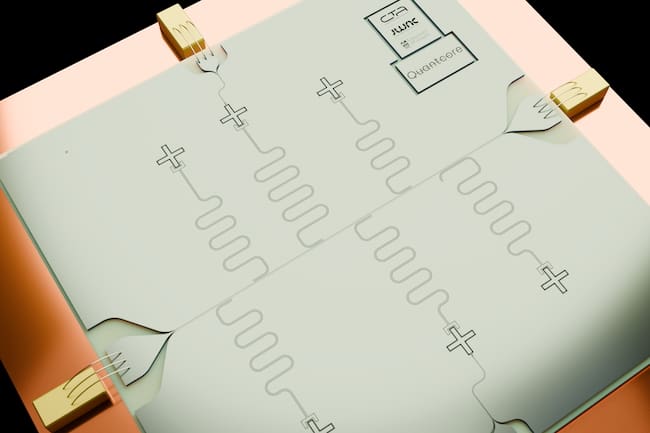
Researchers at the University of Glasgow’s James Watt School of Engineering, in collaboration with Quantcore, a University spinout, have secured a GBP1. 5m grant from the UK Research and Innovation’s (UKRI) Engineering and Physical Sciences Research Council (EPSRC) to establish the UK’s first fabrication facility dedicated to niobium-based superconducting circuits. The three-year Superconductor Prototyping for Critical Technologies (Super-CT) project focuses on overcoming limitations associated with current aluminium-based circuits, which exhibit susceptibility to external electromagnetic noise, by leveraging the advantages of niobium – a material offering greater reliability and enabling operation at faster clock rates while simultaneously reducing power consumption. This initiative aims to address the scalability of niobium superconducting circuits, moving beyond individual chips to larger-scale manufacturing processes, and is predicated on the principle of zero electrical resistance exhibited by superconducting materials below a critical temperature. The project, one of six new research initiatives collectively sharing GBP7. 5m in funding from EPSRC, prioritises the sustainability of manufacturing processes and anticipates contributing to the projected economic impact of quantum computing, potentially reaching trillions of dollars in the coming decades.
Superconductor Development
The University of Glasgow’s James Watt School of Engineering has been awarded a GBP1. 5 million grant from the Engineering and Physical Sciences Research Council (EPSRC), a constituent part of UK Research and Innovation (UKRI), to advance the development of energy-efficient superconducting materials and circuits. This three-year project, entitled ‘Superconductor Prototyping for Critical Technologies’ (Super-CT), forms part of a larger GBP7. 5 million investment by EPSRC into evolving manufacturing technologies, with a specific emphasis on sustainability and productivity enhancement within key UK sectors. The Super-CT initiative directly addresses the growing demand for high-performance, low-energy electronic components, particularly those crucial for the advancement of quantum technologies and their eventual integration into the broader economy. The core focus of Super-CT lies in the fabrication and characterisation of niobium superconducting circuits.
Superconducting materials, as the name suggests, exhibit zero electrical resistance below a critical temperature – a phenomenon arising from the formation of Cooper pairs, where electrons overcome their mutual repulsion and move coherently through the material. Niobium, a Group 5 transition metal, possesses a relatively high critical temperature (approximately 9. 25 K) and critical magnetic field, making it a particularly attractive material for constructing robust and reliable superconducting circuits. This contrasts with aluminium, a commonly used alternative, which is more susceptible to disruption from external electromagnetic interference and operates at lower frequencies. The research team, comprised of engineers and physicists from the University, aims to establish the UK’s first dedicated fabrication facility for niobium-based circuits, attracting investment and driving innovation in the rapidly evolving field of quantum technologies.
More information
External Link: Click Here For More