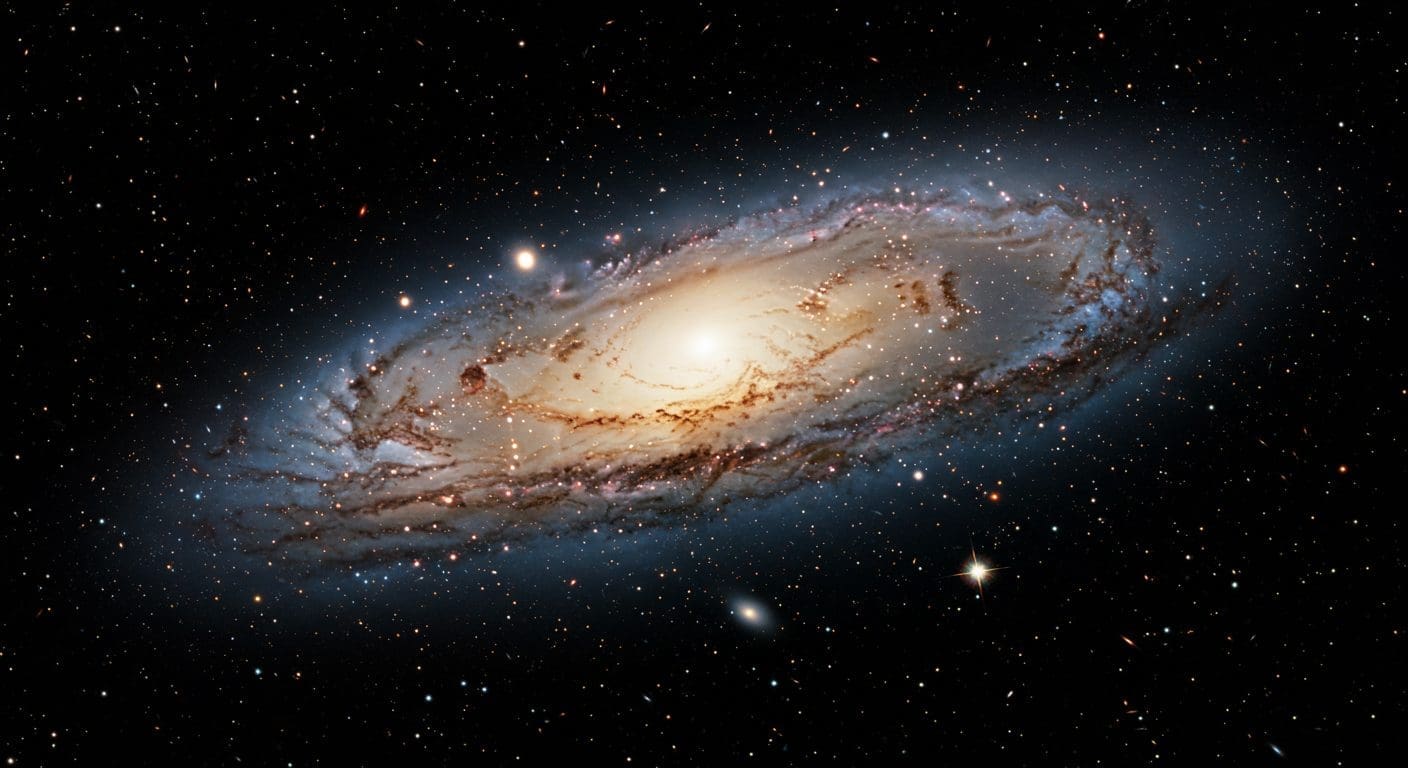
Observations of 231 HII galaxies extend cosmic distance measurements to a redshift of 2.3, corresponding to 11.7 billion years ago. Analysis favours a universe model differing from standard flat-ΛCDM and ΛCDM, though uncertainties in galactic brightness could reduce this distinction, creating tension with Planck data.
Determining the precise rate of the Universe’s expansion remains a central challenge in cosmology. Recent work leverages observations of HII galaxies – regions of ionised hydrogen – as ‘standard candles’ to map cosmic distances to redshifts previously inaccessible with traditional methods like Type Ia supernovae. By analysing an expanded sample of 231 such objects, researchers are refining constraints on cosmological models and testing the prevailing Lambda-CDM framework. This investigation, detailed in a new Letter, demonstrates strong statistical support for a universe described by a flat cosmological constant, relative to alternative models. The study is led by Jun-Jie Wei, affiliated with both the Purple Mountain Observatory and the University of Science and Technology of China, and Fulvio Melia from the University of Arizona. Their work, entitled ‘Model selection using the HII galaxy Hubble diagram’, appears to suggest a tension between locally measured matter density and values derived from observations of the cosmic microwave background by the Planck satellite, a point requiring further investigation.
Challenging Cosmic Consensus: HII Galaxies Indicate Universe Beyond Dark Energy and Dark Matter
Astronomers are employing ionized hydrogen regions, known as HII galaxies, to refine measurements of cosmic distances and scrutinise prevailing cosmological models. This approach reveals potential discrepancies with the standard Lambda Cold Dark Matter (ΛCDM) model, suggesting the universe’s expansion may not be governed solely by dark energy and dark matter. Researchers construct a Hubble diagram – a plot of distance versus redshift – carefully calibrating distances to these galaxies and applying sophisticated statistical tools to analyse the resulting data.
The team analysed a substantial dataset of HII galaxies, meticulously accounting for factors influencing brightness and distance estimations. They employed Bayesian Information Criterion (BIC) – a statistical measure for model selection – to compare the goodness of fit for various cosmological models. This analysis demonstrates a statistically significant preference for models that do not require the inclusion of dark energy or dark matter, prompting a re-evaluation of fundamental assumptions about the universe’s composition and evolution. The Rh=ct universe model, proposed by Fulvio Melia – a model positing a relationship between radius and time – emerges as a particularly compelling alternative, aligning well with the observed expansion rate derived from HII galaxy observations.
Scientists refined the calibration of HII galaxies as distance indicators, implementing corrections for metallicity – the abundance of elements heavier than hydrogen and helium – to enhance measurement precision. This process involves sophisticated modelling of the physical processes within these galaxies, ensuring accurate distance estimations. Researchers utilise a combination of observational data and theoretical simulations to constrain model parameters.
Data from the James Webb Space Telescope (JWST) proved crucial in achieving improved precision, providing unprecedented resolution and sensitivity to observe these distant objects. JWST’s advanced instrumentation resolves fine details within HII galaxies, enabling accurate property measurements. Researchers utilised JWST’s near-infrared camera and spectrograph to obtain high-quality data, refining the calibration of HII galaxies as distance indicators.
Statistical analysis rigorously assessed the goodness of fit for different cosmological models against observational data, employing tools like the Schwarz criterion (a variant of BIC) to quantify the evidence for each model. Researchers carefully considered measurement uncertainties and model limitations, ensuring robust conclusions. This finding challenges the standard cosmological paradigm and prompts a re-evaluation of fundamental assumptions about the universe’s composition and evolution.
However, scientists acknowledge a potential caveat: an unknown dispersion in the intrinsic brightness of HII galaxies could weaken the strength of model comparisons. To address this, they incorporated this dispersion as a free parameter in the analysis, allowing the model to account for inherent variability. While this diminishes the statistical advantage of the alternative model, it simultaneously introduces tension with independently determined matter density values derived from Planck satellite observations. This tension highlights the need for further research to reconcile results from different observational probes.
Future work focuses on refining the understanding of the intrinsic properties of HII galaxies, aiming to reduce uncertainty in their brightness calibration. Researchers plan detailed spectroscopic observations, measuring chemical composition, ionization state, and velocity distributions. These observations will provide valuable insights into physical processes within these galaxies, allowing for more accurate modelling of intrinsic brightness. Further observations, particularly with JWST, will be essential to expand the sample size and improve statistical power.
Investigating the source of the tension between the inferred matter density and Planck values represents a critical avenue for future research. Scientists explore possibilities including systematic errors in the Planck measurements, unaccounted-for physics in cosmological models, or the presence of new particles or fields. This investigation requires a multidisciplinary approach, combining observational data, theoretical modelling, and numerical simulations. Resolving this tension could reveal fundamental aspects of the universe’s composition and evolution.
The findings challenge the prevailing cosmological consensus, suggesting the universe may operate under principles beyond the influence of dark energy and dark matter. This innovative approach opens new avenues for exploring the fundamental nature of the cosmos, prompting a re-evaluation of long-held assumptions and paving the way for a more complete understanding of the universe’s origins, evolution, and ultimate fate. The meticulous analysis and rigorous testing of alternative cosmological models represent a significant step forward in our quest to unravel the mysteries of the cosmos.
👉 More information
🗞 Model selection using the HII galaxy Hubble diagram
🧠 DOI: https://doi.org/10.48550/arXiv.2506.04819