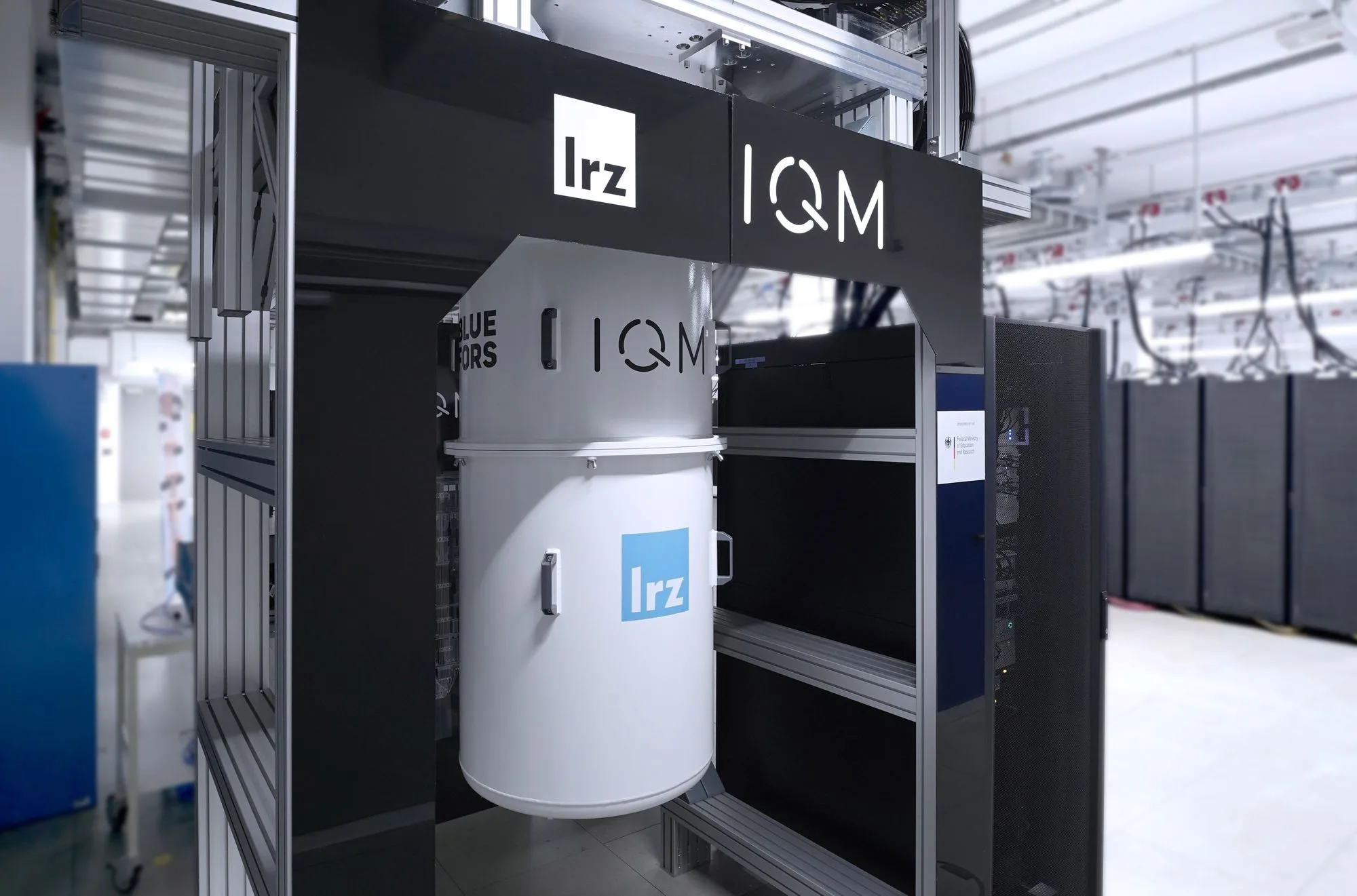
Germany has launched its first hybrid quantum computer, Q-Exa, at the Leibniz Supercomputing Centre (LRZ). The 20-qubit quantum computer, developed by IQM Quantum Computers, has been integrated into the SuperMUC-NG supercomputer. The project, funded by the German Federal Ministry of Education and Research with over 40 million euros, aims to connect quantum processing units to a supercomputer and develop interfaces and control tools. The LRZ plans to open the system for research purposes, strengthening Germany’s position as a technology hotspot and promoting development work on future technology within the Munich Quantum Valley.
Quantum Computing Breakthrough at Leibniz Supercomputing Centre
The Leibniz Supercomputing Centre (LRZ) in Germany has achieved a significant milestone in the field of quantum computing. In collaboration with the Q-Exa consortium, led by IQM Quantum Computers, and including Eviden and HQS Quantum Simulation, a 20-qubit quantum computer has been successfully integrated into a supercomputer, SuperMUC-NG. This marks the first time a quantum computer has been incorporated into a supercomputer, demonstrating the compatibility of these two technologies.
The quantum processor unit from IQM, based on superconducting circuits, has been combined with conventional computer technology. The hybrid system is currently being prepared for regular operation at the LRZ, and selected researchers will soon have the opportunity to access and experiment with it. The integration of the quantum computer into the supercomputer is a result of the project “Quantum Computer Extension for Exascale HPC” (Q-Exa), which received funding of over 40 million euros from the German Federal Ministry of Education and Research (BMBF).
Quantum Computing and High-Performance Computing Convergence
The Q-Exa project was initiated in 2022, with the aim of connecting quantum processing units (QPU) based on superconducting circuits to a supercomputer and developing interfaces and control tools for this purpose. The project was not set up in a laboratory but is located for the first time in direct proximity to other high-performance computing systems at the LRZ. This allows researchers to use the system remotely for experiments and to develop algorithms or scientific codes.
The Q-Exa project lays the groundwork for researching and further developing quantum computing and for accelerating high-performance computing (HPC) through quantum processing units (QPUs). In addition to the hybrid Q-Exa system, specialists at the LRZ and partner institutions of the Munich Quantum Valley also developed the prototype of the Munich Quantum Software Stack (MQSS). This software integrates quantum systems into the workflows of supercomputers and is supplemented by other quantum technologies.
Quantum Computing: A Promising Future Technology
The integration of a quantum computer into a conventional supercomputer is seen as an international breakthrough, strengthening Bavaria’s position as a global hotspot for one of the defining technologies of the 21st century. The development of the Q-Exa computer is a significant success for the Leibniz Supercomputing Centre, IQM, and its partners, as well as the Munich Quantum Valley, which has received 300 million euros from the Hightech Agenda Bayern.
The Q-Exa system will soon be opened at the LRZ in a pilot operation for researchers. This will enable researchers to test and further develop their own application ideas, potentially leading to solutions to problems that are currently unthinkable in a wide range of fields, from medicine and materials science to finance.
Q-Exa: A Key Project for Quantum Computing
The Q-Exa project is seen as a key project for the integration of quantum computers into high-performance computing. The Q-Exa consortium is hopeful that the next generation of processors can be further optimised with these partners, thereby enriching supercomputing and science. The Q-Exa project demonstrates the success of co-design, with the first quantum computer integrated into supercomputers in a short timeframe and made ready for use in science.
The Q-Exa system combines two specific strengths of the high-tech location Bavaria – high-performance computing and quantum computing – in Germany’s first hybrid quantum computer. This innovation offers unique possibilities for developing novel quantum algorithms and testing promising use cases.
About the Leibniz Supercomputing Centre
The Leibniz Supercomputing Centre (LRZ) is a world-class IT service and computing user facility serving Munich’s top universities as well as research institutions in Bavaria, Germany and Europe. As an institute of the Bavarian Academy of Sciences and Humanities, LRZ has provided a robust, holistic IT infrastructure for its users throughout the scientific community for nearly sixty years. It offers the complete range of resources, services, consulting and support – from email, web servers and Internet access to virtual machines, cloud solutions, data storage and the Munich Scientific Network (MWN).
LRZ is part of Germany’s Gauss Centre for Supercomputing (GCS) and serves as part of the nation’s backbone for the advanced research and discovery possible through high-performance computing (HPC). In addition to current systems, LRZ’s Future Computing Group focuses on the evaluation of emerging Exascale-class architectures and technologies, development of highly scalable machine learning and artificial intelligence applications, and system integration of quantum acceleration with supercomputing systems.
External Link: Click Here For More