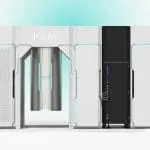
As the world grapples with the escalating threats of cyber sabotage, espionage, and hybrid warfare, researchers in Germany are racing to develop a revolutionary solution: quantum communication networks based on quantum repeaters. These complex devices, far removed from their Wi-Fi boosting counterparts, have the potential to provide an unprecedented level of security by leveraging the laws of quantum physics, rendering them virtually invulnerable to hacking or sabotage.
With the German Federal Ministry of Education and Research committing EUR 20 million over three years to the Quantenrepeater.Net project, a consortium of 42 partners from research and industry is working tirelessly to overcome the significant challenges in developing and implementing these networks. The stakes are high, as the successful realization of quantum-secured IT infrastructure could be crucial for the protection of critical infrastructure and the preservation of free and democratic societies.
The Quest for Secure Quantum Communication Networks
In an era where cyber threats and hybrid warfare are becoming increasingly sophisticated, the need for secure communication networks has never been more pressing. Quantum physics, with its inherent properties of entanglement and superposition, offers a promising solution to this challenge. Researchers in Germany have been at the forefront of developing quantum communication networks based on quantum repeaters, devices that can temporarily cache and transmit quantum states over long distances.
The German Federal Ministry of Education and Research
The German Federal Ministry of Education and Research has recently funded a new project, Quantenrepeater.Net (QR.N), with EUR 20 million over three years to demonstrate the viability of quantum repeaters in test networks outside controlled lab environments.
The Role of Quantum Repeaters in Secure Communication
Quantum repeaters are not ordinary signal-boosting devices found in homes but complex systems designed to extend the range of quantum communication. These repeaters are crucial for establishing secure quantum networks, which could be pivotal for democratic societies and the protection of critical infrastructure. By operating based on the principles of quantum physics, these networks would offer unprecedented security against hacking and sabotage. The development of quantum repeaters capable of ensuring the secure transmission of information over longer distances is a significant step towards realizing a quantum-secured IT infrastructure.
One of the significant challenges researchers face is generating high-quality quantum states while minimizing transmission losses. To build a network, nodes that can cache and transmit these states to the next node are required, which is essentially what repeaters do. The quality of these quantum states and the efficiency of their transmission are critical factors in determining the feasibility of quantum communication networks.
The QR.N Project: A Step Towards Quantum-Secure Communication
The QR.N project, coordinated by Professor Christoph Becher of Saarland University, brings together 42 partners from research and industry to develop the basic requirements for a quantum-communication network structure based on quantum repeaters. Building on the results of the prior Quantenrepeater.Link (QR.X) project, which identified the fundamental requirements for developing a quantum repeater, QR.N aims to make significant progress in this area.
JGU Subproject: Theoretical Modeling and Experimental Realization
JGU Subproject: Theoretical Modeling and Experimental Realization
At Johannes Gutenberg University Mainz (JGU), researchers are involved in both theoretical modeling and experimental realization of concepts related to quantum communication. The experimental team focuses on using defect centers in diamond as light storage interfaces, characterized by narrow bandwidth light emission suitable for transmitting entangled states. Additionally, the project explores atoms, ions, and semiconductor systems for their relevance to quantum repeater functioning.
The theoretical subproject at JGU, led by Professor Peter van Loock, plays a crucial role in modeling quantum repeater systems realistically and exploring new approaches that utilize quantum error correction. This technique, known in quantum computing, is being adapted to the needs of a quantum repeater, to create more robust and long-lived quantum storage systems. The potential for developing optical quantum repeaters that can operate without transient storage is also being explored.
External Link: Click Here For More