
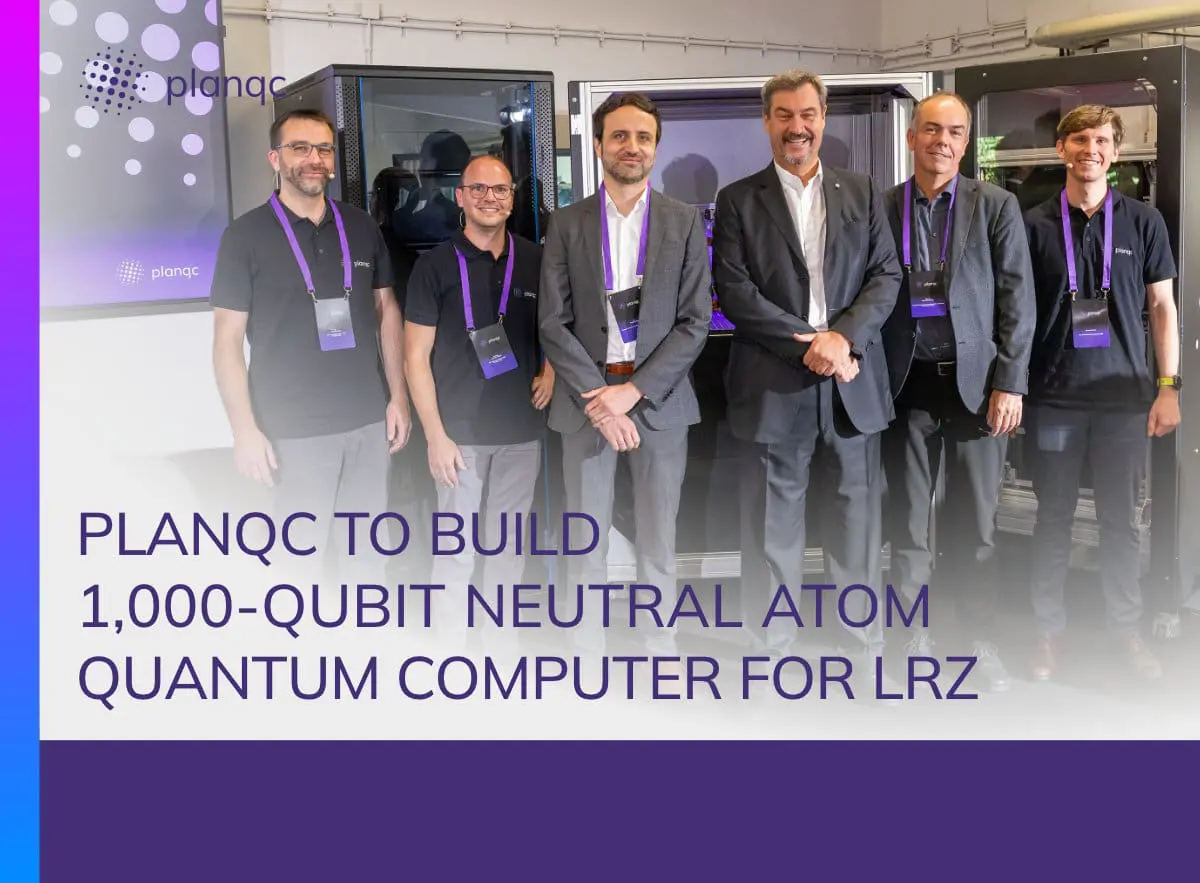
In a significant breakthrough, planqc has been selected to lead a €20 million project to build and deploy a 1,000-qubit quantum computer at the Leibniz Supercomputing Centre in Germany. This advanced quantum computer, based on neutral atoms, will be integrated into the centre’s high-performance computing infrastructure, serving as an accelerator for scientific research and industrial applications.
The project, named “Multicore Atomic Quantum Computing System” (MAQCS), is funded by the German Federal Ministry of Education and Research and aims to install a universally programmable quantum computer that leverages neutral atoms in an innovative multi-core architecture. Alexander Glätzle, CEO and co-founder of planqc, says this milestone brings them closer to developing quantum computers capable of solving complex problems in various industries.
Prof. Dr. Dieter Kranzlmüller, Chairman of the Board of Directors at LRZ, adds that integrating planqc’s neutral atom system into their High-Performance Computing and Quantum Computing environment will offer users a powerful new tool for research and development.
Building a 1,000-Qubit Neutral-Atom Quantum Computer: A €20 Million Government-Funded Project
The Leibniz Supercomputing Centre (LRZ) in Garching near Munich has selected planqc to lead a €20 million project to build and deploy a 1,000-qubit quantum computer. Based on neutral atoms, this advanced quantum computer will be integrated into LRZ’s high-performance computing (HPC) infrastructure, serving as an accelerator for scientific research and industrial applications.
The “Multicore Atomic Quantum Computing System” (MAQCS), aims to install a universally programmable quantum computer that leverages neutral atoms in an innovative multi-core architecture. This design will boost both computational speed and efficiency. The development is supported by the Max-Planck-Institute of Quantum Optics (MPQ) as the third part of the consortium with planqc and LRZ.
The MAQCS system will employ neutral atoms in optical lattices as qubits and feature a multi-core architecture with two independent cores totaling 1,000 qubits. This parallel processing capability reduces latency by enabling one core to reset while the other continues computations, significantly boosting speed and efficiency. The project also emphasizes advancing quantum error correction, a critical step toward reliable and fault-tolerant quantum computing.
Neutral-Atom Quantum Computing: A Promising Approach
planqc’s use of neutral atoms as qubits is particularly promising for scaling to large qubit counts with longer coherence times and higher accuracy, which are crucial for developing industrial-grade quantum computers. In contrast to quantum systems functional only at temperatures close to absolute zero, planqc’s 1,000-qubit quantum computer can be operated at room temperature.
The innovative multi-core architecture boosts efficiency and scalability and lays the groundwork for real-world applications. The project demonstrates the potential of neutral-atom quantum computing, which is expected to generate added value for science and industry-relevant problems for the first time.
Integrating Quantum Computing into High-Performance Computing Infrastructure
The MAQCS quantum computer will be integrated into LRZ’s Munich Quantum Software Stack (MQSS), a hybrid supercomputing environment that tightly links HPC and quantum computing hardware. Users will be able to access the system through both cloud-based interfaces and direct HPC workflows, ensuring broad accessibility and seamless operation.
The planqc system represents the third quantum computing type in LRZ’s portfolio, following a series of systems based on superconducting circuits and trapped ions. The ability to provide on-site solutions for quantum computing in conjunction with supercomputers is essential for the development of cutting-edge high-tech solutions from Europe.
Strengthening Germany’s Quantum Leadership
Quantum computers have the potential to revolutionize fields such as drug discovery, material science, cryptography, and climate research by tackling complex problems beyond the capabilities of classical computers. With planqc’s cutting-edge technology and strong government backing, Germany is poised to establish itself at the forefront of global quantum innovation.
The MAQCS project follows a €29 million order from the German Aerospace Centre (DLR), demonstrating Germany’s commitment to advancing quantum computing research and development. The project’s success will pave the way for further investments in quantum technology, solidifying Germany’s position as a leader in this field.
Quantum Computing for Real-world Applications
The MAQCS project marks an important step toward developing industrial-grade quantum computers that can be operated at room temperature. This achievement has significant implications for developing practical applications in fields such as chemistry, materials science, and optimization problems.
By demonstrating the potential of neutral-atom quantum computing, planqc is laying the groundwork for real-world applications. The project’s success will pave the way for further research and development, ultimately leading to practical solutions that can be integrated into existing industries and workflows.
External Link: Click Here For More