

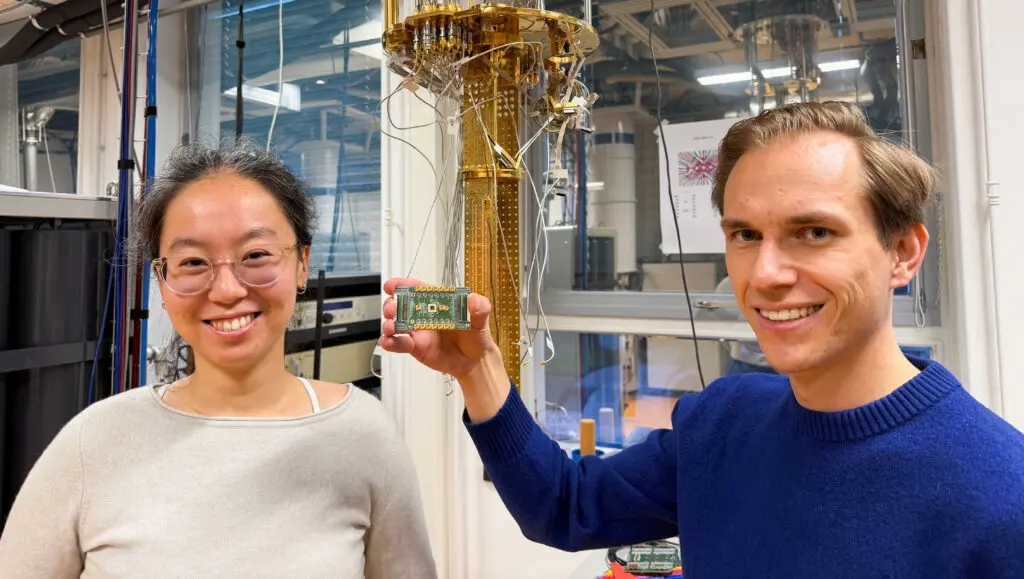
Valentin John and Cécile Yu, doctoral researchers at QuTech, have demonstrated a planar 10-qubit processor fabricated on a strained germanium (Ge/SiGe) heterostructure. The device features ten quantum dots organized in a 3–4–3 layout, enabling uniform high-fidelity control across a two-dimensional array where central qubits connect to four neighbors. This achievement, published in Nature Communications, advances both the number and dimensional scaling crucial for quantum computation. The researchers harnessed, rather than avoided, the sensitivity of germanium spin qubits, achieving single-qubit gate fidelities exceeding 99% and paving the way for implementing two-dimensional error-correcting codes.
Germanium Qubit Device and Architecture
Researchers at QuTech have demonstrated a planar 10-qubit germanium processor fabricated on a strained germanium/silicon-germanium heterostructure. This device utilizes holes—the positively charged counterparts of electrons—confined in quantum dots defined by metallic gate electrodes. The qubits are arranged in a 3–4–3 layout, critically featuring two central qubits each connected to four neighbors. This increased connectivity is essential for implementing two-dimensional error-correcting codes, a cornerstone for achieving fault-tolerant quantum computing.
The team achieved high-fidelity control across the entire 10-qubit array, reporting single-qubit gate fidelities exceeding 99%. Systematic investigation revealed optimal performance by operating the qubits with three holes per dot, driven by a top plunger gate, and utilizing a slightly tilted magnetic field. This configuration minimizes crosstalk and ensures uniform control, maximizing efficiency and robustness across the array.
Further analysis, supported by modeling from CEA Grenoble, showed that the three-hole regime induces a directional, p-like spin wavefunction. This anisotropic characteristic enhances the coupling between the electric drive and the spin state, resulting in faster and more efficient qubit control. The research highlights how understanding the underlying physics of these complex spin qubits can unlock advantages for scaling quantum hardware.
High-Fidelity Control and Operational Insights
Researchers at QuTech have demonstrated high-fidelity control across a 10-spin qubit array in germanium, achieving single-qubit gate fidelities exceeding 99% throughout the device. This planar processor utilizes a 3–4–3 layout, crucially connecting central qubits to four neighbours—a design essential for implementing two-dimensional error-correcting codes needed for fault-tolerant quantum computing. Systematic investigation into optimal operation revealed insights into maximizing reliability and scalability, a critical step forward for quantum hardware.
The team discovered that operating qubits with three holes, driven by a top plunger gate and a slightly tilted magnetic field, provided the most efficient and robust performance. This configuration minimizes crosstalk between qubits and ensures uniform control across the entire array. Analytical and numerical modelling, done in collaboration with CEA Grenoble, showed this improvement stems from the anisotropic nature of the spin states involved, giving the three-hole spin a directional, p-like character.
This research highlights how understanding the underlying quantum physics can transform complexities into advantages. By identifying a regime where hole spins behave predictably and respond strongly to local electric fields, the team proved robust operation is possible even in dense two-dimensional arrays. The device is fabricated on a strained germanium (Ge/SiGe) heterostructure, offering strong spin–orbit coupling, and advancing the field of semiconductor spin qubits.
We found that operating the qubits with three holes, driven by the top plunger gate and using a slightly tilted magnetic field, gives the most efficient and robust performance.
Valentin John
Hole Spin Behavior and Performance Optimization
Researchers at QuTech demonstrated high-fidelity control across a 10-spin qubit array in germanium, achieving single-qubit gate fidelities exceeding 99%. This planar processor utilizes a 3–4–3 layout, crucially connecting central qubits to four neighbours—a design essential for implementing two-dimensional error-correcting codes needed for fault-tolerant quantum computing. The team systematically investigated operational parameters to optimize performance, moving beyond simply scaling qubit numbers to achieving reliable control within a two-dimensional architecture.
The research revealed that operating qubits with three holes, driven by a top plunger gate and a slightly tilted magnetic field, provided the most efficient and robust performance. This configuration minimizes crosstalk between qubits and ensures uniform control across the array. Varying hole occupation (one, three, or five) and the driving gate revealed a clear optimum, highlighting the importance of precisely tuning device parameters for stability and reliable operation.
The choice of a strained Germanium/Silicon-Germanium heterostructure is not arbitrary; the strain engineering is critical because it modifies the band structure of the host material. This strain precisely alters the confinement potential experienced by the valence band holes, enabling tighter control over the hole wavefunctions. By optimizing the lattice mismatch, researchers can enhance the quantum dot potential profile, thereby isolating the spin degree of freedom and minimizing charge noise effects that typically limit qubit coherence times in conventional semiconductor platforms.
Operationally, the achieved high connectivity (four neighbors for central qubits) is a direct enabler for implementing surface codes or other topological quantum codes. These codes inherently require high qubit interaction capacity and local, uniform coupling geometries. This advanced coupling capability allows for the simultaneous encoding and manipulation of logical qubits, significantly reducing the physical overhead required compared to designs limited to simple linear chains or nearest-neighbor connectivity.
Furthermore, the reliance on valence band holes offers inherent advantages in the spin coherence domain. Unlike electron spin qubits, hole spin qubits can exhibit distinct tunability and a unique coupling mechanism driven by the overlap between the hole wavefunction and the applied gate voltages. This specific p-like anisotropic wave function geometry allows for electrical control of the exchange coupling ($J$), providing a faster and more reliable means of mediating entanglement between adjacent spin pairs.
Scaling this technology demands sophisticated cryogenic control and readout schemes. While the coherence and fidelity metrics are highly encouraging, realizing the full potential requires integrating on-chip quantum transducers. These transducers are necessary to efficiently convert the highly sensitive spin quantum state into a measurable microwave or optical signal, linking the quantum processor to classical control electronics operating at millikelvin temperatures.
Analytical and numerical modelling, in collaboration with CEA Grenoble, explained the improved performance. The three-hole regime induces a more directional, p-like spin wavefunction, unlike the nearly symmetric form of a single hole. This anisotropic ‘personality’ allows the qubit to be more easily driven by the electric field from the top gate, resulting in stronger coupling and faster, more efficient control—turning qubit complexity into an advantage.


