
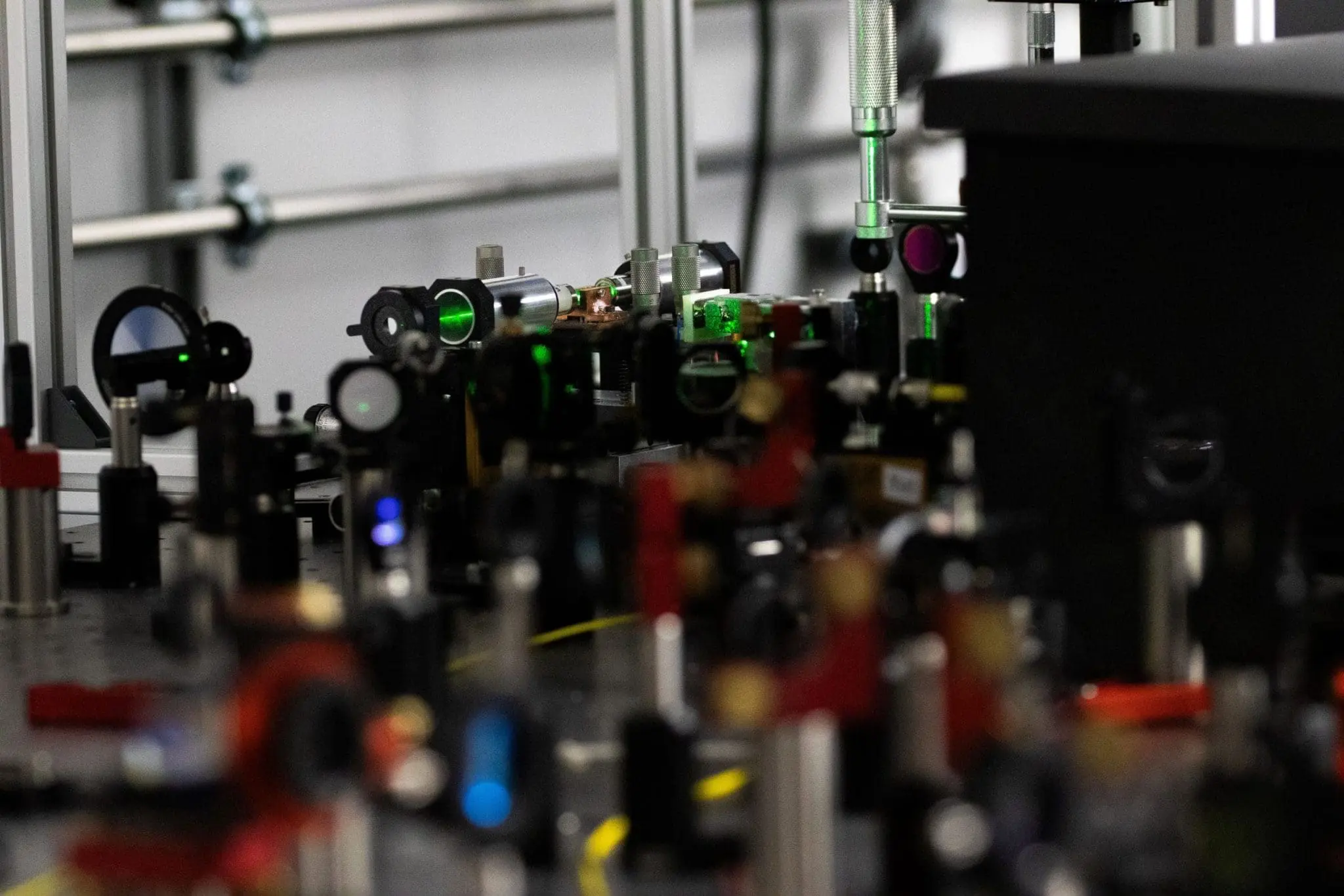
Researchers at Paderborn University in Germany have successfully constructed Europe’s largest sampling-based quantum computer, dubbed “PaQS” (Paderborn Quantum Sampler). This pioneering achievement marks a significant milestone in the development of light-based quantum technologies. The project, funded by the Federal Ministry of Education and Research with around 50 million euros, brings together expertise from 13 science and industry partners to put Germany at the forefront of photonic quantum computing.
Led by Professor Christine Silberhorn, physicist and spokesperson for the Institute for Photonic Quantum Systems (PhoQS) at Paderborn University, the team has created a Gaussian boson sampler consisting of scalable components. This innovative approach enables any desired configuration, making it possible to measure where photons exit the large photonic network.
The PaQS machine is driven by squeezed states, a quantum mechanical phenomenon that creates incredibly high computing power in quantum computers. The “Integrated Quantum Optics” working group at Paderborn University has developed highly optimized squeezed states using optical waveguides. Key partners involved in this project include Menlo Systems, Fraunhofer IOF Jena, and Swabian Instruments, with Q.ANT, a German company specializing in industrial quantum technologies, coordinating the effort.
Germany’s First Photonic Quantum Computer: A Breakthrough in Light-Based Quantum Technologies
Researchers at Paderborn University have successfully constructed Europe’s largest sampling-based quantum computer, marking a significant milestone in the development of light-based quantum technologies. The ‘PaQS’ (Paderborn Quantum Sampler) was built as part of the PhoQuant funding initiative by the Federal Ministry of Education and Research (BMBF), with support from Menlo Systems, Fraunhofer IOF Jena, and Swabian Instruments.
Major Technological Challenges
The development of quantum computers is fraught with technological challenges. Scientists across the globe are working on various experimental platforms to overcome these hurdles. The largest photonic quantum computers currently exist in China, Singapore, France, and Canada. Each approach to realizing quantum computing has its pros and cons. For instance, photonic networks can operate at room temperature and be implemented in miniaturized, programmable circuits. However, they have to contend with optical losses.
Europe’s Largest Gaussian Boson Sampling Machine
Paderborn’s scientists have created Europe’s largest Gaussian boson sampling machine with the PaQS. The aim is to measure where photons exit the large photonic network. Unlike previous implementations, the team built the PaQS with a forward-looking approach to system integration and full programmability. This means that they are using a fully programmable and integrated interferometer with which they can implement any configuration they choose.
Photonic Quantum Computing: A Promising Platform
Photonic quantum computers use light to perform quantum calculations, while alternative quantum computing platforms are based on superconducting qubits or trapped ions. The benefits of photonic quantum computers include a clear route towards scalability and high clock-rate operation. However, the entire field of quantum computing technology is still in its infancy. Further research is required to verify the benefits and disadvantages of the various quantum computing platforms that are currently under investigation.
Squeezed States: A Key Component
Implementing a system like PaQS requires an in-depth understanding of all the components involved. Quantum mechanics phenomena, such as squeezing or photon entanglement, create incredibly high computing power in quantum computers. The “Integrated Quantum Optics” working group at Paderborn University has a long tradition of using optical waveguides to develop highly optimized squeezed states.
Future Applications and Research Directions
The PaQS machine is currently being expanded to enable more complex calculations and serve as the basis for investigating future devices that will further increase system integration. The full programmability of the system also means that it even allows for the implementation of applications arising from future investigations – creating unprecedented flexibility and a high degree of future applicability.
External Link: Click Here For More