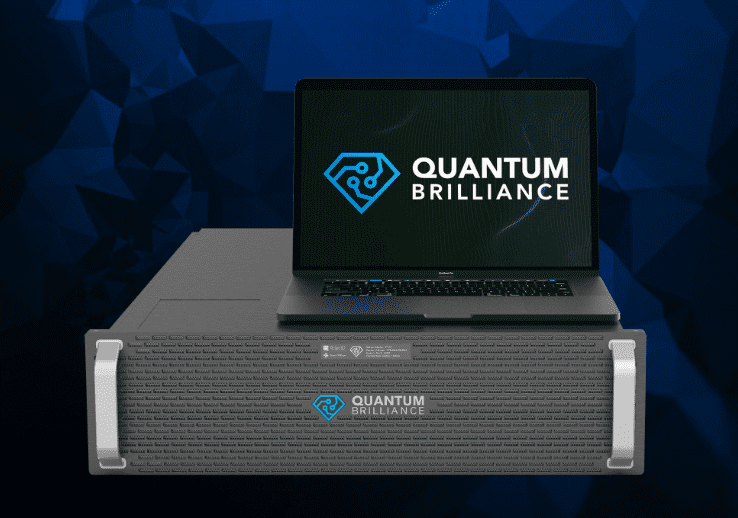
Fraunhofer Institute for Applied Solid State Physics IAF has become the first European institution to purchase a room-temperature quantum accelerator from Quantum Brilliance, a global leader in diamond-based quantum technology. This cutting-edge technology leverages synthetic diamonds to operate at room temperature, eliminating the need for expensive and energy-intensive refrigeration units.
The purchased system, QB-QDK2.0, features nitrogen-vacancy centers in diamond and enhances Fraunhofer IAF’s existing software suite, including the open-source Qristal SDK and Qristal Emulator powered by NVIDIA’s CUDA-Q platform. This collaboration builds on the institutions’ joint work on advancing quantum computing technologies using diamond-based qubits, including the DE BRILL project. Key individuals involved in this development include Mark Mattingley-Scott, Chief Revenue Officer at Quantum Brilliance, and Tim Costa, Senior Director of CAE, EDA & Quantum at NVIDIA.
Room-Temperature Quantum Accelerators: A New Era in Quantum Computing
Quantum Brilliance, a company specializing in diamond-based quantum technology, has announced the first purchase of a room-temperature quantum accelerator in Europe by Fraunhofer Institute for Applied Solid State Physics IAF (Fraunhofer IAF). This milestone marks a significant step forward in the development of scalable and energy-efficient quantum computing solutions.
The purchased system, QB-QDK2.0, is a 19” rack-mountable quantum accelerator featuring nitrogen-vacancy centers in diamond. It enhances Fraunhofer IAF’s existing software suite, which includes the Qristal SDK (open-source) and Qristal Emulator. These tools allow users to simulate quantum computing back-ends with realistic noise models powered by NVIDIA’s CUDA-Q platform. The QB-QDK2.0 is a hybrid quantum-classical compute node that integrates classical co-processors, including NVIDIA GPUs, as well as CPUs, alongside Quantum Brilliance’s quantum processor (QPU). This architecture enables users to explore different depths of hybrid quantum-classical algorithms, such as quantum machine learning techniques that seamlessly combine quantum and classical neural networks.
Fraunhofer IAF is one of the world’s leading research institutes for synthetic diamonds and their potential use in quantum computing applications. The institute has been collaborating with Quantum Brilliance on multiple projects, including DE BRILL, which focuses on advancing quantum computing technologies using diamond-based qubits. The nitrogen-vacancy (NV) based system, together with the corresponding high-performance computing (HPC) integrated virtual emulation system, will advance Fraunhofer IAF’s research infrastructure as part of a comprehensive quantum computing ecosystem.
Diamond-Based Quantum Technology: A Key to Scalable Quantum Computing
Quantum Brilliance’s technology differs from other quantum mainframe computers by leveraging synthetic diamonds to run at room temperature in any environment. This eliminates the need for large, expensive, and energy-intensive refrigeration units to keep qubits stable. The use of diamond-based qubits offers a promising solution for scalable and energy-efficient quantum computing.
The QB-QDK2.0 is designed to operate at room temperature, making it an attractive option for researchers and organizations looking to explore the potential of quantum computing without the need for complex and expensive cooling systems. This technology has the potential to unlock new possibilities for hybrid quantum-classical computing, enabling the development of more powerful and efficient quantum computers.
Hybrid Quantum-Classical Computing: A New Frontier
The QB-QDK2.0 is a hybrid quantum-classical compute node that integrates classical co-processors, including NVIDIA GPUs, as well as CPUs, alongside Quantum Brilliance’s quantum processor (QPU). This architecture allows users to explore different depths of hybrid quantum-classical algorithms, such as quantum machine learning techniques that seamlessly combine quantum and classical neural networks.
NVIDIA’s CUDA-Q platform is supporting researchers in developing and scaling these hybrid systems, which are leading the charge to useful quantum computing. The collaboration between Quantum Brilliance and Fraunhofer IAF highlights the potential of room-temperature quantum accelerators and continues to push the boundaries of scalable, energy-efficient quantum computing solutions.
Installation and Integration: A Key to Successful Deployment
Quantum Brilliance will be supported in the installation of the new system by SVA System Vertrieb Alexander GmbH, one of Germany’s leading IT system integrators. SVA provides tailored solutions for intensive computational workloads, supporting clients from research and development through to diverse industries such as healthcare, finance, public services, and manufacturing.
The successful deployment of the QB-QDK2.0 will require careful installation and integration with Fraunhofer IAF’s existing infrastructure. The collaboration between Quantum Brilliance and SVA ensures that the system is installed and configured correctly, enabling researchers at Fraunhofer IAF to quickly begin exploring the potential of room-temperature quantum accelerators.
Global Adoption: A Growing Trend
The first global procurement of the second-generation Quantum Development Kit was by Oak Ridge National Laboratory in the United States. The purchase by Fraunhofer IAF marks a significant milestone in the adoption of room-temperature quantum accelerators globally.
As researchers and organizations continue to explore the potential of quantum computing, the demand for scalable and energy-efficient solutions is likely to grow. Quantum Brilliance’s technology has the potential to play a key role in this trend, enabling more widespread adoption of quantum computing across various industries and applications.
External Link: Click Here For More