

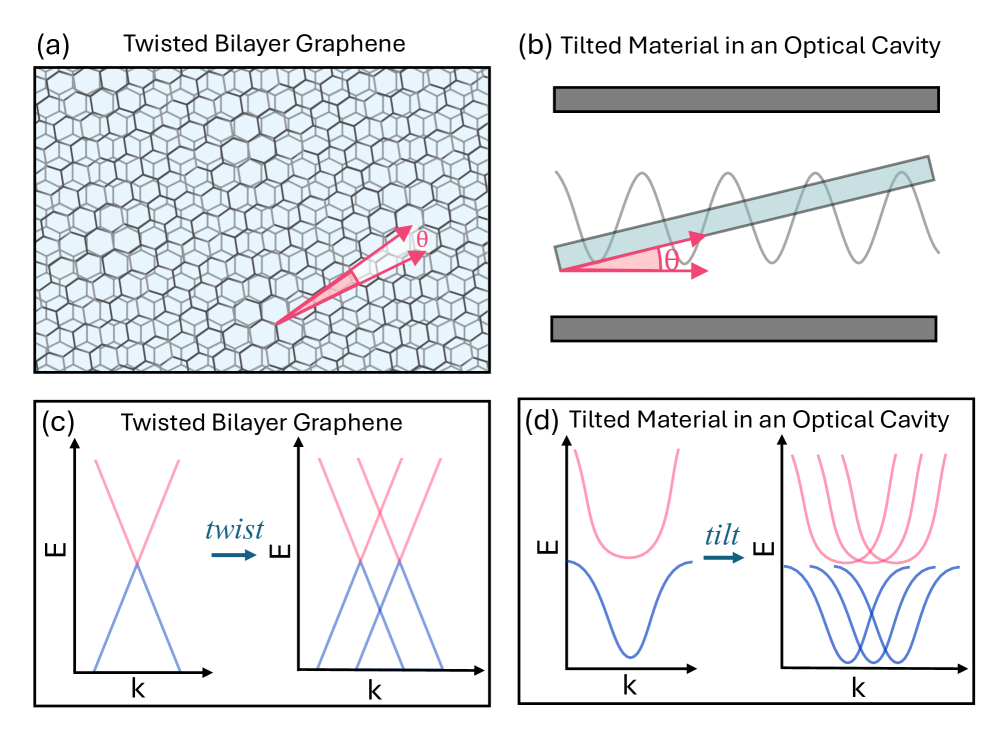
The interplay of light and matter at the nanoscale holds immense promise for future technologies, and researchers are continually seeking new ways to control this interaction. Arshath Manjalingal, Saeed Rahmanian Koshkaki, and Logan Blackham, along with colleagues at Texas A and M University, now demonstrate a novel phenomenon called the light-matter moiré effect, achieved by simply tilting a two-dimensional material within an optical cavity. This innovative approach, distinct from traditional twisted layered structures, creates repeating patterns in how light and matter couple, resulting in unique properties like flat bands of energy and the potential for efficient frequency conversion of light. The findings establish a new route for designing materials with tailored optical properties and could pave the way for advanced polariton-based devices with enhanced functionality and performance.
In a two-dimensional material tilted within an optical cavity, researchers have discovered a unique approach to controlling light-matter interactions, differing from conventional methods that rely on stacking layers. This geometric tilt creates a periodic modulation of the coupling between light and the material, resulting in displaced replicas of the polariton dispersion and the formation of flat bands near the center of the energy spectrum. Through detailed quantum simulations, the team demonstrates that this technique, termed Light-Matter Mode Engineering (LMME), enables coherent frequency conversion and exhibits robustness against energy loss caused by vibrations within the material. These findings establish LMME as a novel platform for engineering polariton band structures, generating flat bands, and performing coherent frequency conversion.
Moiré Superlattices for Strong Light-Matter Coupling
This research investigates the strong coupling between light and matter, specifically focusing on excitons and photons within optical cavities, leading to the formation of exciton-polaritons. These hybrid light-matter quasiparticles possess unique properties and hold promise for applications in quantum technologies. The work builds upon the concept of moiré superlattices, which can create flat bands, electronic states with very low effective mass, enhancing light-matter interactions and facilitating polariton formation. A central theme is the ability to manipulate and convert the frequency of light using polariton-based systems, crucial for building quantum repeaters and communication networks.
Tilting Creates Novel Light-Matter Moiré Effect
Researchers have discovered a novel phenomenon, the light-matter Moiré effect, which arises when a two-dimensional material is tilted within an optical cavity. This effect creates a unique pattern of light-matter interaction, differing from traditional Moiré patterns formed by stacking layers. The tilting introduces a periodic modulation of the coupling between light and the material, resulting in displaced replicas of the polariton dispersion and the formation of flat bands near the center of the energy spectrum. These flat bands are particularly significant because they enhance the potential for manipulating light and matter at the nanoscale.
The research demonstrates that this light-matter Moiré effect enables efficient frequency conversion, a process where light of one color is converted into another, and importantly, this conversion remains robust even with slight disturbances that typically cause energy loss. The team achieved this understanding through detailed simulations of light and matter interactions within the cavity, revealing that the tilt angle directly controls the periodicity of the light-matter coupling, effectively tailoring the properties of the resulting polaritons. This level of control represents a significant advancement in the field of polaritonics, potentially leading to the development of more efficient and versatile optical technologies.
Light-Matter Moiré Effect Enables Polariton Control
This work introduces the light-matter moiré effect (LMME), a novel phenomenon arising when a two-dimensional material is tilted within an optical cavity. Unlike traditional moiré effects created by stacking layers, LMME originates from the geometric modulation of light-matter coupling, producing replicas of the polariton dispersion and enabling the formation of flat bands near the center of the energy spectrum. The research demonstrates that LMME facilitates coherent frequency conversion, a process where the phase of light is preserved even with interactions with vibrations within the material. The significance of these findings lies in the potential for engineering polariton band structures and tailoring light-matter interactions, opening avenues for developing polariton-based quantum devices and potentially efficient polariton condensation at room temperature. The team showed that the phase-preserving frequency conversion remains robust even with substantial interactions between excitons and phonons, suggesting a practical advantage for quantum information processing.
🗞 Tilted Material in an Optical Cavity: Light-Matter Moiré Effect and Coherent Frequency Conversion
🧠 ArXiv: https://arxiv.org/abs/2508.11237


