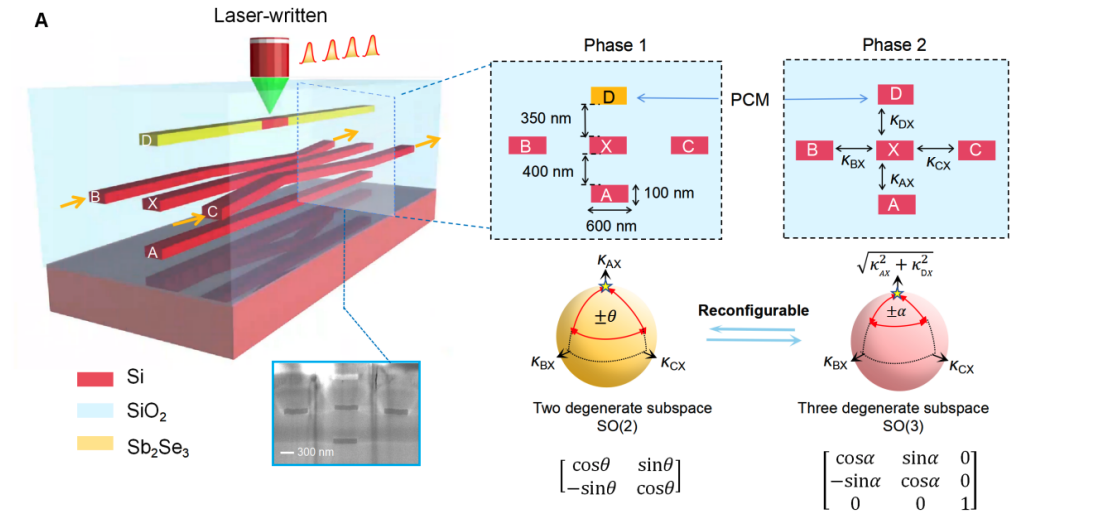
The manipulation of light using geometric phases, which rely on the overall shape of a light wave rather than its oscillations, offers inherent robustness against external disturbances, a significant advantage in optical technologies. Youlve Chen, Jiaxin Zhang, and colleagues report a method for actively controlling these geometric phases within integrated photonic circuits. Their research, detailed in the article ‘Reconfigurable non-Abelian geometric phase in hybrid integrated photonics’, demonstrates a reconfigurable system utilising the phase-change material antimony selenide (Sb2Se3) to modulate the geometric phase, enabling dynamic control over light’s behaviour and opening possibilities for advanced optical switching and processing. The team, spanning the State Key Laboratory of Photonics and Communications at Shanghai Jiao Tong University and the Hangzhou Institute for Advanced Study, University of Chinese Academy of Sciences, achieve multilevel control and tunable braiding operations, representing a step towards practical, robust photonic devices.
Holonomic quantum computation utilises geometric principles for robust information processing. Current approaches to quantum computation often rely on dynamic phase manipulation, which is susceptible to environmental noise and fabrication imperfections. Geometric phases, however, offer inherent resilience as they depend on the geometry of a system’s evolution rather than precise timing or energy levels.
The non-Abelian geometric phase allows for the simultaneous manipulation of multiple quantum states, offering greater computational power than simpler geometric phases. Achieving reconfigurability – the ability to dynamically adjust these transformations – presents a significant challenge, as robustness typically comes at the cost of flexibility. Phase-change materials (PCMs) are emerging as promising candidates for programmable photonic circuits due to their ability to switch between distinct optical states.
These materials exhibit a substantial change in refractive index when transitioning between crystalline and amorphous phases, offering a mechanism for controlling light propagation. This non-volatile switching reduces energy consumption and simplifies circuit design. Integrating PCMs into photonic platforms provides a pathway towards reconfigurable geometric operations, enabling the creation of adaptable and efficient optical circuits. Specifically, antimony selenide (Sb₂Se₃) is a PCM exhibiting a high refractive index contrast and compatibility with standard fabrication techniques, allowing researchers to tailor the propagation of light and manipulate the geometric phase.
Researchers are developing a new photonic platform that utilises a hybrid integration of phase-change materials with silicon waveguides to achieve reconfigurable non-Abelian geometric phases, with potential applications in optical computing and switching. This innovation centres on the use of Sb₂Se₃, a material that can switch between crystalline and amorphous states, altering its refractive index and influencing how light propagates within the silicon waveguide. This allows for the control of degenerate states, multiple quantum states with the same energy, enabling specific optical transformations.
The methodology centres on fabricating a three-layer structure
The methodology centres on fabricating a three-layer structure where Sb₂Se₃ is integrated with amorphous silicon waveguides, enabling active control over the number of degenerate states. The behaviour of this system is described by a Hamiltonian, a mathematical equation that defines the total energy of the system and dictates its evolution, incorporating coupling coefficients that quantify the interaction between different parts of the structure. Switching the phase of the Sb₂Se₃ waveguide alters the refractive index and, consequently, the number of degenerate subspaces, achieving reconfigurability.
Experimental validation involves meticulous characterisation of the resulting geometric phases and transformations, demonstrating the ability to create two-level reconfigurable SO(2) holonomy, a type of geometric phase, and reconfigurable two-mode braiding. Researchers cascade these SO(2) building blocks to achieve multi-level tunability, implementing a high-dimensional reconfigurable mesh, synthesising an eight-level (3-bit) SO(3) transformation using Givens rotations, a mathematical technique for rotating vectors in three-dimensional space. The performance of these devices is assessed through measurement of matrix elements and fidelity assessment.
To confirm the material properties and structural integrity of the fabricated devices, researchers employ several characterisation techniques, utilising Raman spectroscopy to verify the crystalline and amorphous states of the Sb₂Se₃. Microscope imaging provides visual confirmation of the surface textures, allowing for a comprehensive understanding of the device’s behaviour and performance.
The realisation of reconfigurable non-Abelian geometric phases represents an advance in photonic computing, addressing a critical limitation of this approach – a lack of adaptability. Researchers demonstrate this reconfigurability using a three-layer hybrid integrated photonic platform incorporating Sb₂Se₃, actively controlling the number of degenerate states by switching between the crystalline and amorphous states of the material. This control tunes the geometric phase and enables complex optical manipulations.
The core of the system lies in an ‘M-pod’ structure, where the phase state of the Sb₂Se₃ waveguide dictates the number of degenerate states available, creating three degenerate states in the amorphous phase and supporting only two in the crystalline phase. This difference generates distinct non-Abelian geometric phases, analogous to a two-sphere, offering inherent robustness against errors. Experimental results confirm the system’s ability to modulate geometric phases, demonstrating a reconfigurable two-level SO(2) holonomy and a reconfigurable two-mode braiding operation.
Researchers cascade two independently tunable SO(2) building blocks
Researchers cascade two independently tunable SO(2) building blocks to achieve multi-level discrete reconfigurability, extending this scalability to a three-bit (eight-level) reconfigurable SO(3) transformation, synthesised using Givens rotations. This work overcomes a key obstacle in fully geometric photonic computing, offering a pathway towards practical applications in optical information processing.
This research demonstrates a reconfigurable non-Abelian geometric phase achieved through a three-layer hybrid photonic platform incorporating Sb₂Se₃, actively adjusting the number of degenerate subspaces by switching between the crystalline and amorphous states of the phase-change material. This contrasts with conventional photonic circuits which rely on manipulating dynamic phases. The demonstrated platform realises multi-level, large-tunability range SO(m) matrices, representing an advance in the control of light polarisation and manipulation of quantum states.
Furthermore, the research showcases reconfigurable third-order matrices with 3-bit control, indicating a substantial degree of programmability within the optical circuit, allowing for complex transformations of light signals. Tunable braiding operations are also successfully demonstrated, enabling the creation of complex quantum gates and circuits. The ability to achieve larger reconfigurable rotation angles expands the range of possible optical transformations, enhancing the versatility of the system. High-dimensional reconfigurable braiding exhibits considerable potential for application in optical switching networks.
Future work focuses on scaling the demonstrated platform to create larger and more complex photonic circuits, investigating alternative phase-change materials with faster switching speeds and lower energy consumption, and exploring the integration of this reconfigurable geometric phase approach with other photonic technologies, such as silicon photonics. Expanding the dimensionality of the reconfigurable braiding operations and developing algorithms to exploit the unique capabilities of this all-geometric approach are also key areas for future investigation.
🗞 Reconfigurable non-Abelian geometric phase in hybrid integrated photonics
🧠 DOI: https://doi.org/10.48550/arXiv.2507.03955