

The interplay between electron interactions and lattice geometry dictates magnetic order in materials, yet predicting this order on complex structures remains a significant challenge. Revathy B S and Shovan Dutta, both from the Raman Research Institute, investigate how deliberately introducing ‘frustration’ – a geometric arrangement that prevents simple magnetic alignment – impacts the behaviour of interacting electrons known as itinerant fermions. Their research demonstrates that localised frustration centres on a grid bind electron pairs, termed singlets, while simultaneously allowing a single electron, or ‘hole’, to move freely. This collective effect extends to more disordered, random structures, enabling precise control over both the direction of magnetic alignment and the overall magnetic strength. The findings suggest a pathway towards spatially resolved manipulation of magnetism, potentially realised through existing experimental techniques utilising cold atoms – atoms cooled to near absolute zero.
Shaping Magnetic Order by Local Frustration for Itinerant Fermions on a Graph
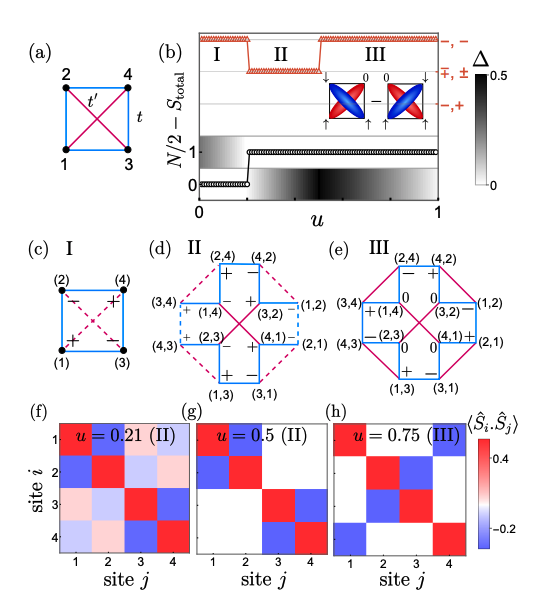
Recent investigations into frustrated magnetism have revealed novel phases of matter arising from competing interactions or, alternatively, from quantum interference effects influencing mobile spins. Revathy and Dutta explore the impact of local frustration on kinetic magnetism—a purely quantum-mechanical phenomenon—using a bottom-up approach. They demonstrate that introducing frustration centres into a rectangular grid binds singlets while preserving the delocalization of a hole and the surrounding spin-polarised background, effectively reducing the net magnetisation in discrete steps.
The researchers systematically investigate this effect using exact diagonalisation, initially focusing on a square lattice with diagonal bonds. They find that increasing the strength of frustration—represented by the hopping amplitude across the diagonals—induces a transition from a ferromagnetic ground state to one where a singlet binds, reducing the net magnetisation. This transition occurs because the frustration centres alter the kinetic energy landscape, favouring configurations with reduced overall spin.
Extending their analysis to random graphs, the team observed a strong correlation between the level of local frustration and the net magnetisation. Unlike exchange magnetism, where frustration has minimal impact on magnetisation, the researchers found that increasing local frustration consistently decreased the net magnetisation, exhibiting characteristic oscillations as a function of the smallest loop size within the graph. This suggests a powerful ability to shape spin order and tune magnetisation through the deliberate introduction of geometric frustration.
The study utilises the Hubbard model—a fundamental model in condensed matter physics—in the limit of strong on-site repulsion and a single hole. By analysing the lowest energy states for different spin configurations, the researchers determine the ground-state magnetic order and demonstrate the quantifiable relationship between frustration and magnetisation. Their findings offer insights into the complex interplay between network topology, quantum interference, and collective magnetic behaviour.
More information
Shaping Magnetic Order by Local Frustration for Itinerant Fermions on a Graph
DOI: https://doi.org/10.48550/arXiv.2507.07886


