

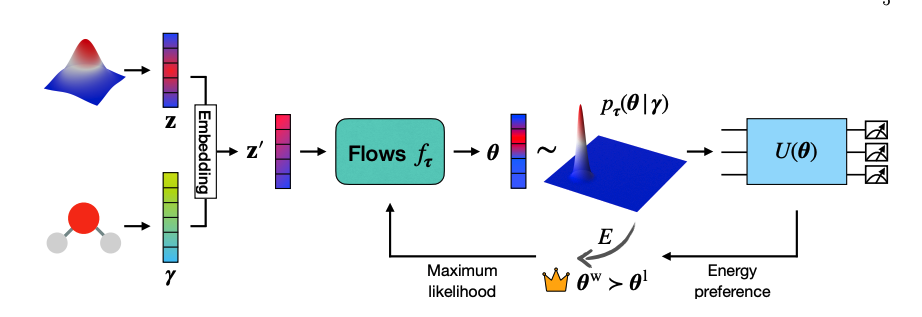
Quantum computing seeks to harness the principles of quantum mechanics to solve problems intractable for classical computers, yet current devices face limitations in scale and coherence. Researchers are therefore developing hybrid quantum-classical algorithms, such as the variational quantum eigensolver (VQE), to extract useful results from these near-term machines. VQE relies on optimising parameters within a quantum circuit, a process often hampered by complex energy landscapes and computational expense. Hang Zou, Martin Rahm, and colleagues, from Chalmers University of Technology and the University of Gothenburg, present a new approach in their article, ‘Generative flow-based warm start of the variational quantum eigensolver’, detailing Flow-VQE, a generative modelling framework designed to accelerate this optimisation process and improve parameter transfer between related computational problems.
Near-term quantum computing progresses rapidly, yet current hardware limitations necessitate innovative algorithmic approaches. Researchers continually explore methods to reduce computational costs and enhance the efficiency of variational quantum algorithms, crucial for tackling complex problems beyond the reach of classical computers. A team recently introduced Flow-VQE, a novel framework integrating conditional normalizing flows with parameterized quantum circuits, demonstrably improving the performance of variational quantum algorithms and offering a pragmatic pathway toward more scalable quantum simulations.
Flow-VQE addresses inherent limitations in traditional variational eigensolver (VQE) approaches, specifically those related to complex objective functions and computationally expensive optimisation procedures. VQE seeks to find the lowest energy state of a quantum system by iteratively adjusting parameters within a quantum circuit. Flow-VQE embeds a generative model within the VQE optimisation loop, employing preference-based training to generate high-quality variational parameters and facilitate gradient-free optimisation. This innovative approach also introduces a systematic strategy for parameter transfer between related computational problems, significantly reducing the computational burden.
The researchers demonstrate Flow-VQE’s effectiveness through extensive numerical
The researchers demonstrate Flow-VQE’s effectiveness through extensive numerical simulations on diverse molecular systems, including hydrogen chains, water, ammonia, and benzene. Results consistently reveal Flow-VQE outperforms baseline optimisation algorithms, achieving comparable accuracy with significantly fewer circuit evaluations – improvements range from modest gains to over two orders of magnitude in certain cases. This enhanced efficiency stems from the generative model’s ability to propose promising parameter configurations, accelerating the convergence of the VQE optimisation process.
Flow-VQE exhibits a substantial advantage in scenarios involving the optimisation of new systems, further solidifying its potential. When employed to warm-start optimisation procedures, the method accelerates subsequent fine-tuning by up to 50-fold compared to initialisation using Hartree-Fock parameters. Hartree-Fock theory provides an initial approximation to the quantum state, often used as a starting point for more sophisticated calculations. This capability highlights the potential of Flow-VQE to leverage knowledge gained from previously solved problems, reducing the computational cost associated with tackling novel molecular systems.
This work builds upon existing research in variational quantum algorithms and generative modeling, forging a new path forward. Researchers leverage concepts from normalizing flows, a type of generative model that learns a probability distribution by transforming a simple distribution into a complex one. This allows for the creation of a systematic approach for generating and refining variational parameters.
The study highlights the potential of combining generative models with quantum algorithms, creating a synergistic approach that overcomes the limitations of both individual techniques. Generative models excel at exploring complex parameter spaces and identifying promising configurations, while quantum algorithms provide the computational power to evaluate these configurations efficiently.
Researchers envision Flow-VQE having a significant impact on
Researchers envision Flow-VQE having a significant impact on various fields, including materials science, drug discovery, and fundamental physics. The ability to accurately simulate molecular systems with reduced computational cost opens up new possibilities for designing novel materials, identifying promising drug candidates, and understanding complex physical phenomena.
The team plans to extend Flow-VQE to address more complex quantum simulation problems, such as those involving time-dependent dynamics and many-body interactions. They also aim to explore the use of more advanced generative models, such as variational autoencoders and generative adversarial networks, to further enhance the performance and efficiency of the framework.
The study underscores the importance of interdisciplinary collaboration in advancing the field of quantum computing. The team comprised experts in quantum physics, machine learning, and computer science, bringing together diverse perspectives and expertise to address a challenging problem.
Researchers believe Flow-VQE represents a significant step toward realising the full potential of quantum computing, offering a practical and efficient solution for tackling complex scientific problems. The framework’s ability to reduce computational costs and accelerate simulations opens up new avenues for exploration and discovery.
The team actively encourages other researchers to explore and build upon their work, fostering a collaborative ecosystem that accelerates the development of quantum algorithms and promotes wider adoption of generative modeling techniques. By sharing their code and expertise, they aim to empower the quantum computing community and drive innovation in this rapidly evolving field.
🗞 Generative flow-based warm start of the variational quantum eigensolver
🧠 DOI: https://doi.org/10.48550/arXiv.2507.01726


