
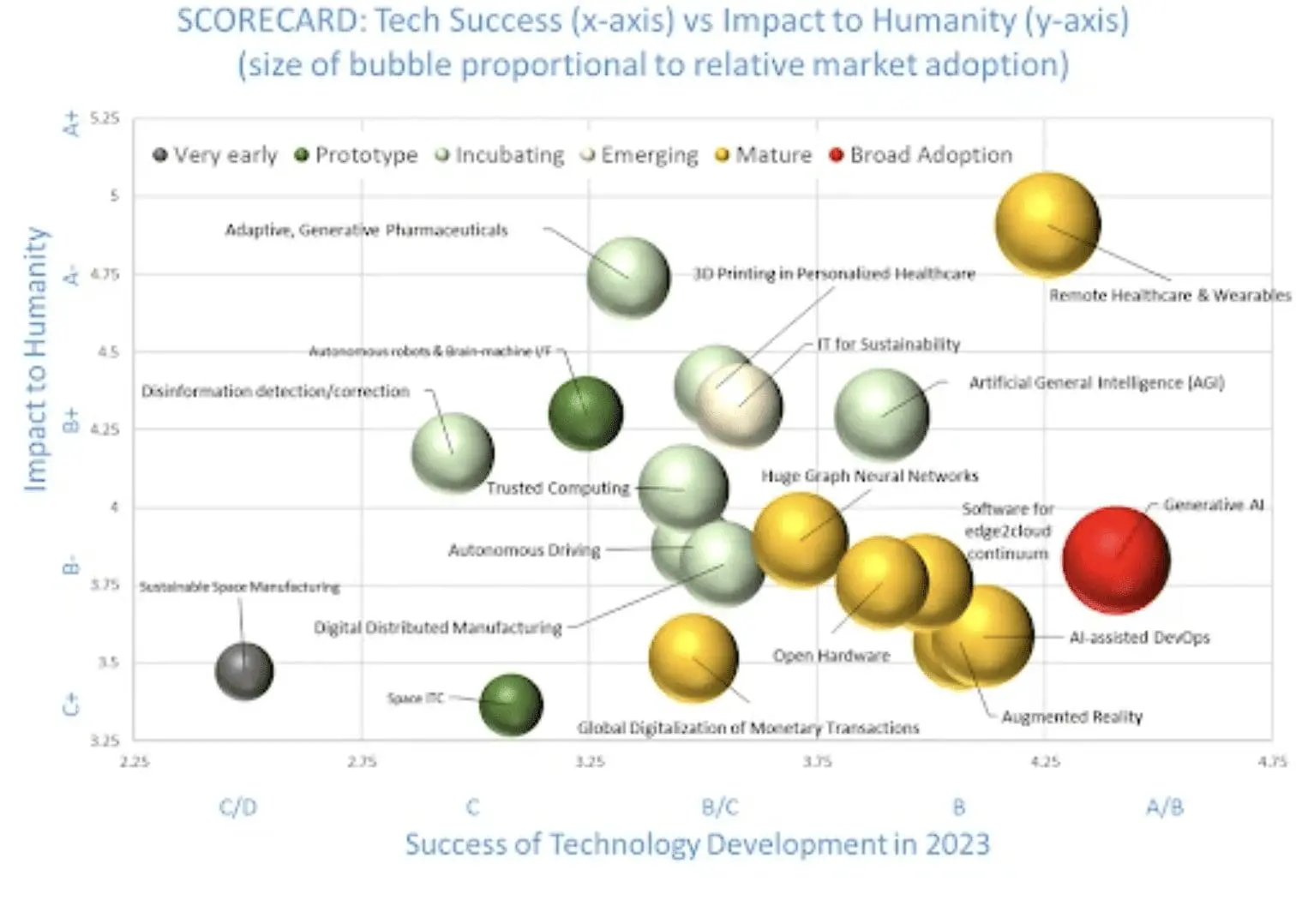
The IEEE Computer Society (CS) has announced that AI-based solutions, particularly Generative AI, led technological advancements in 2023. Dejan Milojicic, 2014 IEEE CS president and current HPE Fellow and VP at Hewlett Packard Labs, noted that Generative AI was the only technology with broad adoption. Other significant advancements included Artificial General Intelligence (AGI) and AI-assisted DevOps. Disinformation Detection/Correction also saw a significant rise due to technological advancements and market need. However, IT for Sustainability saw a decline in focus, potentially due to economic and geopolitical factors. The 2024 IEEE CS Technology Predictions will be revealed in January.
IEEE Computer Society’s 2023 Technology Trend Predictions
The IEEE Computer Society (CS), a prominent community of computer science and engineering members, recently released its annual scorecard, evaluating 2023 technology predictions against their current states. The society found that AI-based solutions ranked highest in their assessment.
Dejan Milojicic, 2014 IEEE CS president and current HPE Fellow and VP at Hewlett Packard Labs, highlighted that Generative AI showed the most technological advancement and maturity. It was also the only technology marked with broad adoption, reflecting the significant growth in both advancement and adoption of generative AI.
Artificial General Intelligence (AGI) showed the highest relative difference from original predictions. This technology’s success is attributed to advancements in Generative AI and growing consumer access to the capabilities. AI-assisted DevOps also saw significant growth, once again linked to Generative AI increases.
Key Technology Observations of 2023
Several technologies were impacted this year, including Disinformation Detection/Correction, which saw the third largest climb in the technology rankings. Autonomous Robots & Brain-Machine I/F (interface) remain at prototype-level maturity but are a research focus. 3D Printing in Personalized Healthcare slowed down from predictions as the healthcare industry adjusted to a more normative state with COVID. IT for Sustainability saw a decline in focus, potentially due to economic and geopolitical factors. Space ITC (Information Technology and Communication) had one of the most accurate predictions this year.
The shift in predictions between the final scorecard and the original report for Technical Success versus Impact to Humanity was demonstrated. The size of the bubble in the figures is proportional to relative market adoption.
Advancement of Technology in 2023
The advancement of each given technology over the year, between the prediction versus the scorecard, was shown in a figure. This figure includes the delta for Technology Success in 2023, Impact to Humanity, Maturity in 2023, and Market Adoption in 2023.
Milojicic expressed satisfaction with how their original grades stood the test of time, reflected in overall A/B grading, one of the highest in their 10-year history of predictions. The 2024 IEEE CS Technology Predictions will be revealed in January.
About the IEEE Computer Society
The IEEE Computer Society (CS) is the world’s largest and most established professional organization of its type, engaging computer engineers, scientists, academia, and industry professionals from all areas and levels of computing. It sets the standard for the education and engagement that fuels continued global technological advancement.
“The most technological advancement and most maturity in absolute terms, is attributed to Generative AI,” said Dejan Milojicic, 2014 IEEE CS president and current HPE Fellow and VP at Hewlett Packard Labs. “It is also the only technology that was marked with broad adoption. This is not a surprising outcome given the huge growth in both advancement and adoption of generative AI.”
“2023 was a huge year for AI in all forms,” noted Milojicic. “Its influence on a wide variety of other technological solutions created a ripple effect that has launched a whole new set of possibilities.”
“We are pleased how our original grades stood the one-year test of the time, as reflected in overall A/B grading, one of the highest in our 10-year history of predictions,” explained Milojicic. “The biggest differences in predictions were reflected in an unusually high growth of generative AI and slowdown of COVID-related technologies. Our technology predictions process continues to improve year-over-year. This year we introduced a more rigorous overall grading that will serve us for the years to come.”
“With a lot of sadness, we would like to express tribute to one of our most distinguished technology predictions team members. We and the whole world have lost Roberto Saracco. The impact he has left cannot be overemphasized. May his soul rest in peace! He will be remembered,” concluded Milojicic.
Summary
Artificial Intelligence (AI), particularly Generative AI, led technological advancements in 2023, with broad adoption and significant growth noted. Other technologies such as Disinformation Detection/Correction and Space Information Technology and Communication also made strides, while areas like 3D Printing in Personalised Healthcare and IT for Sustainability saw slower progress.
- The IEEE Computer Society (CS), a leading computer science and engineering community, has released its annual technology scorecard for 2023.
- The scorecard ranks AI-based solutions as the highest in terms of technological advancement and maturity. Generative AI, in particular, has seen significant growth and broad adoption.
- Artificial General Intelligence (AGI) has shown the highest relative difference from original predictions, attributed to advancements in Generative AI and increased consumer access.
- AI-assisted DevOps also saw significant growth due to advancements in Generative AI.
- Other technologies impacted this year include Disinformation Detection/Correction, Autonomous Robots & Brain-Machine Interface, 3D Printing in Personalized Healthcare, IT for Sustainability, and Space ITC.
- The scorecard also notes a slowdown in COVID-related technologies and a decline in focus on IT for Sustainability.
- The 2024 IEEE CS Technology Predictions will be revealed in January.