

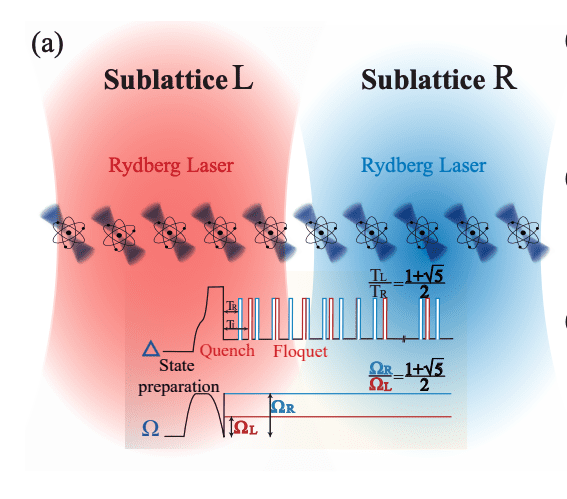
Discrete-time quasi-crystals represent a fascinating class of non-equilibrium phenomena characterised by quasi-periodic order in the temporal dimension. Building upon the concept of discrete-time crystals, these structures offer new insights into the dynamics of matter under non-equilibrium conditions. While Rydberg atomic arrays have proven to be effective platforms for simulating discrete-time crystal phases, exploring discrete-time quasi-crystals within such systems remains largely uncharted territory.
In a recent study titled Discrete time quasi-crystal in Rydberg atomic chain, researchers Xiaofan Luo et al. from Shanxi University propose an innovative approach to generate discrete time quasi-crystal behaviour. Their method involves coupling two discrete time crystals with driving frequencies that exhibit maximal incommensurability, a condition crucial for inducing the desired quasi-periodic dynamics. Researchers propose generating discrete-time quasi-crystals by coupling two discrete-time crystals with maximally incommensurate driving frequencies. They analyze robustness, phase diagrams of observables, and calculate entanglement entropy, finding that aperiodic responses arise from Rydberg blockade interactions. This method opens new possibilities for exploring novel phases in simulators.
The team’s analysis delves into the robustness of this phenomenon and maps out the corresponding phase diagrams. Additionally, they compute the entanglement entropy between system components, revealing the intricate interplay of quantum correlations. A key finding is that the observed aperiodic response arises from interactions mediated by the Rydberg blockade effect, underscoring the importance of this mechanism in shaping the system’s dynamics.
Rydberg systems investigate novel quantum phases using time crystals.
The quest for exotic quantum phases has driven significant advancements in quantum simulation platforms. Time crystals (TCs), proposed by Wilczek, represent a non-equilibrium phase characterized by broken time-translation symmetry. These TCs have been realized across various experimental systems, including trapped ions and atom-cavity setups.
Rydberg atoms, known for their strong dipole-dipole interactions and long coherence times, are ideal platforms for quantum simulations. Their unique properties enable the emulation of spin models and exploration of topological phenomena, making them a cornerstone in many-body quantum physics research.
The application of Floquet-engineered protocols has allowed precise control over Rydberg systems’ dynamics. Lukin et al. demonstrated discrete time crystals (DTCs) using these methods, highlighting the potential for exploring novel quantum phases through controlled driving.
Building on this foundation, researchers are now investigating whether discrete time quasi-crystals (DTQCS) can be realised in Rydberg systems. DTQCs require a system to exhibit lower symmetry than its external drive and produce oscillatory responses without a clear period, concepts borrowed from solid-state physics.
While NV centers have shown DTQC behavior, achieving this in Rydberg atoms presents a new challenge. The proposed method involves coupling two DTCs within a one-dimensional Rydberg array using time-modulated fields with incommensurate frequencies, aiming to induce the desired quasi-periodic responses. The research defines key observables, such as antiferromagnetic order parameters, to identify DTQC characteristics. Initial findings suggest that quasiperiodic responses emerge due to interactions mediated by the Rydberg blockade effect, offering insights into how these novel phases can be engineered and observed.
The proposed method involves coupling two discrete time-crystals with incommensurate driving frequencies to create a system exhibiting quasi-periodic dynamics.
The research explores the relationship between quantum many-body scars and discrete time quasi-crystals, utilizing Rydberg atomic arrays as a simulation platform. The key insight is that the Hamiltonian ˆHPXP,L and the Floquet operator ˆCL anticommute, implying a symmetry that protects certain eigenstates from dephasing, leading to long-lived coherence—a hallmark of quantum many-body scars.
The proposed method involves coupling two discrete time-crystals with incommensurate driving frequencies, aiming to create a system exhibiting quasi-periodic dynamics. This setup is analyzed for robustness and phase diagrams, with entanglement entropy calculations revealing the role of quantum correlations. The aperiodic response observed is attributed to interactions via the Rydberg blockade effect, where excited atoms prevent others from being excited, influencing the system’s dynamics.
The study highlights how symmetries imposed by Floquet operators protect states, preventing decoherence and enabling the persistence of scars. This protection mechanism is crucial for understanding the emergence of quasi-periodic order in time, offering new avenues for exploring novel phases in quantum simulators. The research underscores the importance of understanding how Floquet dynamics and symmetries interplay to create complex systems with unique dynamical properties.
Quantum scars persist in PXP models, resisting thermalisation.
The PXP model is a spin-1/2 system that exhibits quantum many-body scars, which are long-lived excited states that do not thermalize. These scars arise due to specific symmetries and dynamics within the system. The model involves nearest-neighbor interactions characterized by Pauli-X and Pauli-P operators, making it notable for its non-ergodic behaviour.
A key mechanism behind these quantum scars is an anticommutation relation between the Hamiltonian and a specific operator. This relation imposes constraints on the system’s dynamics, leading to degeneracies or selection rules in the Floquet spectrum. Consequently, certain states are protected from thermalization, resulting in long-lived scarred states that do not relax to equilibrium.
In a related study, researchers proposed generating discrete time quasi-crystals by coupling two discrete time-crystals with maximally incommensurate driving frequencies. This method was analyzed for robustness and phase diagrams of observables, revealing insights into the system’s behaviour under such conditions.
The research also involved calculating entanglement entropy between system parts, demonstrating that aperiodic responses emerge due to interactions via the Rydberg blockade effect. These findings offer new possibilities for exploring novel phases in quantum simulators, highlighting the potential of Rydberg atomic arrays as platforms for studying non-equilibrium phenomena.
Quantum scars created via Floquet engineering show promise for understanding complex dynamics.
The study demonstrates that leveraging the symmetry enforced by the Floquet operator in the PXP model provides a pathway to creating exact quantum many-body scars. These states are robust against perturbations due to enforced symmetries and retain coherent properties in a complex system. The anticommutation relation between the Floquet operator ( C_L ) and the Hamiltonian ( H_{\text{PXP},L} ) suggests that certain states may be protected, potentially leading to the emergence of quantum many-body scars. These findings highlight the potential for such systems to exhibit quasi-periodic dynamics, akin to discrete-time quasicrystals, which could correspond to specific configurations protected by the Floquet operator’s symmetry.
The research further explores the connection between these scarred states and time-crystalline behaviour, suggesting that the system could display stable, non-trivial temporal patterns under periodic driving. Tensor network simulations, such as those implemented in TeNPy, provide a powerful tool to study the dynamics and properties of these scarred states, offering insights into their coherence and stability.
Future work should focus on understanding how the anticommutation relation affects the Hamiltonian’s spectrum and induces protected states. Exploring examples where similar symmetries create exotic phases could provide deeper insights into the interplay between symmetry enforcement and quantum many-body dynamics. Additionally, investigating the robustness of these states under various perturbations and exploring their potential applications in quantum information processing and non-equilibrium phase transitions remains a promising direction.
The proposed method of generating discrete-time quasi-crystal behaviour by coupling two discrete-time quasi-crystals with incommensurate driving frequencies offers new possibilities for studying novel phases in Rydberg atomic systems. Analyzing the entanglement entropy between system parts and the robustness of the aperiodic response caused by the Rydberg blockade effect provides a foundation for further experimental exploration. This approach could pave the way for observing discrete-time quasi-crystals in cold atom experiments, offering new insights into non-equilibrium quantum phenomena.
In conclusion, the study underscores the importance of Floquet engineering in creating and controlling quantum many-body scars, which could potentially be applied to understanding complex quantum dynamics and time-crystalline behaviour. The proposed experimental framework provides a promising avenue for exploring these phenomena in Rydberg atomic systems, offering new opportunities to study non-equilibrium phases of matter.
🗞 Discrete time quasi-crystal in Rydberg atomic chain
🧠 DOI: https://doi.org/10.48550/arXiv.2505.09117


