

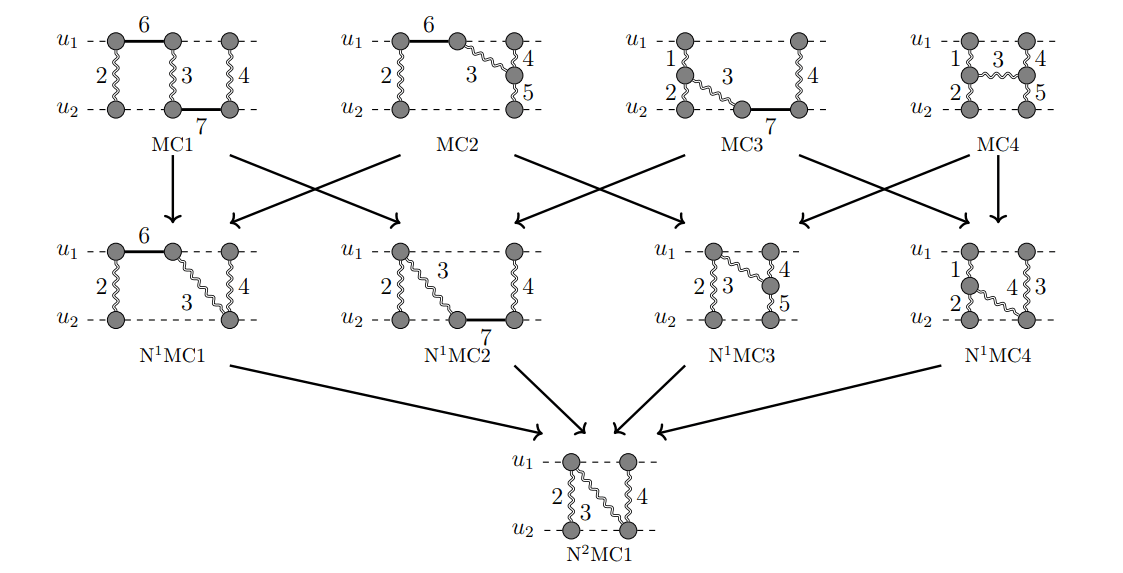
The calculation of interactions between particles, a cornerstone of physics, often relies on complex and potentially redundant methods. Vincent F. He and Julio Parra-Martinez, from Institut des Hautes Études Scientifiques, now present a new approach to this problem, developing a generalized unitarity method for theories describing the paths of point-like particles. This technique computes interactions from fundamental principles, locality and unitarity, bypassing the need for traditional, diagram-based calculations and avoiding associated ambiguities. The researchers demonstrate the power of their method by accurately predicting gravitational waveforms produced when two massive objects collide, achieving results consistent with established theory and paving the way for more efficient and systematic studies of these complex interactions.
The research presents a method utilising Feynman diagrams to calculate gravitational waveforms, specifically for the scattering of two point masses at next-to-leading order. The team successfully reproduces known results using this approach, demonstrating its validity and accuracy. This method streamlines the calculation of scattering dynamics within compact binary systems, offering a more efficient pathway for investigation and advancing the field of gravitational wave astronomy and theoretical physics.
Scattering Amplitudes and Effective Field Theory Approaches
Modern research in gravitational physics increasingly focuses on scattering amplitudes, effective field theory, and post-Minkowskian/post-Newtonian gravity. These approaches, including the double copy and worldline quantum field theory, offer powerful tools for understanding gravitational interactions. Early work established the foundation for calculating scattering amplitudes efficiently, moving away from complex Feynman diagrams towards more direct calculations. The discovery of the double copy relationship, where gravity amplitudes can be derived from gauge theory amplitudes, proved particularly significant.
Researchers then applied effective field theory to gravity, allowing for systematic calculations of post-Newtonian and post-Minkowskian corrections, essential for modelling realistic gravitational systems. These calculations involve expanding physical quantities in powers of velocity, providing approximations valid at low speeds. A key challenge lies in accurately accounting for energy lost to gravitational radiation, prompting investigations into radiation reaction forces using these advanced techniques. Worldline quantum field theory provides an alternative approach to calculating scattering amplitudes and gravitational dynamics, representing particles as worldlines and applying quantum field theory methods.
Modern developments focus on applying these techniques to calculate higher-order corrections to scattering amplitudes and gravitational waveforms, revealing connections to conformal field theory and fundamental concepts like causality. Current research converges on a more complete understanding of gravity, with a focus on practical calculations for realistic gravitational systems. The tails of gravitational waveforms, the long-lasting signals emitted after initial bursts, are emerging as a key area of study, providing crucial information about binary system dynamics. These investigations uncover deep connections between gravity, quantum field theory, and fundamental concepts like causality and conformal symmetry.
Unitarity Simplifies Gravitational Wave Calculations
Scientists have developed a generalized unitarity method for calculating interactions of point-particle worldlines coupled to gravity, mirroring techniques used in quantum field theory for scattering amplitudes. This innovative approach computes perturbative observables based on fundamental principles like locality and unitarity, effectively bypassing the need for Feynman diagrams. The research streamlines calculations of gravitational waveforms, successfully reproducing known results for the scattering of two point masses. The team’s method leverages the factorization properties of scattering amplitudes, demonstrating that as momentum approaches zero, the amplitude simplifies into a product of sub-amplitudes.
This relies on the on-shell condition for gravitons, where the graviton momentum satisfies a specific equation. By recursively applying this principle, complex calculations can be broken down into simpler components, revealing fundamental coupling constants. This allows for the construction of amplitudes directly from basic principles, avoiding the complexities of traditional diagrammatic approaches.
Gravitational Waveforms via Unitarity and Worldlines
This research presents a new method for calculating gravitational observables, building upon the worldline formalism and employing generalized unitarity, a technique traditionally used in quantum field theory. The team successfully applied this approach to compute the gravitational waveform resulting from the scattering of two point masses, achieving results consistent with previously known calculations. This advancement streamlines the process of calculating the dynamics of compact binary systems, offering a more efficient pathway for investigating gravitational interactions. The core achievement lies in adapting techniques from particle physics, specifically generalized unitarity, to the worldline framework, which models compact objects as point particles.
This allows researchers to bypass the complexities of traditional Feynman diagram calculations and leverage powerful integration methods already established in the study of scattering amplitudes. By constructing integrands using generalized unitarity, the team demonstrates a systematic way to calculate gravitational effects, potentially opening doors to further exploration of the structure within these observables. While the current work focuses on point-particle interactions, the team anticipates that the underlying principles could be adapted to study more realistic astrophysical systems.
👉 More information
🗞 Generalized Unitarity Method for Worldline Field Theory
🧠 ArXiv: https://arxiv.org/abs/2510.00989

