The behaviour of quantum systems over time often relies on the assumption of standard, predictable evolution, but many real-world systems exhibit ‘memory effects’ where past states influence present behaviour. Alexander Lopez from Escuela Superior Politécnica del Litoral, Sébastien Fumeron from Université de Lorraine Nancy, and Malte Henkel from Universidade de Lisboa, alongside Trifce Sandev and Esther D. Gutiérrez, investigate this phenomenon through a generalised mathematical framework known as fractional dynamics. Their work reveals that even simple quantum systems, modelled using an extended two-level Rabi system, exhibit surprising behaviour when subject to this type of evolution, displaying inherent damping and controllable dephasing without any external influence. This discovery not only expands our understanding of non-standard quantum dynamics, but also offers potential avenues for experimental observation through measurable quantities like the Loschmidt echo and autocorrelation function, and suggests new ways to explore memory-induced effects in materials such as graphene and topological chains.
Fractional Calculus Describes Quantum System Dynamics
Scientists are expanding the understanding of quantum mechanics by incorporating fractional calculus, a mathematical framework that accounts for memory effects and non-local behavior in quantum systems. Traditional quantum mechanics often assumes systems evolve based solely on their present state, but this research demonstrates that a system’s past history can significantly influence its future behavior. Researchers utilize fractional derivatives to model these memory effects, providing a more accurate description of complex quantum phenomena. The team investigates non-Markovian dynamics, where the past matters, using a modified Schrödinger equation incorporating fractional time derivatives.
This equation governs the evolution of quantum states in systems exhibiting memory, and its behavior is probed using the Loschmidt echo and out-of-time-ordered correlators, which characterize quantum chaos. This approach offers new insights into quantum phase transitions and the behavior of open quantum systems. This work demonstrates that incorporating fractional dynamics provides a more accurate description of quantum systems with memory effects, offering powerful tools for probing quantum dynamics and chaos. The fractional approach reveals new insights into quantum phenomena like revivals, phase transitions, and topological states of matter, with potential implications for developing robust quantum technologies by mitigating decoherence and improving device performance. Scientists are exploring how the fractional order of the derivative can be tuned to control the strength of memory effects, and are addressing the numerical challenges associated with solving the time-fractional Schrödinger equation. This research connects to concepts like anomalous diffusion and has implications for understanding systems like Rydberg atoms, highly excited atoms useful for quantum simulations.
Fractional Dynamics and Quantum System Evolution
Scientists have developed a new approach to understanding quantum dynamics by employing fractional calculus within a Green’s function formulation. This allows them to investigate nonlocal temporal behavior and memory effects in quantum systems, extending traditional quantum evolution beyond its reliance on first-order time derivatives. Researchers derived explicit iterative expressions to calculate the evolved state of a quantum system, enabling detailed analysis of time-dependent behavior under fractional dynamics. Applying this methodology to an extended two-level Rabi model, a standard system for studying coherent quantum control, they found that even without external driving, the static Hamiltonian induces nontrivial spin dynamics characterized by damping, directly linked to the degree of fractional temporal nonlocality.
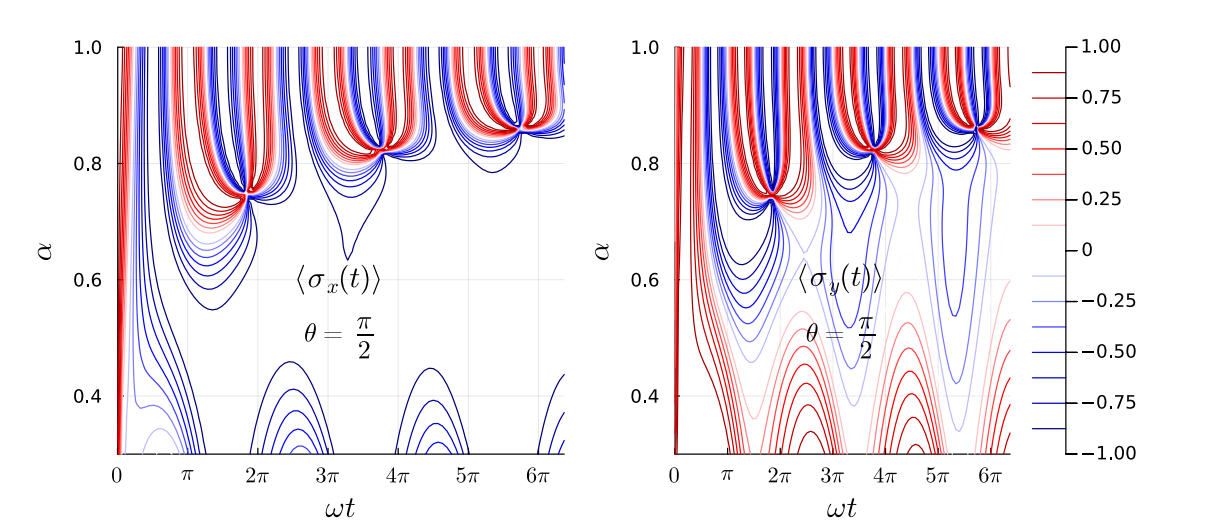
Introducing a periodically varying driving field generates richer dynamical behavior, observable through the evolution of spin polarization, autocorrelation functions, and fidelity. Unlike standard Rabi oscillations with fixed frequencies, the fractional regime introduces controllable damping and dephasing, governed by the degree of fractionality, allowing for precise manipulation of quantum dynamics. Scientists anticipate that these distinctive signatures could be experimentally observed through measurements of the Loschmidt echo and autocorrelation functions, providing a pathway to probe fractional quantum dynamics directly. This research opens new avenues for exploring memory-induced dynamical phenomena in systems approximated by a two-level model, such as graphene-like materials and topological SSH chains, where non-integer order evolution may reveal novel topological or relaxation effects.
Fractional Dynamics Reveal Damped Spin Evolution
Scientists have achieved a comprehensive understanding of fractional quantum dynamics, extending the standard Schrödinger equation to incorporate memory effects and nonlocal temporal behavior. This work details a novel approach to analyzing systems where past events influence present dynamics, utilizing a Green’s function formulation based on the Caputo fractional derivative. The team derived explicit iterative expressions to model the evolution of quantum states, successfully applying this method to an extended two-level Rabi model, a fundamental system for studying coherent control. Experiments reveal that even without external driving forces, the static Hamiltonian induces distinct spin dynamics characterized by damping, directly linked to the fractional nature of time.
Introducing a periodically varying driving field generates richer dynamical behavior, manifested in the evolution of spin polarization, autocorrelation functions, and fidelity measurements. Results demonstrate that the fractional regime introduces controllable damping and dephasing, offering a significant departure from the fixed frequency oscillations observed in standard Rabi models. Specifically, the team observed that fidelity at longer times evolves almost independently from memory effects, while the autocorrelation function exhibits a complementary behavior, providing a means to distinguish between short- and long-term dynamics. The research establishes a fractional Green’s function expansion that depends solely on the perturbation potential and the static system’s Green’s function, a key achievement enabling the analysis of complex systems. Applying this to the fractional Rabi problem, scientists obtained expressions for the time evolution of spin polarization, autocorrelation functions, and the Loschmidt echo, revealing the physical consequences of memory effects in periodically driven systems. These findings open pathways to explore memory-induced phenomena in systems approximated by a two-level model, such as graphene-like materials and topological SSH chains, where non-integer order evolution may reveal novel topological or relaxation effects.
Fractional Dynamics Reveal Nontrivial Rabi Oscillations
This work investigates the consequences of describing quantum mechanical evolution using fractional-order dynamics, a framework that incorporates nonlocal temporal behavior and memory effects. Researchers developed a Green’s function approach and derived explicit expressions to calculate how a system evolves in time when governed by a Caputo fractional derivative. Applying this to an extended two-level Rabi model, a standard system for studying coherent control, they found that even without external forces, the system exhibits nontrivial dynamics with damping linked to the fractional nature of time. Introducing a periodically varying driving field further enriches the system’s behavior, creating a competition between energy input from the field and the inherent memory effects of the fractional dynamics.
This competition manifests in the evolution of spin polarization, autocorrelation, and fidelity, resulting in damped oscillations that differ from the fixed-frequency oscillations of standard Rabi models. The degree of fractionality controls the extent of this damping, offering a potential means of manipulating these oscillations. Researchers suggest that the distinctive signatures of this system could be experimentally observed through measurements of fidelity, the Loschmidt echo, and the autocorrelation function. Future research could extend this framework to explore similar dynamical effects in other systems approximated by a two-level model, such as graphene-like materials and topological SSH chains, potentially revealing novel topological or relaxation phenomena arising from non-integer order evolution.