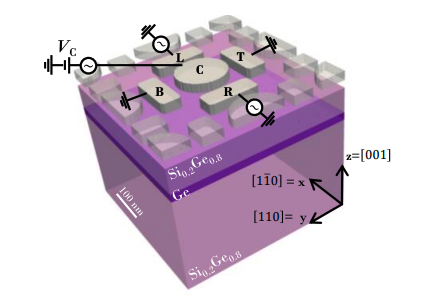
The pursuit of scalable quantum computation necessitates the development of robust and reproducible qubit technologies, and semiconductor-based spin qubits represent a particularly promising avenue. Hole spin qubits, leveraging the angular momentum of ‘holes’ – the absence of electrons – within germanium structures, offer advantages in terms of electrical control and interface quality. However, these qubits are susceptible to variations induced by imperfections at material interfaces, potentially hindering the realisation of large-scale quantum processors. Biel Martinez, from the Université Grenoble Alpes and CEA-LETI, and Yann-Michel Niquet, from the Université Grenoble Alpes and CEA-IRIG-MEM-L_Sim, alongside their colleagues, address this challenge in their recent work, “Variability of hole spin qubits in planar Germanium”, where they utilise numerical simulations to quantify the impact of interface charge traps on qubit performance and propose strategies for mitigating variability.
Quantum computing exploits the principles of quantum mechanics to address computational problems intractable for conventional computers, and semiconductor spin qubits represent a viable pathway towards scalable quantum processors. These qubits utilise the intrinsic angular momentum of electrons or holes, confined within nanostructures, as the carrier of quantum information, offering potential benefits in coherence and control. Current research concentrates on materials systems such as germanium-silicon-germanium (Ge/SiGe) heterostructures, which provide a comparatively clean environment for qubits compared to traditional silicon-based devices.
Hole spin qubits, fabricated within germanium-silicon heterostructures, present a compelling route to scalable quantum computation, leveraging clean epitaxial interfaces and inherent spin-orbit coupling for electrical control. Spin-orbit coupling, a relativistic effect linking an electron’s spin to its motion, allows manipulation of the qubit’s state using electric fields. However, this very interaction introduces heightened sensitivity to electrical disorder, potentially undermining the uniformity crucial for large-scale quantum processors.
Sophisticated numerical simulations model qubit behaviour within realistic
Sophisticated numerical simulations model qubit behaviour within realistic device geometries to quantify and mitigate this variability. These simulations investigate the impact of charge traps present at the silicon-germanium/oxide interfaces, identifying them as a primary source of qubit property dispersion. The methodology centres on detailed modelling of charge trap distributions and their influence on the electrostatic potential within the quantum dot, employing realistic device parameters, including layer thicknesses and doping concentrations, to accurately represent the physical system.
Researchers account for the spatial correlation of charge traps, recognising they are not randomly distributed but tend to cluster due to fabrication processes. They systematically assess the impact of varying density and spatial distribution of these traps on key qubit parameters, such as g-factors—which determine the qubit’s response to magnetic fields—and Rabi frequencies, which dictate the speed of qubit manipulation. Simulations reveal that while charge properties exhibit moderate variability, spin properties demonstrate considerably wider dispersion, suggesting the spin-orbit interaction amplifies the effect of charge fluctuations on the qubit’s spin state, making it more susceptible to noise and decoherence.
Current work focuses on quantifying the impact of charge traps present at the SiGe/oxide interfaces on qubit characteristics, demonstrating that while charge properties exhibit moderate variability, spin properties – specifically g-factors and Rabi frequencies – display substantial dispersion. This dispersion arises from the influence of interface traps on the local electric fields experienced by the hole spins.
Significant variations in qubit parameters necessitate precise individual calibration and control, increasing the complexity and cost of large-scale quantum processors. Consequently, studies explore strategies to mitigate this variability, including stringent requirements for interface quality during material growth and the development of optimal operation strategies that minimise the impact of charge traps on qubit coherence.
Theoretical modelling plays a crucial role in understanding
Theoretical modelling plays a crucial role in understanding the mechanisms driving this variability, providing valuable insights into the optimal operating conditions for minimising qubit variability. The research also emphasises the potential of electrical control, facilitated by spin-orbit coupling, as a key advantage of this qubit platform, but the same spin-orbit interaction that enables electrical control also amplifies the qubit’s sensitivity to electrical disorder, presenting a trade-off that must be carefully considered during device design and optimisation.
Investigating novel materials and heterostructure designs that inherently minimise disorder also represents a promising avenue for research, exploring error mitigation strategies tailored to address the specific types of noise and variability observed in these qubits, and developing standardised characterisation techniques and metrics for quantifying qubit variability will facilitate comparisons between different devices and platforms. Achieving stable and predictable performance from hole spin qubits fabricated in germanium/germanium-silicon heterostructures presents significant challenges, primarily stemming from electrical disorder at the material interfaces.
This sensitivity to interface quality necessitates careful consideration for scalable quantum architectures, with a central finding concerning the impact of charge traps located at the silicon-germanium/oxide interfaces, introducing fluctuations in the electric field, directly influencing qubit coherence and control. Minimising interface trap density emerges as a critical requirement for advancing this qubit platform.
🗞 Variability of hole spin qubits in planar Germanium
🧠 DOI: https://doi.org/10.48550/arXiv.2507.04953