

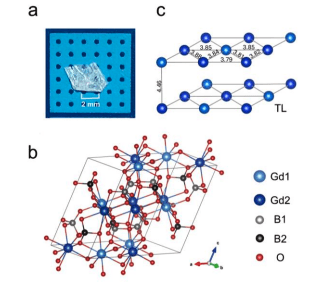
On April 11, 2025, researchers reported a significant advancement in ultra-low temperature cooling with their study titled Quantum Fluctuation-enhanced Milli-Kelvin Magnetic Refrigeration in Triangular Lattice Magnet GdBO3. The research demonstrated the ability to achieve temperatures as low as 50 millikelvins using the magnetic properties of GdBO3, a rare-earth-based material, leveraging quantum fluctuations and the magnetocaloric effect.
The study investigates GdBO3, a rare-earth-based triangular lattice antiferromagnet with strong spin fluctuations, enabling significant magnetocaloric effect (MCE) near critical points. Researchers observed multiple phase transitions in zero-field specific heat measurements and identified five distinct phase regions under magnetic fields. Using a custom adiabatic demagnetization refrigerator, they achieved a minimum temperature of 50 mK near the field-induced critical point. The material’s high density of magnetic Gd3+ ions and broad specific heat features demonstrate its potential for milli-Kelvin magnetic cooling applications.
Studying quantum materials has led researchers to explore compounds with unique properties that could transform technology. Gadolinium Borate (GdBO3) stands out due to its intriguing magnetic behaviour, making it a subject of intense scientific interest.
Gadolinium borate is a rare-earth borate compound with a monoclinic crystal structure. Its magnetic properties are highly sensitive to the direction of an applied magnetic field, a phenomenon known as anisotropy. This directional dependence makes GdBO3 a promising candidate for studying quantum phenomena and developing advanced materials for applications such as data storage, sensors, and even quantum computing.
To uncover the magnetic behavior of GdBO3, researchers employed a combination of experimental techniques. X-ray diffraction was used to determine the crystal structure, while specific heat measurements provided insights into the material’s thermal properties and phase transitions. Additionally, magnetic entropy measurements were conducted to assess how the material’s magnetic order changes under different conditions.
The findings reveal that GdBO3 exhibits anisotropic magnetism, meaning its magnetic response varies depending on the direction of the applied field. This property is particularly significant in quantum materials research, as it can lead to novel electronic and magnetic behaviors with potential technological applications.
Furthermore, the magnetic entropy measurements indicate that GdBO3 undergoes a magnetocaloric effect—a phenomenon where the material’s temperature changes in response to an applied magnetic field. This effect has practical implications for refrigeration technologies, potentially leading to more efficient cooling systems.
The study of GdBO3 represents a significant step forward in understanding quantum materials and their unique properties. By revealing the anisotropic magnetic behavior and magnetocaloric effects of this compound, researchers have opened new avenues for exploring its potential applications. As quantum materials research continues to advance, compounds like GdBO3 will play a pivotal role in shaping the future of technology.
In summary, GdBO3’s magnetic properties not only contribute to our fundamental understanding of quantum materials but also pave the way for innovative technological solutions. Ongoing exploration into this compound underscores its potential for practical applications across multiple fields.
👉 More information
🗞 Quantum Fluctuation-enhanced Milli-Kelvin Magnetic Refrigeration in Triangular Lattice Magnet GdBO3
🧠 DOI: https://doi.org/10.48550/arXiv.2504.08636


