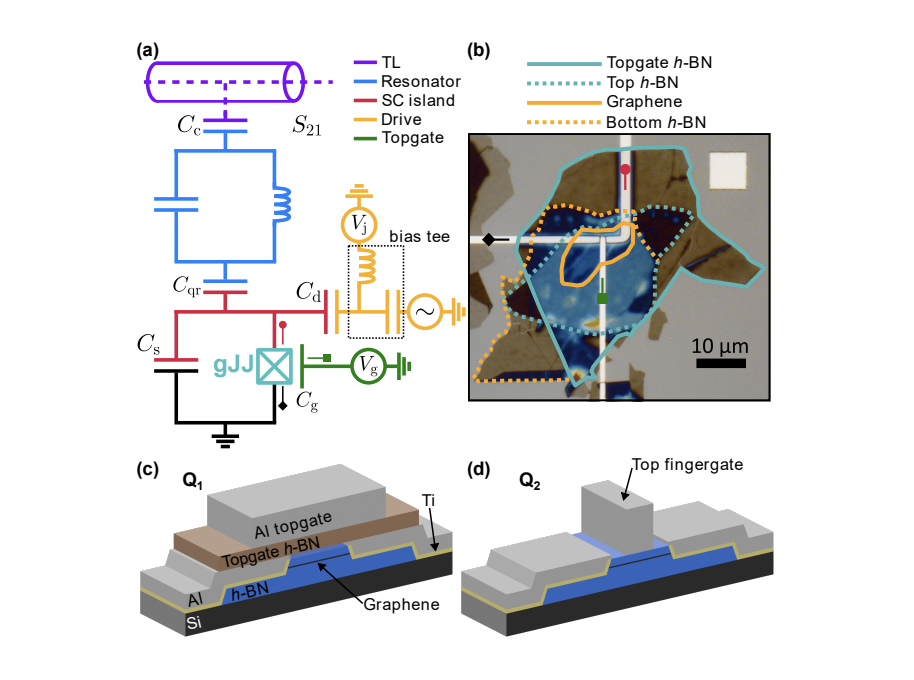
Researchers demonstrated substantial electrical control over key qubit characteristics – frequency, anharmonicity and charge dispersion – within a superconducting circuit. This tunability arises from Cooper pair transmission through Andreev bound states in gate-controlled Josephson junctions, notably suppressing charge dispersion and offering versatility for advanced quantum circuits.
The pursuit of stable and controllable qubits – the fundamental units of quantum information – relies heavily on precise manipulation of superconducting circuits. Researchers are increasingly focused on electrically tunable Josephson junctions – components enabling superconducting current flow – as a means to refine qubit characteristics in situ, offering advantages over traditional magnetic field control. A collaborative team, comprising Nicolas Aparicio, Simon Messelot, Edgar Bonet-Orozco, Eric Eyraud, Johann Coraux, and Julien Renard from the Université Grenoble Alpes, CNRS, and Grenoble INP, alongside Kenji Watanabe and Takashi Taniguchi from the National Institute for Materials Science in Japan, detail their investigation into this area in the article “Gate-tunable spectrum and charge dispersion mitigation in a graphene superconducting qubit”. Their work demonstrates substantial electrical control over key qubit properties – frequency, anharmonicity and charge dispersion – achieved through a novel graphene-based Josephson junction, and provides a theoretical model explaining the observed suppression of charge dispersion via Andreev bound states – quantum mechanical states arising at the interface between a superconductor and a normal conductor.
Electric-field Control Enhances Superconducting Qubit Performance
Precise control over the properties of quantum-coherent superconducting circuits – specifically excited state energies, circuit anharmonicity, and charge dispersion – remains central to advances in quantum computation. Current methods typically rely on adjustments to circuit geometry and external magnetic fields to manipulate these characteristics, particularly utilising tunnel Josephson junctions. However, Josephson junctions incorporating semiconductor weak-links present a promising alternative, offering tunability via the electric-field effect and opening new avenues for qubit manipulation.
Researchers have successfully integrated these gate-tunable junctions into superconducting circuits, employing materials such as semiconducting nanowires and two-dimensional electron gases. A recent study demonstrates substantial electric-field tunability of key qubit properties – frequency, anharmonicity, and charge dispersion – within a functioning superconducting circuit. The observed features are explained by a detailed model considering the transmission of Cooper pairs – the charge carriers in superconductors – through Andreev bound states, providing a theoretical framework for understanding device behaviour.
Critically, the study reveals that high transmission of Cooper pairs strongly suppresses charge dispersion. Minimising charge dispersion is vital for improving qubit coherence – the duration for which a qubit maintains its quantum state – and reducing errors in quantum computations. Increased coherence allows for more complex calculations to be performed before the quantum information is lost.
The team’s work highlights the potential of semiconductor-based qubits as versatile building blocks for advanced quantum circuits, potentially enabling more complex and powerful quantum computing architectures. This research investigates gate-tunable superconducting qubits, focusing on achieving precise control over qubit properties through innovative material design. The emphasis on electric-field tunability offers a pathway to overcome limitations associated with traditional magnetic control methods, potentially enabling the development of scalable and compact quantum processors. This progression represents a shift from fundamental materials investigations to the successful integration of these junctions into functional circuits.
Several foundational papers underpin this research. Early work by Koch et al. (2007) established the importance of controlling qubit parameters for optimal performance. The use of semiconductor materials for tunable Josephson junctions builds upon advancements detailed in papers by Zuo et al. and others exploring hybrid material integration. Specifically, the team leverages the electric-field effect, a concept explored in earlier studies of semiconductor nanowires and two-dimensional electron gases. This study also draws upon foundational knowledge of superconducting circuits and Josephson junction physics, as evidenced by citations from early work on circuit quantum electrodynamics. Papers detailing the formation of Andreev bound states – quantum states that arise at the interface between a superconductor and a normal conductor – provide the theoretical basis for the model used to explain the observed tunability.
👉 More information
🗞 Gate-tunable spectrum and charge dispersion mitigation in a graphene superconducting qubit
🧠 DOI: https://doi.org/10.48550/arXiv.2506.04959