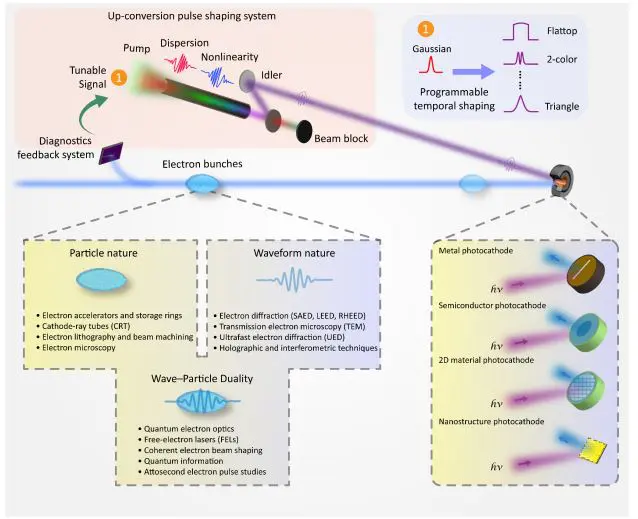
Controlling charged particles with light represents a significant frontier in physics, and researchers are now demonstrating unprecedented precision in this area. Hao Zhang, Joshua Mann, and James Rosenzweig, from the University of California, Los Angeles, alongside Michael Chini from The Ohio State University and Sergio Carbajo from multiple institutions including UCLA and SLAC National Accelerator Laboratory, are pioneering new techniques using gas-based nonlinear optics. Their work demonstrates how carefully shaped pulses of light, created within gas-filled waveguides, can steer and manipulate charged particle emission with sub-cycle timing and precision. This achievement opens exciting possibilities for developing compact, ultrafast electron sources and advancing applications in fields powered by nonlinear photonics, promising a new era of control over matter at the quantum level.
This work builds upon advancements in laser technology and nonlinear optics, enabling unprecedented control over charged particle dynamics. The team focused on generating tailored laser pulses within gas-filled waveguides, achieving broadband spectral broadening and precise control over the dispersion of light, essential for shaping optical fields. Photonic crystal fibers and hollow-core capillaries were employed to create supercontinuum spectra spanning from the visible to the mid-infrared, supporting soliton dynamics and dispersive wave emission.
Scientists further refined this technique by generating multi-millijoule, carrier-envelope phase stable, and few-cycle pulses, crucial for driving high-harmonic generation and creating isolated attosecond pulses across a wide range of photon energies. This system also functions as a compressor for various high-power laser systems, forming the foundation for state-of-the-art attosecond beamlines. The research team developed a parametric-frequency-conversion-based temporal shaping technique, enabling the generation of user-defined temporal profiles, such as Gaussian, flattop, and two-color pulses, for precise control over photoemission dynamics. Experiments involved illuminating various materials, including metals, semiconductors, and nanostructures, with shaped ultraviolet light, producing customized electron bunches tailored for specific applications.
Gas-Waveguide Control of Electron Dynamics
Researchers have demonstrated a novel approach to controlling charged particles by harnessing spatio-temporally coupled (STC) laser pulses generated within gas-filled waveguides. The study focused on utilizing gas-filled photonic crystal fibers (PCFs) and hollow-core capillaries (HCCs) to generate few-cycle pulses, achieving broadband spectral broadening and tunable dispersion engineering essential for shaping optical fields. PCFs, filled with noble gases, enabled the generation of supercontinuum spectra spanning from the visible to the mid-infrared, with exceptional spectral coherence and precise control over phase-matching conditions, supporting soliton dynamics and dispersive wave emission. Scientists further refined this technique by employing HCCs, achieving multi-millijoule, carrier-envelope phase stable, and few-cycle pulse outputs, crucial for driving high-harmonic generation and creating isolated attosecond pulses across a wide photon energy range.
This system also functions as a backend compressor for high-power optical parametric chirped pulse amplification (OPCPA), Yb: solid-state, and Ti: sapphire lasers, forming the foundation for state-of-the-art attosecond beamlines. The research team developed a parametric-frequency-conversion-based temporal shaping technique, enabling the generation of user-defined temporal profiles, such as Gaussian, flattop, and two-color pulses, for precise control over photoemission dynamics. Experiments involved illuminating various photocathode materials, metals, semiconductors, 2D materials, and nanostructures, with shaped ultraviolet light, producing customized electron bunches tailored for specific applications. The study demonstrated the ability to control both the temporal and momentum distributions of photoemitted electrons, resulting in coherent electron sources for next-generation imaging and quantum technologies. Researchers are actively investigating the interplay between gas dynamics, nonlinear propagation, and spatio-temporal couplings, particularly under high-repetition-rate and high-energy driving conditions, to further optimize the stability, scalability, and reproducibility of this innovative approach.
Tailored Light Pulses Steer Electron Emission
Researchers have achieved significant advancements in controlling charged particles using light, specifically through the development of gas-filled waveguides capable of producing few-cycle, spatio-temporally coupled pulses with programmable structure. This work explores the landscape of optical-field-driven photoemission and investigates gas-based nonlinear drivers, photonic crystal fibers, and hollow-core capillaries for synthesizing tailored pulses. The team demonstrated mechanisms for deterministic pulse shaping, notably spectral-phase transfer in hollow-core capillaries, which allows for precise control over waveform structure. Experiments revealed that these tailored waveforms can steer emission dynamics, transitioning from multiphoton to tunneling regimes, and enabling sub-cycle gating, the ability to control electron emission within fractions of a second.
Measurements confirm that this approach facilitates momentum control and brightness scaling, significantly enhancing the characteristics of emitted electron beams. The research team successfully demonstrated the ability to manipulate electron behavior at the attosecond timescale, opening new avenues for high-resolution imaging and advanced materials science. Further investigations focused on optimizing laser-electron interactions to enhance the brightness of linear accelerators and X-ray free-electron lasers. The team achieved precise control over laser pulse characteristics, including shaping and timing, to maximize electron beam quality.
Measurements show that optimized pulse shaping can improve the coherence and stability of electron beams, leading to brighter and more focused radiation sources. The study also explored novel approaches to on-chip particle acceleration, demonstrating the potential for compact and integrated accelerator technologies. The team’s work culminated in the development of advanced laser infrastructure for the Linac Coherent Light Source II, achieving unprecedented levels of control over laser pulse parameters. Measurements confirm the successful implementation of spatio-temporal pulse shaping techniques, enabling the generation of high-brightness electron beams with tailored properties.
Light and Electrons in Gas Waveguides
This review highlights recent advances in utilizing gas-filled waveguides to manipulate light and charged particles, establishing a powerful platform for integrating ultrafast photonics with electron science. Researchers demonstrate how these waveguides enable the creation of complex, spatio-temporally coupled pulses, allowing precise control over the structure of optical fields. By tailoring these waveforms, scientists can steer electron emission dynamics, transitioning between different emission regimes and achieving sub-cycle gating and momentum control, ultimately enhancing brightness. These developments establish gas-filled waveguides as programmable interfaces between light and electrons, opening opportunities in diverse fields such as spectroscopy, imaging, and quantum applications.
The work builds upon existing techniques in ultrafast electron diffraction and particle acceleration, offering a new approach to controlling electron beams with unprecedented precision. While acknowledging limitations in current phase stability and scalability to mid-infrared wavelengths, the authors suggest future research should focus on coupling these waveguides to nanophotonic emitters and developing compact, coherent electron sources. This continued development promises to unlock transformative applications in areas requiring synchronized electrons and photons on extremely short timescales.
🗞 Charged-particle control via spatio-temporally tailored pulses from gas-based nonlinear optics
🧠 ArXiv: https://arxiv.org/abs/2511.11507