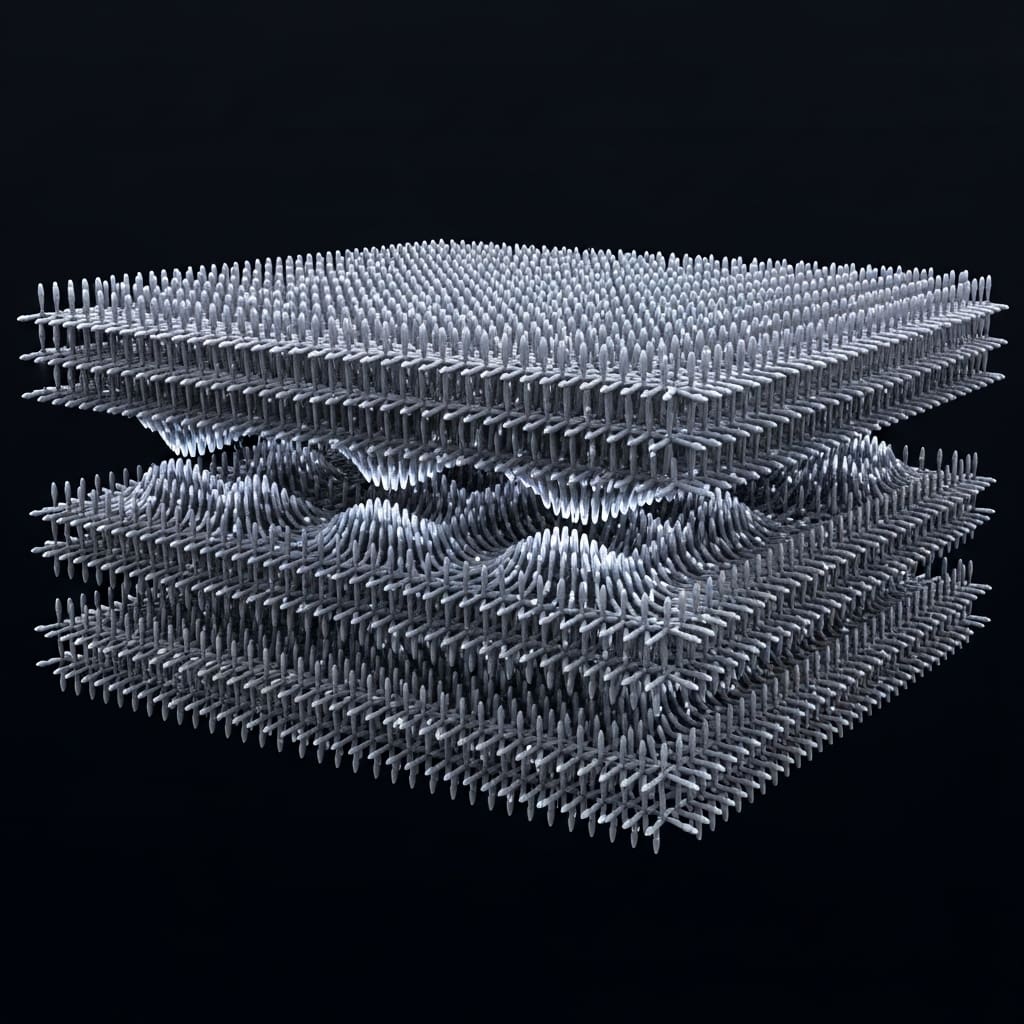
Researchers investigating the exotic magnetic properties of the material -RuCl have uncovered compelling evidence for fractionalized excitations within its disordered phase. C. L. Sarkis, K. D. Dixit, and P. Rao, alongside colleagues including G. Khundzakishvili, C. Balz, and J-Q. Yan from Oak Ridge National Laboratory, detail their findings using inelastic neutron spectroscopy, revealing a gapped spin excitation spectrum at fields above 8 Tesla. This work is significant because it moves beyond conventional magnetic descriptions , specifically ruling out a simple magnon-decay picture , and strongly supports the theoretical prediction of fractionalized excitations, a key characteristic of the sought-after Kitaev spin liquid state, potentially bringing us closer to realising quantum computing applications.
The team achieved detailed mapping of the spin excitation spectrum under varying magnetic fields, revealing crucial insights into the material’s Quantum behaviour. Specifically, researchers observed a gapped spin excitation spectrum at and above a magnetic field of 8 Tesla along both in-plane high-symmetry directions, with excitation modes sharpening with increasing field but remaining broader than the experimental resolution even at 13.5 Tesla. In this critical regime, the observed excitations are remarkably broad and largely flat across accessible energy-momenta, a characteristic that sharply contrasts with predictions based on magnon-decay models. By contrast, a continuum of fractionalized excitations naturally explains the broad continuum response, potentially accompanied by sharper modes originating from bound states of these fractionalized excitations. The damping of these bound states by the continuum accounts for the observed spectral broadening and its dependence on the applied magnetic field, offering a compelling explanation for the experimental data.
Experiments were performed on two single crystals, each weighing approximately 2 grams, exhibiting a single Néel transition at 7 Kelvin, and field was applied along two distinct crystallographic directions. Researchers utilised the 14 Tesla split coil magnet at the Hybrid Spectrometer (HYSPEC) beamline of the Spallation Neutron Source (SNS) to perform a detailed inelastic neutron scattering (INS) study, capturing the evolution of the continuum and its underlying spin gap. While techniques like Terahertz Spectroscopy and Raman Spectroscopy focus on specific points in momentum space, INS measures the full S(q, ω), providing a complete picture of the mode lineshape in both energy and momentum, allowing for precise tracking of dispersions. Further research will focus0.25 K with incident energies of 5.5 meV, and 6.5 meV for the 12 T data. Momentum-dependent measurements were performed, constructing pseudocolor plots of energy transfer versus momentum transfer, specifically focusing on the (0 0 L) and (H 0 1.5) planes. Integration ranges of [-0.076:0.076], [-0.053:0.053], and [1.25:1.75] reciprocal lattice units (r. l. u. ) were used for data analysis, allowing precise tracking of dispersions and spectral broadening.
Researchers observed a gapped mode near the edge of experimental coverage at 13.5 T, exhibiting dispersion along the out-of-plane direction with minima at L = 1.5 r. l. u. and maxima at L = 3.0 r. l. u. . Lowering the field to 11 T softened this gap, revealing a gapped continuum, while the 8-10 T regime showcased a remarkably uniform continuum intensity with a parabolic dispersive envelope. Notably, the out-of-plane dispersion diminished in this regime, indicating enhanced two-dimensional behaviour as in-plane liquid correlations were established. Momentum-integrated cuts centred on (0 0 1.5) confirmed a flat continuum between 7-8 T, and the team carefully offset intensities linearly with field for clear comparison. For fields applied along both in-plane high-symmetry directions, the team measured a gapped spin excitation spectrum at and above a magnetic field of 8 T. Excitation modes then sharpened with increasing field, but consistently remained broader than the experimental resolution, even at 13.5.5 Tesla. Researchers observed a diminishing out-of-plane dispersion between 7 and 10 Tesla, indicating enhanced two-dimensional behaviour as in-plane liquid correlations develop.
Within this field range, excitations are broad, largely flat across energy and momentum, and inconsistent with a simple magnon-decay scenario. Instead, the data strongly suggest the presence of fractionalized excitations, with sharper modes potentially representing bound states damped by the broader continuum. Preliminary heat capacity studies corroborate these findings, suggesting that inelastic neutron scattering probes gapped flux excitations while thermodynamics is sensitive to gapless Majorana modes. The authors acknowledge limitations stemming from the absence of a fully established microscopic model and reliable numerical methods for accurately determining dynamical signatures.
They also note that their experiments cannot fully rule out gap closing at unobserved points in the reciprocal space. Future studies could investigate the behaviour of the spectrum more closely between 7.5 and 9 Tesla, potentially revealing non-monotonic behaviour near the phase transition.
👉 More information
🗞 Intermediate Field Spin(on) Dynamics in -RuCl
🧠 ArXiv: https://arxiv.org/abs/2601.16850