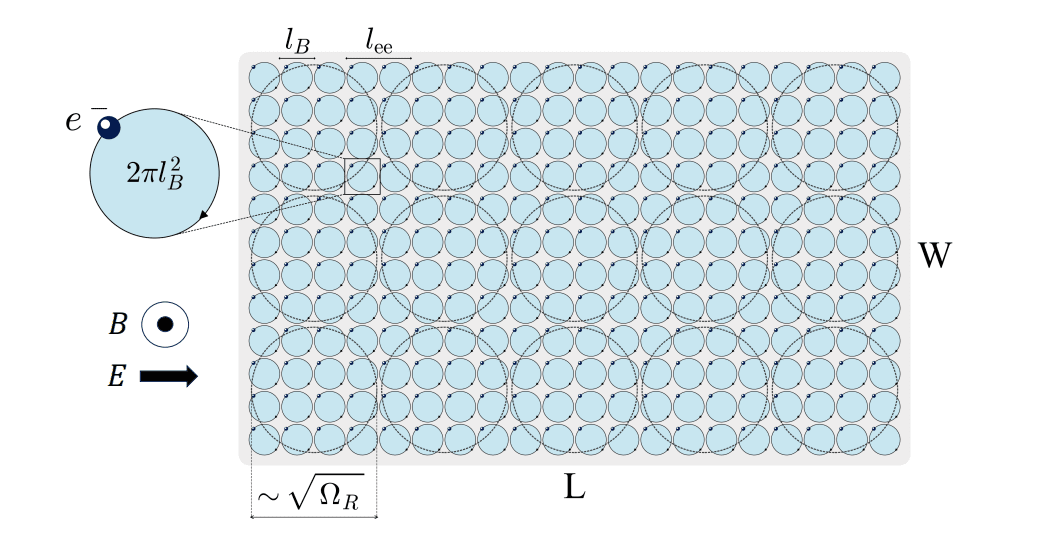
Understanding how electrons flow in materials under extreme conditions remains a central challenge in physics, and recent work by Danyu Shu, Hiroshi Funaki, Ai Yamakage, and Ryotaro Sano, along with Mamoru Matsuo, sheds new light on this problem. The team investigates the behaviour of electrons in gapped graphene within the quantum Hall regime, developing a comprehensive theory to describe both charge and valley transport as a fluid. This research establishes a fundamental connection between Hall viscosity and electrical conductivity, predicting a quantifiable Hall viscosity for both charge and valley currents, and importantly, reveals that valley currents respond uniquely to pressure, offering a new way to observe and control these quantum fluids. The findings represent a significant step towards understanding exotic states of matter and potentially harnessing their unique properties for future technologies.
Quantized Hall Viscosity and Lorentz Force Effects
This work investigates the fluid-like behavior of electrons in two-dimensional materials, specifically focusing on graphene in strong magnetic fields. Researchers explore the roles of Hall viscosity, a property related to dissipationless flow, and the Lorentz force, which acts on moving charges. They demonstrate that the pressure field, a measure of force per unit area within the electron fluid, is central to understanding the system’s dynamics and can be experimentally probed using measurements of electrostatic potential. The team shows that the system exhibits a hydrodynamic regime, characterized by the formation of vortices at boundaries, indicating a fluid-like flow of charge and valley currents.
They demonstrate that the pressure field is a key variable for understanding the system’s dynamics and provide numerical evidence supporting the existence of quantized Hall viscosity, a long-predicted but difficult-to-observe phenomenon. Importantly, the Lorentz force does not significantly alter the velocity field and can be incorporated into the pressure field description. The researchers establish a strong correlation between vorticity and the pressure field, suggesting that the pressure field can be used to infer the hydrodynamic behavior. They validate their theoretical model through numerical simulations, achieving excellent agreement between simulations and theory.
Hall Viscosity, Vorticity, and Quantum Hydrodynamics
This work establishes a unified theoretical framework for understanding charge and valley transport in graphene’s quantum Hall regime, successfully integrating viscous hydrodynamics with quantum Hall physics. Researchers redefined Hall viscosity not as a response to strain, but to gradients in electric fields, revealing a fundamental connection between it and nonlocal Hall conductivity. The theory predicts quantized Hall viscosity for both charge and valley currents, including contributions from the ground state, and identifies a unique valley-viscous term that couples directly to vorticity while remaining unaffected by the Lorentz force. Crucially, the team demonstrated a robust relationship between pressure and vorticity in low-Reynolds-number systems and under various boundary conditions, suggesting that electrostatic potential mapping can serve as a practical method for probing quantized Hall viscosity in strong magnetic fields. This achievement places valleytronics and viscous electron hydrodynamics on a common footing, enabling systematic investigation of odd-viscous topological responses.
👉 More information
🗞 Charge and Valley Hydrodynamics in the Quantum Hall Regime of Gapped Graphene
🧠 ArXiv: https://arxiv.org/abs/2510.00760