

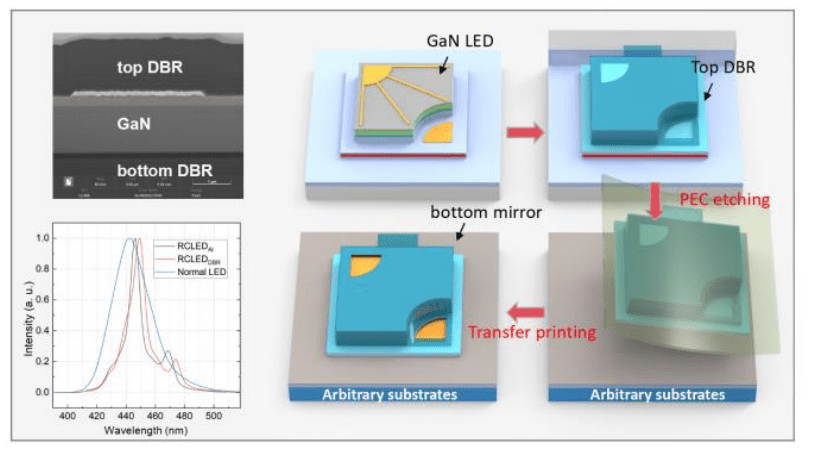
Resonant cavity light-emitting diodes (RCLEDs) represent a significant advance in light source technology, offering improved coherence and narrow light emission crucial for next-generation micro-displays and communications. Huanqing Chen from Peking University, alongside Zhi Li and Menglai Lei, also of Peking University, with contributions from Muhammet Genc and Brendan Roycroft at Tyndall National Institute, University College Cork, and Linghai Meng from Guangxi Hurricane Chip Technology Co., Ltd., demonstrate a new method for fabricating high-performance GaN-based RCLEDs. Their innovative approach combines photo-electrochemical etching with micro-transfer printing to create devices exhibiting a dramatically narrower emission linewidth, reduced from 32nm to approximately 5nm, and a significantly reduced shift in peak wavelength with increasing current. This scalable fabrication process not only minimises residual stress within the GaN material but also enables a substantial decrease in the far-field divergence angle, reaching only 52°, paving the way for compact and efficient resonant cavity devices with broad applications.
GaN Resonant Cavity LED Material Optimisation
Research into gallium nitride (GaN)-based resonant cavity light-emitting diodes (RCLEDs) continues to advance, focusing on design, fabrication, and optimisation of materials and structures to enhance device performance and explore novel applications for these compact light sources. Investigations consistently highlight the importance of high-quality GaN and indium gallium nitride (InGaN) layers, with particular attention paid to controlling quantum well structures and minimising defects during material growth. A significant area of research involves the design of the resonant cavity itself and the reflectors used to enhance light extraction and resonance. Scientists are exploring various reflector types, including multilayer dielectric stacks, metal layers, and porous GaN layers created through techniques like ion implantation.
Optimising these reflectors and the overall cavity design is crucial for improving light extraction efficiency and maximising the amount of light emitted by the device. Researchers are actively working to improve key performance metrics, such as output power, efficiency, and wavelength control, with a key goal being precise control over the emitted light’s colour. Efforts are underway to increase the modulation bandwidth, which determines how quickly the LED can be turned on and off, and different device architectures are being explored for microdisplay applications. These advancements aim to create brighter, more efficient, and more versatile RCLEDs for a range of applications.
Fabrication techniques are also receiving considerable attention, with scientists developing methods for creating and releasing GaN-based devices. Photo-electrochemical etching is emerging as a prominent technique for selectively removing layers and creating freestanding structures, while lift-off techniques and transfer printing are being refined to enable device integration onto various substrates. Complementing these experimental efforts, researchers are employing optical simulations and modelling to optimise device designs and predict performance characteristics. This research extends to specific applications, including visible light communication (VLC) and the development of microdisplays. Emerging areas of investigation include the potential of GaN-based devices for achieving polariton lasing, a phenomenon that could lead to even more efficient and coherent light sources. Collectively, this body of work demonstrates a sustained and multifaceted effort to advance the field of GaN-based RCLEDs, with a strong emphasis on materials science, device fabrication, optical engineering, and the pursuit of improved performance and novel applications.
GaN RCLED Fabrication via Etching and Transfer
Scientists have developed a novel fabrication method for gallium nitride (GaN)-based resonant cavity LEDs (RCLEDs) that combines photo-electrochemical etching with micro-transfer printing (MTP) technology, addressing key challenges in achieving narrow linewidth and directional emission. The process begins with precise photo-electrochemical etching, carefully optimising conditions to selectively remove an indium gallium nitride (InGaN) sacrificial layer while preventing unwanted etching of adjacent layers. This results in exfoliated GaN films with remarkably smooth underside roughness, measuring only 3. 3nm.
Raman spectroscopy confirms that this etching process effectively reduces residual stress in the released material from 0. 74 GPa to -0. 15 GPa, improving device performance and stability. Following etching, the team employed MTP to transfer GaN coupons, each featuring a deposited upper dielectric mirror, onto target substrates prepared with either an aluminium mirror or a dielectric distributed Bragg reflector, creating two distinct types of blue RCLEDs. This MTP technique provides a simple and effective solution for mass transfer of microchips, circumventing the complexities of traditional wafer bonding and substrate removal processes.
Electroluminescence spectra reveal a substantial reduction in linewidth for these RCLEDs, decreasing from 32nm in conventional LEDs to approximately 5nm, alongside improved wavelength stability with increasing current density, reducing peak wavelength shift from 9. 3nm to less than 1nm. Furthermore, the far-field emission pattern is demonstrably influenced by the bottom mirror configuration, and scientists achieved a minimised far-field divergence angle of only 52° by carefully matching the cavity characteristics with the quantum well exciton modes, enhancing light extraction efficiency and directionality. This scalable approach promises significant advancements in compact resonant cavity devices, paving the way for innovative applications in displays and optical communications.
GaN RCLEDs Fabricated with High Coherence
Researchers have achieved a significant breakthrough in resonant cavity light-emitting diode (RCLED) technology, demonstrating a novel fabrication method that delivers remarkably coherent and efficient light emission. The research team successfully created gallium nitride (GaN)-based RCLEDs by combining photo-electrochemical etching with micro-transfer printing (MTP) technology, resulting in devices with substantially improved performance characteristics. The process begins with a specifically designed epitaxial structure grown on sapphire, incorporating a sacrificial layer for precise material removal via photo-electrochemical etching. This etching process selectively removes the sacrificial layer, achieving a remarkably smooth underside surface with a roughness of only 3.
3nm. Measurements confirm a substantial reduction in residual stress within the released GaN material, decreasing from 0. 74 GPa to -0. 15 GPa, which enhances device stability and performance. Utilising the MTP method, the team transferred GaN coupons, coated with a dielectric upper mirror, onto target substrates featuring either aluminium or dielectric distributed Bragg reflectors as bottom mirrors, creating two distinct types of blue RCLEDs.
Electroluminescence spectra of these RCLEDs reveal a dramatically narrower linewidth, reduced from 32nm in conventional LEDs to approximately 5nm, indicating significantly improved spectral purity. Furthermore, the peak wavelength remains remarkably stable with increasing current density, exhibiting a shift of less than 1nm, a substantial improvement over the 9. 3nm shift observed in conventional LEDs. Analysis of the far-field emission patterns demonstrates that the bottom mirror influences the light directionality, and by carefully matching the cavity and exciton modes, the far-field divergence angle was reduced to only 52°. These results demonstrate a simplified and controlled approach to fabricating high-performance RCLEDs, paving the way for compact resonant cavity devices with applications in displays and communications. The team achieved a minimum divergence angle of ±26° in matched RCLEDs, representing a significant advancement in light emission control.
Stress Reduction Boosts Gallium Nitride LED Performance
Researchers have successfully demonstrated a new method for fabricating high-performance gallium nitride-based resonant cavity light-emitting diodes, or RCLEDs, using a combination of photo-electrochemical etching and micro-transfer printing. This approach effectively reduces stress within the GaN material, leading to improved device performance and stability. The process begins with precise photo-electrochemical etching, selectively removing a sacrificial layer to create freestanding GaN films with remarkably smooth surfaces. Measurements confirm a substantial reduction in residual stress, decreasing from 0. 74 GPa to -0. 15 G.
👉 More information
🗞 GaN-based Resonant Cavity LEDs Fabricated by Photo-Electrochemical Etching and Micro-Transfer Printing
🧠 ArXiv: https://arxiv.org/abs/2510.18507


