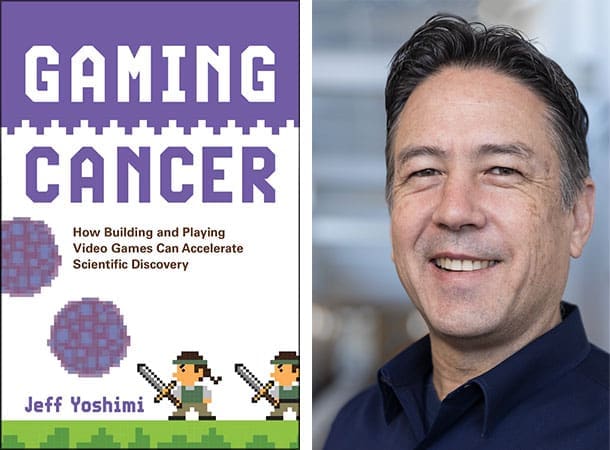
The quest to combat cancer has led to an innovative approach that leverages the collective computing power of millions of video gamers, bolstered by artificial intelligence, to accelerate clinical research into detection and prevention. According to Professor Jeff Yoshimi’s book “Gaming Cancer,” the key to unlocking significant advances in cancer research lies in harnessing the problem-solving capabilities of gamers and channeling them towards complex scientific challenges.
By creating a suite of engaging video games that simulate biological systems and tackle specific cancer-related conundrums, Yoshimi envisions a future where citizen science and AI collaborate seamlessly to drive progress in the fight against this devastating disease, which is expected to claim over 618,000 lives in the US by 2025. With the potential to tap into the vast reservoir of untapped problem-solving power among gamers worldwide, this novel approach could pave the way for groundbreaking discoveries and improved treatments, ultimately bringing hope to the millions of people affected by cancer each year.
Introduction to Citizen Science Games
The concept of citizen science games has been around for a while, with examples like “Foldit” making a video game out of protein folding to help scientists understand cellular mutation and runaway replication of diseased tissue. However, Professor Jeff Yoshimi, a founding faculty member at the University of California, Merced, is thinking bigger. He envisions a suite of powerful, irresistible games that can tap into the collective problem-solving power of millions of people around the world to accelerate scientific discovery in the fight against cancer.
Yoshimi’s book, “Gaming Cancer: How Building and Playing Video Games Can Accelerate Scientific Discovery,” lays out a roadmap for creating these games. He discusses the need for crack programmers, visionary leaders, and deep-pocketed financiers, as well as reward structures for users and smooth links between gamers and labs. At the center of it all is Simbody, a game engine that simulates biological systems from whole bodies to nanoscale.
The Potential of Human-AI Symbiosis
Yoshimi believes that the key to success lies in human-AI symbiosis, where artificial intelligence (AI) is used to process large amounts of data and perform statistical generalizations, while humans provide creative insight and intuition. This approach can be seen in existing citizen science games, which have AI elements that work hand-in-hand with the player. By combining the strengths of both humans and AI, Yoshimi hopes to create games that are not only engaging but also effective in advancing our understanding of cancer.
The recent arrival of large language models such as ChatGPT has raised questions about the role of human crowdsourcing in scientific research. However, Yoshimi argues that AI is not yet at a point where it can solve complex problems on its own. Instead, he believes that the best games will take AI as far as it can go and then interweave it with human intelligence to create a seamless experience.
The Benefits of Citizen Science Games
Citizen science games have the potential to make a significant impact in the fight against cancer. By engaging millions of people around the world, these games can foster an understanding of clinical research and promote lifestyle choices that can reduce cancer risk. Additionally, they can provide valuable insights into the biology of cancer, which can be used to develop new treatments and detection methods.
Yoshimi’s vision is not limited to eradicating cancer, but also includes promoting a broader understanding of scientific research and its applications. By making science more accessible and engaging, he hopes to inspire a new generation of scientists and researchers who can tackle some of the world’s most pressing problems.
The Future of Citizen Science Games
The future of citizen science games looks promising, with the potential to tap into the collective problem-solving power of millions of people around the world. Yoshimi’s book provides a roadmap for creating these games, and his vision of human-AI symbiosis offers a powerful approach to advancing scientific discovery.
As the field continues to evolve, we can expect to see more sophisticated games that combine AI and human intelligence to tackle complex problems. The potential benefits are enormous, from accelerating our understanding of cancer to promoting a broader understanding of scientific research and its applications. With the help of citizen science games, we may be able to make significant progress in the fight against cancer and other diseases, and inspire a new generation of scientists and researchers to tackle some of the world’s most pressing problems.
Conclusion
In conclusion, Professor Jeff Yoshimi’s vision for citizen science games has the potential to revolutionize the way we approach scientific research and discovery. By tapping into the collective problem-solving power of millions of people around the world, these games can accelerate our understanding of cancer and other diseases, and promote a broader understanding of scientific research and its applications. With the help of human-AI symbiosis, we may be able to make significant progress in the fight against cancer and inspire a new generation of scientists and researchers to tackle some of the world’s most pressing problems.
The potential benefits of citizen science games are enormous, and Yoshimi’s book provides a roadmap for creating these games. As the field continues to evolve, we can expect to see more sophisticated games that combine AI and human intelligence to tackle complex problems. The future of citizen science games looks promising, and with the help of these games, we may be able to make significant progress in the fight against cancer and other diseases.
External Link: Click Here For More