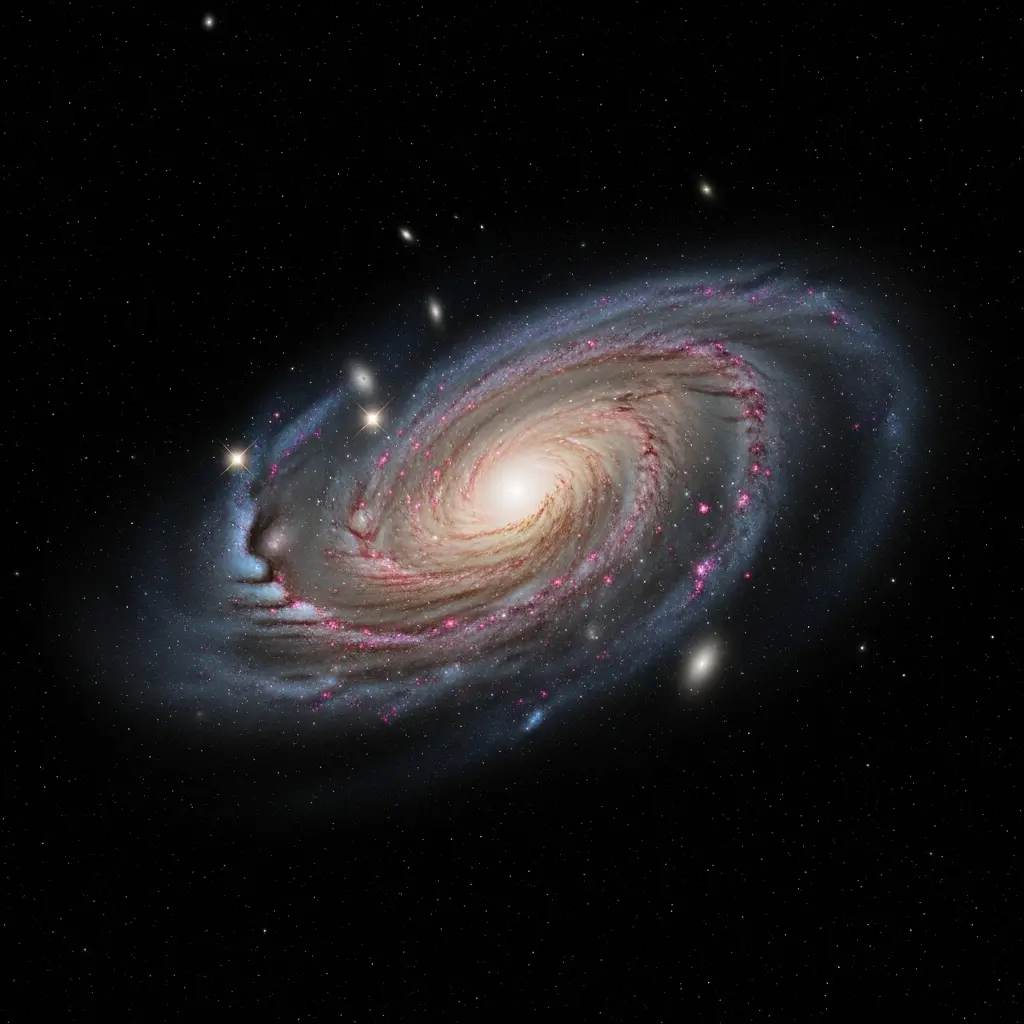
Scientists are increasingly focused on understanding the subtle distortions in the Milky Way’s disk, and new research published this week suggests a galactic merger may be responsible for its characteristic warp. Mingji Deng, Cuihua Du, and Jian Zhang, all from the School of Astronomy and Space Sciences at the University of Chinese Academy of Sciences, alongside Haoyang Liu and Zhongbcheng Li, present a low-mass model of the Milky Way demonstrating how a past collision with another galaxy , the Gaia-Sausage-Enceladus merger , could have initiated and sustained this warp. Their simulations, utilising the GIZMO code, reveal a dynamic interplay between the dark matter halo and the galactic disk, offering a crucial insight into the evolution of spiral galaxies and explaining the observed decline in the Milky Way’s rotation curve. This work identifies a ‘seesaw’ effect of angular momentum exchange and a mechanism for long-lived precession, fundamentally advancing our understanding of galactic dynamics.
Galaxy merger drives Milky Way disk warp
Researchers identified a dual-regime interaction mechanism driven by this asymmetric halo potential, revealing distinct behaviours on different timescales. Furthermore, the team demonstrated that high-inclination mergers can sustain long-lived prograde precession, where a persistent, albeit decaying, gravitational torque maintains the prograde bending mode against differential wind-up. This finding challenges previous models favouring transient warps caused by recent satellite interactions, offering an explanation for the long-standing persistence of the Galactic warp observed for over 5 Gyr. By combining the observed S-shaped warp with the timeline of the gas-rich GSE merger, the study builds upon tailored GSE merger simulations, employing a grid of 500 idealized runs with the GADGET code to identify a fiducial model matching H3 survey data. This work deepens understanding of the vertical bending mode through Fourier decomposition and calculates the vertical acceleration exerted by dark matter particles on the disk, evaluating its misalignment relative to the disk plane, ultimately providing insights into the long-term evolution of galactic disk warps.
GSE Merger Simulations of Milky Way Warps
At a redshift of approximately z ∼2, the Milky Way was modelled as a combination of a thick disk with 1.5 × 10¹⁰ M⊙ stellar mass, a gas disk, and a bulge, utilising data from Xiang et al. (2025) to define disk scale lengths of 2 kpc and thicknesses of 0.4 × R⋆. The gas disk, with a scale length of 3 × R⋆ and half the scale length as its thickness, followed an exponential + sech-z profile, while the bulge, adopting the Bulge-E model from Jiao et al. (2023), possessed a mass of 1.95 × 10¹⁰ M⊙ and a scale length of 0.9 kpc, modelled with an Einasto profile. This approach enabled a detailed reconstruction of galactic components, validated against observational data from Jiao et al. (2023) and Ou et al. (2023), as demonstrated by the rotation curve decomposition presented in Figure 1. Researchers then configured orbital parameters for the merging galaxies, placing them on a radially-biased, retrograde orbit with a high eccentricity of 0.9 to replicate observed velocity and anisotropy features in GSE debris.
Initial separation was determined by summing the virial radii of both progenitors, with relative velocity calculated using a Keplerian orbit. To investigate the influence of mergers on vertical disturbances, the inclination angle was systematically varied from 15◦ to 75◦ in 15◦ intervals, including a 55◦ angle from prior work. The DICE configuration defined the orbit using parameters like polar and azimuthal angles, and spin angles, ensuring a comprehensive exploration of merger dynamics.
GSE Merger Drives Milky Way Disk Warp
This suggests a dynamic interplay where angular momentum is transferred between the halo and the disk, influencing the warp’s shape and orientation. Measurements confirm that high-inclination mergers can sustain long-lived prograde precession, maintaining the prograde bending mode against differential wind-up through a persistent, albeit decaying, gravitational torque. Furthermore, the team employed Fourier decomposition to identify the vertical bending mode and investigate its behaviour, calculating the vertical acceleration exerted by dark matter particles on the disk and assessing its misalignment with the disk plane. By incorporating a gas component into their simulations, scientists successfully reproduced the Galactic disk warp, providing insights into its long-term evolution. The simulations employed a grid of 500 idealized merger runs with the GADGET code, building upon previous work that identified a fiducial model matching H3 survey data. This research offers a universal mechanism for warp formation through galaxy mergers, aligning with observations that at least half of spiral galaxies exhibit similar warped structures.
Merger Halo Tilt Drives Warp Amplitude modulation
Scientists have demonstrated that galaxy mergers can induce and shape disk warps in spiral galaxies like our own Milky Way. Through simulations using the GIZMO code, researchers modelled galaxy mergers with varying parameters to investigate how disk warps develop and change over time. Simulations also showed a ‘regeneration’ phenomenon, where warp amplitude declines then rises again, suggesting internal processes drive the warp’s persistence. The authors acknowledge that their simulations only considered a single initial merger event, which is a limitation. They also simplified calculations within their kinematic warp model by assuming a constant precession rate and neglecting certain time-dependent terms, though they found these approximations had minimal impact on their results. Future research could explore the effects of multiple mergers and more complex halo structures on disk warp evolution, potentially refining our understanding of galactic formation history and dark matter distribution. This work establishes a connection between merger dynamics and observable galactic features, offering insights into the processes shaping spiral galaxies.
👉 More information
🗞 A Low-mass Model of The Milky Way: The Disk Warp Resulting from A Galaxy Merger
🧠 ArXiv: https://arxiv.org/abs/2601.21638