

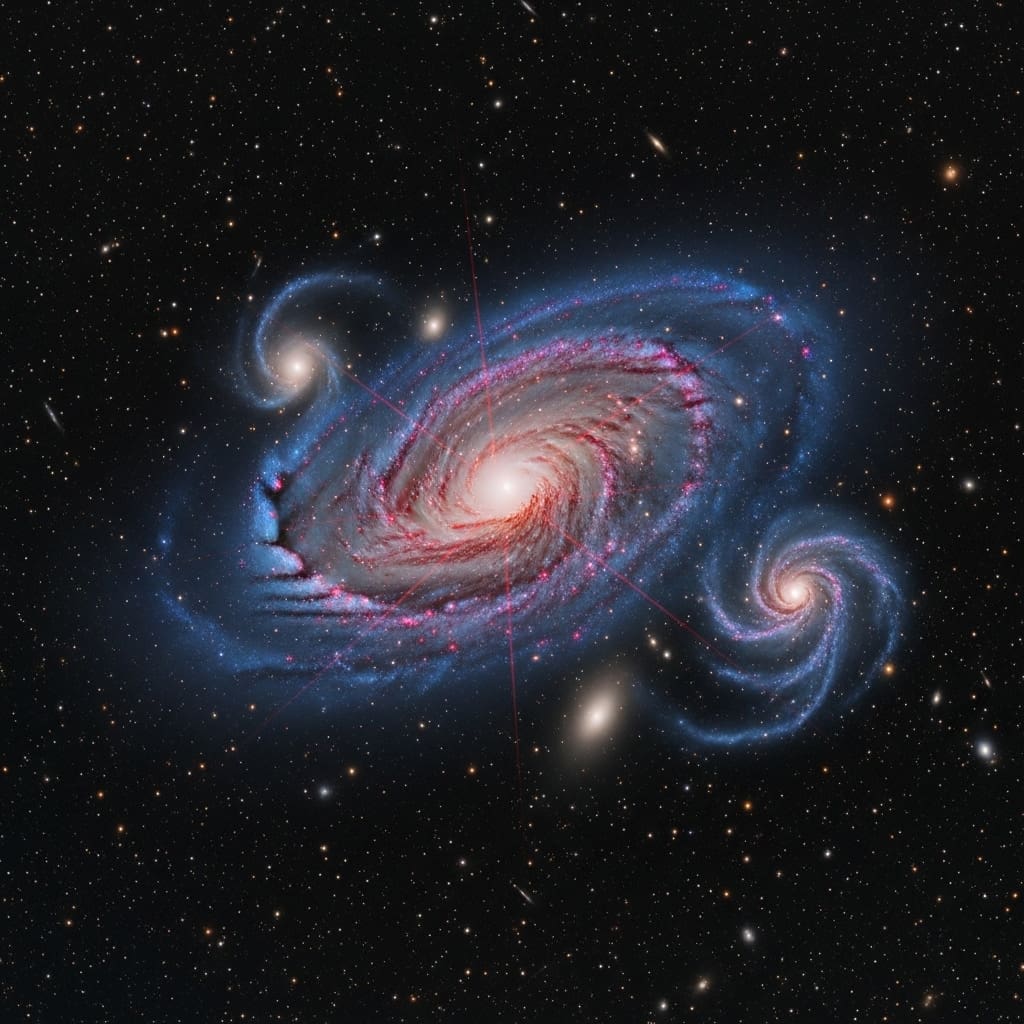
Scientists are reassessing the nature of active galactic nuclei (AGN) with new observations of NGC 1068, a well-studied Seyfert galaxy. Spearheaded by S. Bianchi and B. Vander Meulen, from institutions not specified, this research utilises data from the XRISM/Resolve instrument to analyse iron line complexes, providing crucial insights into the galaxy’s obscured core. In collaboration with colleagues including E. Bertola, V. Braito, A. Comastri, and further researchers at institutions such as the Italian National Institute for Astrophysics and the University of Leicester, the team demonstrate that the observed iron emission does not solely originate from a homogeneous, Compton-thick medium as previously thought. Instead, their findings suggest a geometrically complex environment with optically thin or mildly Compton-thick material dominating the fluorescence, alongside a highly ionized, fast outflow traced by broadened iron XXV and XXVI emission lines, potentially representing a significant feedback mechanism in heavily obscured galaxies.
Eight thousand kilometres per second, the speed measured in NGC 1068’s outflowing gas, challenges established ideas about how active galaxies expel material. This observation reveals a complex environment where X-rays trace distinct, fast-moving components of a galactic wind. Understanding this process is key to unlocking how galaxies and their central supermassive black holes co-evolve.
Scientists have long sought to understand the environments immediately surrounding supermassive black holes at the centres of galaxies, particularly those obscured from view by dense clouds of gas and dust. These obscured active galactic nuclei (AGN) offer a unique opportunity to study the reprocessing of energetic radiation and the powerful outflows that shape galactic evolution.
NGC 1068, a well-known Seyfert 2 galaxy, has served as a key example for decades. Yet a complete picture of its inner workings has remained elusive. Previous X-ray observations lacked the spectral resolution needed to fully separate emission components and accurately determine the properties of the obscuring material. Now, data from the XRISM/Resolve instrument is changing this, providing unprecedented detail in the iron K-band spectrum of NGC 1068.
By disentangling neutral and ionized iron emission has proven difficult, hindering precise measurements of optical depth, structure, and the connection between reprocessing regions and nuclear outflows. Observations with XRISM/Resolve are now allowing astronomers to probe the physical properties of the gas, including its density, ionization, geometry, and velocity.
Initial analysis focuses on the characteristic iron Kα and Kβ fluorescent lines, alongside emission from highly ionized iron species like Fe XXV and Fe XXVI. By understanding the origin and kinematics of these ionized lines is vital for determining their role in galactic feedback, the process by which energy from the central black hole influences star formation and galactic growth.
The observed velocity widths of the Fe XXV and Fe XXVI lines are remarkably large, reaching several thousand kilometres per second — these velocities are comparable to those seen in optical and infrared observations of a large-scale biconical outflow. A physical connection between the X-ray emission and the broader outflow structure. Through carefully analysing the energies, widths. Ratios of these iron lines, researchers are beginning to reveal a stratified circumnuclear environment where neutral and ionized components reside in distinct regions.
The new XRISM/Resolve the neutral iron emission originates not from a single, dense cloud — but from optically thin or mildly Compton-thick gas, challenging previous assumptions about the geometry of the obscuring material. In turn, the observed properties of the ionized iron emission lines suggest a fast, bipolar outflow on parsec scales, and potentially representing an efficient channel for transferring energy into the surrounding galaxy. Local spectral fitting determined line centroid energies, intrinsic widths, flux ratios, and constraints on the Compton shoulder, allowing for comparisons with atomic calculations and theoretical predictions.
This technique provides detailed information about the emitting material without relying on broad assumptions about its geometry or composition. Scientists examined the centroid energies of the Fe Kα and Fe Kβ lines to rigorously constrain the emitting material’s ionization state. Meanwhile, the effort carefully assessed intrinsic line widths to understand the dynamics of the gas.
Flux ratios between different emission lines were then calculated, providing insights into the physical conditions and relative abundances of various elements. Through constraining the Compton shoulder, a feature arising from scattered X-rays, proved vital for discerning the opacity of the surrounding medium. Through comparing observed line profiles with predictions from atomic calculations, scientists could test hypotheses about the physical processes occurring within the circumnuclear environment.
In turn, the observed Fe Kβ/Kα ratio, coupled with the upper limit on the Compton shoulder — strongly suggested that reflection wasn’t dominated by a uniform, highly obscured medium. Instead, much of the neutral Fe Kα emission originated in gas that was either optically thin or only mildly Compton-thick, and the remarkably broad profiles of the Fe XXV and Fe XXVI emission lines, reaching several thousand km s−1, were investigated. These profiles closely matched those of optical and infrared lines associated with a large-scale biconical outflow, leading to the interpretation that these X-ray lines represent a highly ionized, faster. More compact component of the same outflow.
Neutral Iron Emission and Highly Ionised Outflow Components in NGC1068
XRISM/Resolve observations of NGC1068 reveal precise centroid energies for the Fe Kα and Fe Kβ lines, constraining the emitting material to be neutral or near-neutral in ionization state. Meanwhile, the observed ratio of Fe Kβ to Fe Kα emission, alongside an upper limit of 8, 11% for the Compton shoulder relative to the core flux, argues against a reflection process dominated by a uniform, highly Compton-thick medium.
Much of the neutral Fe Kα emission originates within optically thin or only moderately Compton-thick gas. At wavelengths indicative of highly ionized species. This are associated with a large-scale biconical outflow.
As a result, these X-ray lines are interpreted as originating from a faster, more highly ionized. Spatially confined phase of the same outflow. The iron-K emission from NGC1068 demonstrates a stratified circumnuclear environment where neutral and highly ionized components arise in separate physical regions — by focusing on fluorescence, the neutral Fe K emission predominantly comes from optically thin or mildly Compton-thick material. Despite the overall Compton-thick obscuration along the line of sight.
This indicates a geometrically complex arrangement of cold reprocessing material. The highly ionized iron emission lines trace a fast component consistent with a bipolar outflow extending to parsec scales. With large velocities and substantial inferred energetics, this outflow may represent an effective mechanism for feedback within this heavily obscured Seyfert galaxy.
Layered gas and powerful outflows define structure near galactic black holes
The structure surrounding supermassive black holes is now coming into sharper focus. Observations of NGC1068, a Seyfert galaxy, reveal a surprisingly organised environment around its central engine, with distinct zones of hot and cooler gas. For years, astronomers struggled to reconcile observations of intensely bright, yet obscured, galactic centres with theoretical models of accretion and outflow.
To determine the geometry and physical conditions of the material closest to these black holes proved exceptionally difficult. As any light emitted is heavily altered by absorption and scattering. This the iron-rich gas surrounding NGC1068 isn’t a uniform, dense cloud as previously assumed. Instead, it appears layered, with thinner, more diffuse material dominating the emission of specific X-ray signatures.
The detection of extremely fast-moving, highly ionized gas confirms a powerful outflow, potentially a key mechanism for regulating star formation within the galaxy. The precise relationship between this outflow and the central black hole remains unclear; is it directly driven by the black hole, or a consequence of star formation activity in the galactic centre.
The limitations lie in the inherent complexity of these systems and the challenges of interpreting X-ray spectra — while the data strongly suggest a stratified environment, mapping the full three-dimensional structure requires further observations at different wavelengths. Future work might focus on applying similar techniques to other Seyfert galaxies, and building a broader picture of how these powerful engines shape their host galaxies. Numbers suggest that this feedback mechanism is common, and understanding its efficiency is vital for modelling galaxy evolution.
👉 More information
🗞 A XRISM View of the Iron Line Complex in NGC 1068: Rethinking the Prototypical Compton-Thick AGN
🧠 ArXiv: https://arxiv.org/abs/2602.16252

