

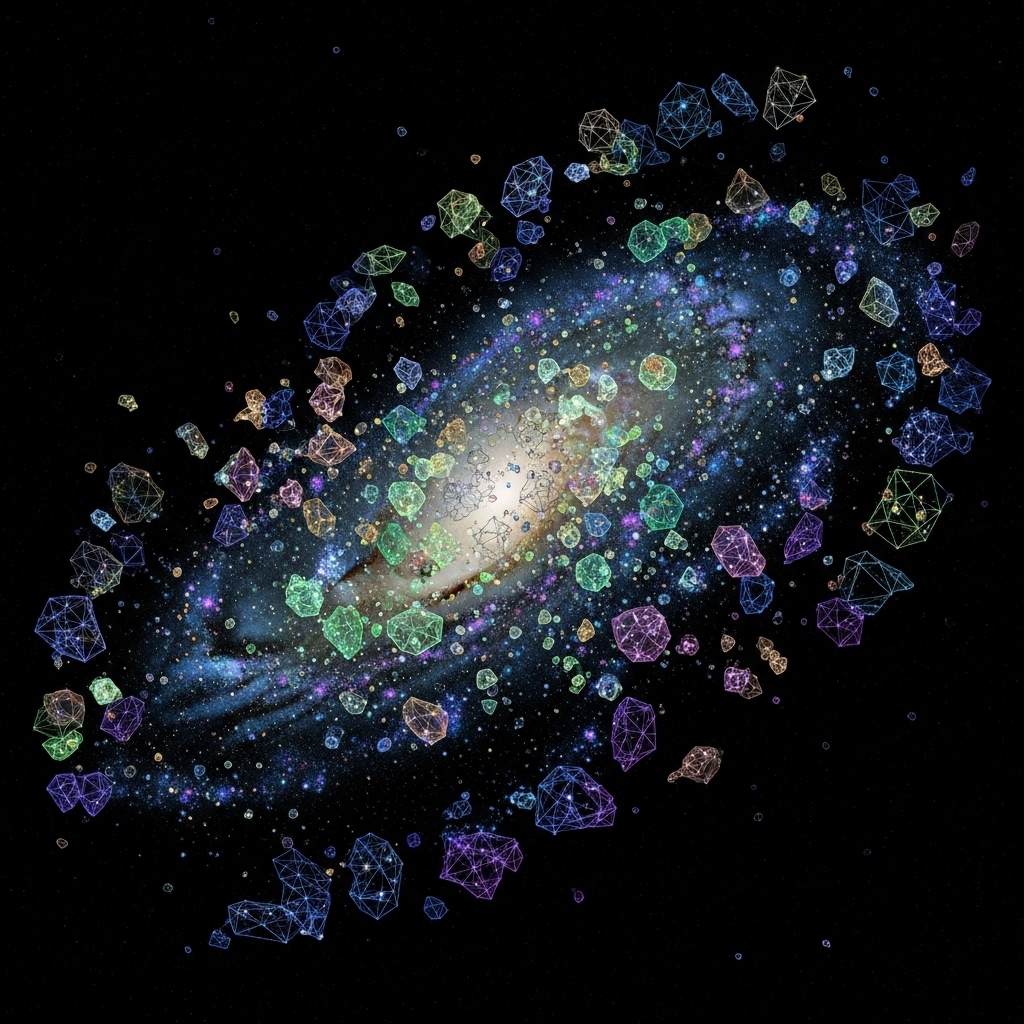
Researchers are developing novel techniques to analyse galaxy images using phase space, potentially unlocking new insights into dark matter and cosmological structures. Shun Arai from the Kobayashi-Maskawa Institute for the Origin of Particles and the Universe, Nagoya University, alongside colleagues, introduce Wigner Function Shapelets (WFS), a method extending shapelet analysis into phase space. This formalism represents images directly within a four-dimensional phase space, utilising the unique properties of the Wigner function to encode image information symmetrically and sensitively detect spatial coherence. By formally organising formulae from both astrophysics and mathematical physics, this work establishes a powerful new basis for analysing galaxy morphology and cosmological imprints, offering a potentially transformative approach to image analysis in astronomy.
The research introduces an orthogonal and complete basis for the Wigner function, constructed from bilinear forms of cross-Wigner functions of Laguerre-Gaussian modes, effectively mapping irreducible representations of the phase space using Hopf tori.
This work establishes a scalar function linking these tori to a two-dimensional space of constants of motion, harmonic energy and axial angular momentum, resulting in a natural “band structure” within the phase space. The study formally organises formulae related to the Wigner function within both astronomical terminology and quantum information theory. By representing galaxy images as Wigner functions, researchers can analyse their properties with tools from quantum mechanics, such as the Liouville equation, which describes the time evolution of quantum systems.
This approach not only provides a new way to model galaxy morphology but also opens avenues for extracting cosmological information encoded in the subtle patterns within these images. Unlike conventional shapelets that analyse images separately in configuration or Fourier space using Hermite-Gaussian or Laguerre-Gaussian modes, WFS utilises a bilinear form of the cross-Wigner function of Laguerre-Gaussian modes to create an orthogonal and complete basis for the image’s Wigner function.
This approach leverages irreducible representations of phase space with Hopf tori, enabling a novel analysis of galaxy morphology and cosmological imprints. The research introduces a scalar function mapping from covariant tori to a two-dimensional space defined by the harmonic energy and axial angular momentum, yielding a natural phase-space “band structure” characterised by a pair of winding numbers.
This construction exploits key properties of the Wigner function, including its ability to encode an image’s entirety in a symmetry-preserving manner and its connection to the Liouville equation. Furthermore, the Wigner function’s oscillatory patterns on a plane are sensitive to the spatial coherent structure of galaxies, while systematics and noise are treated as channel operations.
This study formally organises formulae related to the Wigner function within both astronomical and mathematical terminologies. The WFS are constructed within a phase space described by the transverse coordinate and its conjugate momentum, establishing a symplectic structure. A galaxy image is represented by its Wigner function, and the resulting shapelets provide a basis that preserves symplectic geometry, effectively creating a Hilbert-Schmidt space spanned by bilinear products of Laguerre-Gaussian modes. These shapelets leverage the symplectic group, quantised by a telescope’s resolution limit, to represent images and offer a new approach to astrophysical and cosmological image analysis.
The core of this work lies in the construction of an orthogonal and complete basis, the WFS, derived from the cross-Wigner function of Laguerre-Gaussian modes. Specifically, the WFS are defined as the cross-Wigner function between two Laguerre-Gaussian modes, ΨLG j,s and ΨLG j′,s′, denoted as W LG (j,s),(j′,s′).
The orthogonality of these modes, expressed as W LG (j1,s1),(j2,s2) |W LG (j3,s3),(j4,s4) HS = δj1j3 δs1s3 δj2j4 δs2s4 (2πλ)2, establishes a Hilbert-Schmidt space, enabling any quadratically integrable function within the phase space to be expanded as a complete series of WFS. This expansion, mathematically related to conventional polar shapelets via the coefficients c(j,s),(j′,s′) ≡ (2πλ)2W(j,s),(j′,s′) |W HS, allows for a robust decomposition of the Wigner function of a galaxy image.
The analytic form of the WFS is intrinsically linked to the phase space structure, exhibiting U(1) × U(1) invariance when considering a single Laguerre-Gaussian mode. This invariance arises from the dependence on a pair of U(1)-invariant variables: harmonic energy, Q0, and angular momentum, Q2. The research establishes a connection between the phase space and SU(2) algebra, defining commutation relations and scalar variables that reveal a Casimiar constant, Q0, invariant under SU(2) transformations. Unlike conventional shapelets that operate separately in either configuration or Fourier space using Hermite-Gaussian or Laguerre-Gaussian modes, WFS directly represents images within a four-dimensional phase space, quantified by a resolution limit determined by telescope capabilities.
This method utilises a bilinear form of the cross-Wigner function of Laguerre-Gaussian modes, creating an orthogonal and complete basis for the Wigner function of an image and reflecting irreducible representations of phase space. WFS leverages key properties of the Wigner function to encode image information symmetrically, facilitating analysis through a Liouville equation and enabling sensitivity to spatial coherent structures within galaxy morphology and potential cosmological imprints.
Systematics and noise can be effectively managed as channel operations within this framework. The development formally organises formulae related to the Wigner function, bridging terminology between astronomy and mathematical physics. Limitations acknowledged by the authors include the need for careful consideration when choosing parameters such as sigma and lambda to optimise image recovery.
Future research directions involve extending the WFS method to handle polarised or coloured images and exploring its application to weak-lensing operators with Swinger two oscillators. These advancements build upon existing shapelet formalisms and provide a robust foundation for analysing data from upcoming high-resolution imaging surveys, such as those conducted by the James Webb Space Telescope and the Vera C.
Rubin Observatory. The resulting phase-space representation offers a natural “band structure” and a powerful tool for extracting cosmological information from galaxy images.
👉 More information
🗞 Wigner Function Shapelets I : formalism
🧠 ArXiv: https://arxiv.org/abs/2602.01141