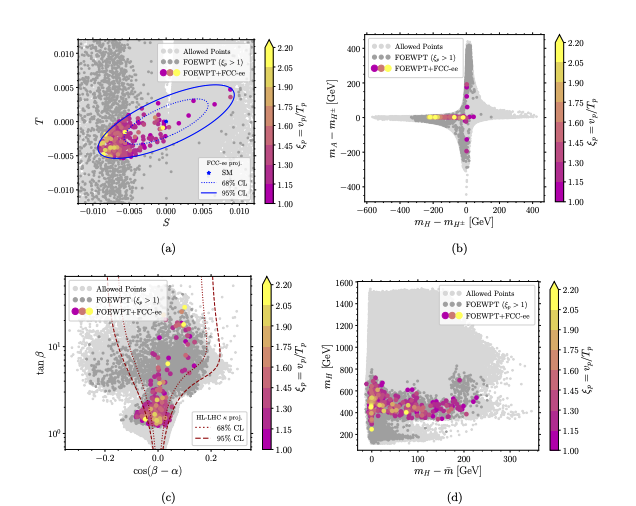
Future electron-positron colliders, like the FCC-ee and CEPC, possess the capacity to investigate two-Higgs-doublet models potentially enabling electroweak baryogenesis, a process explaining the matter-antimatter asymmetry. Precision measurements of Higgs boson production reveal subtle deviations from Standard Model predictions, even though they are consistent with LHC data.
The standard model of particle physics successfully describes the fundamental forces and particles observed in nature, yet leaves several questions unanswered, notably the observed matter-antimatter asymmetry in the universe. One proposed explanation involves a ‘strong first-order electroweak phase transition’ (SFOEWPT) in the early universe. During this period, the Higgs field underwent a dramatic shift, potentially creating the conditions for matter to dominate. Investigating this requires precise measurements of the Higgs boson’s properties and searches for additional, undiscovered particles. Anisha, Francisco Arco, Stefano Di Noi Mühlleitner, Christoph Englert, and Margarete Mühlleitner, collaborating across the Karlsruhe Institute of Technology, Deutsches Elektronen-Synchrotron DESY, and the University of Glasgow, present research detailed in their article, “Z and Higgs Factory Implications of Two Higgs Doublets with First-Order Phase Transitions”, which explores the potential of future colliders to probe extensions to the standard model, specifically ‘two-Higgs-doublet models’ (2HDMs), and assess their compatibility with an SFOEWPT. These 2HDMs propose the existence of additional Higgs bosons beyond the one discovered in 2012, offering a potential pathway to explain the matter-antimatter imbalance.
Future colliders offer a sensitive means of investigating physics beyond the Standard Model, particularly within the Higgs sector, complementing the ongoing investigations at facilities like the Large Hadron Collider. Researchers currently focus on Two-Higgs-Doublet Models (2HDMs) as a viable extension to the Standard Model, specifically examining scenarios that permit a strong first-order phase transition. This transition is considered crucial for electroweak baryogenesis, a theoretical process attempting to explain the observed asymmetry between matter and antimatter in the universe. 2HDMs introduce additional Higgs bosons beyond the single one observed in 2012, and this research identifies parameter regions within these models that both facilitate the required phase transition and remain consistent with the anticipated precision measurements from future colliders.
The study demonstrates that precisely resolving radiative corrections,
The study demonstrates that precisely resolving radiative corrections, which are quantum loop effects that subtly modify particle interactions, provides a powerful method for probing the Higgs sector and searching for evidence of new physics. These corrections manifest as small deviations in the production cross-sections of particles, and future lepton colliders, such as the proposed Future Circular Collider (FCC-ee) and Circular Electron Positron Collider (CEPC), are projected to achieve the sub-percent precision necessary to detect these deviations.
A comprehensive analysis considers the interplay between direct searches for these exotic Higgs bosons and the indirect constraints derived from precision measurements. The research also investigates the sensitivity of the results to different renormalization schemes, a mathematical technique employed to remove infinities arising in quantum calculations, thereby ensuring the robustness of the findings. Expanding the analysis to encompass other potential beyond-the-Standard Model (BSM) scenarios, including supersymmetry – a theory proposing a symmetry between bosons and fermions – or models incorporating additional vector bosons, provides a broader context for interpreting future collider results.
Detailed simulations of detector performance and background processes are essential for accurately estimating achievable precision and optimising the experimental strategy. Refining the theoretical predictions for radiative corrections, incorporating higher-order calculations and improving the accuracy of input parameters, demands significant computational resources. Researchers explore the impact of different 2HDM scenarios, including those allowing for CP violation – a phenomenon where physical laws are not preserved under charge-parity transformation – on precision measurements. The current study concentrates on 2HDMs operating within the CP-conserving limit, meaning the model preserves charge-parity symmetry, and assesses how well these regions align with anticipated precision measurements. These measurements encompass both electroweak parameters, which characterise the weak interaction, and precise determinations of Higgs boson properties, alongside direct searches for exotic Higgs bosons, particles beyond those predicted by the Standard Model.
👉 More information🗞Z and Higgs Factory Implications of
🗞 Z and Higgs Factory Implications of Two Higgs Doublets with First-Order Phase Transitions
🧠 DOI: https://doi.org/10.48550/arXiv.2506.18555