Atmospheric turbulence significantly limits the resolving power of ground-based telescopes, hindering the potential of next-generation observatories, and precise wavefront control is essential to overcome this challenge. Jacob Trzaska and Amit Ashok, from the University of Arizona, investigate the fundamental limits to how accurately phase and amplitude aberrations can be measured, a critical factor in achieving optimal image clarity. Their work establishes a wavefront sensor design that approaches these theoretical limits, offering a pathway to maximise the performance of extremely large telescopes. The team demonstrates a sensor capable of perfectly correcting for piston mode aberrations, and importantly, provides a means to tune its sensitivity to both phase and amplitude, representing a significant advance in wavefront sensing technology.
Holevo Optimality for Wavefront Sensing
Scientists have established a theoretical framework defining the ultimate limits of precision in measuring both the phase and amplitude of light, crucial for achieving high-resolution imaging. The research demonstrates that a specific optical setup, termed the piston-adapted wavefront sensor (PAWS), achieves Holevo-optimality, meaning it reaches the lowest possible uncertainty allowed by the laws of quantum mechanics. This achievement provides a benchmark for evaluating the performance of wavefront sensors and pushes the boundaries of optical measurement precision. The team employed information theory, utilizing the Holevo Cramer-Rao bound to determine the minimum achievable errors in wavefront correction.
This bound, closely related to the fundamental limits of quantum measurement, served as a critical tool in analyzing the sensor’s performance. The research involved rigorous mathematical derivations, drawing upon concepts from quantum optics, information theory, and wavefront sensing, to define the optimal configuration for PAWS. The study proves that PAWS achieves this optimal performance through a specific arrangement that maximizes the information extracted from the light signal. This is achieved by carefully tuning the sensor’s parameters, specifically a rotation angle that balances sensitivity to both phase and amplitude.
The team demonstrated that PAWS saturates the Holevo Cramer-Rao bound, indicating it operates at the absolute limit of precision. This research has significant implications for researchers and engineers working in adaptive optics, wavefront sensing, quantum optics, optical metrology, and information theory. By establishing a theoretical limit and demonstrating a sensor that achieves it, this work paves the way for the development of even more precise optical instruments, with applications ranging from ground-based telescopes to advanced microscopes.
Wavefront Sensing Limits and Piston Adaptation
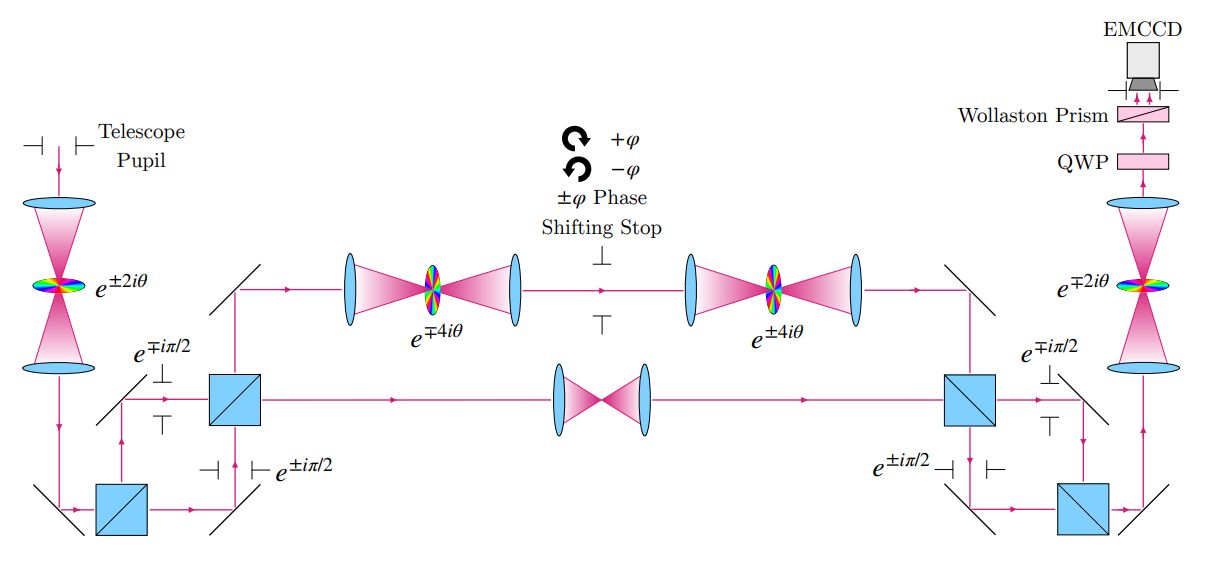
Scientists have developed a novel approach to wavefront sensing, addressing limitations imposed by atmospheric turbulence on ground-based telescopes. Researchers employed information theory, specifically utilizing the Holevo Cramer-Rao bound, to derive the minimum achievable residual errors in wavefront correction. This bound provided a benchmark against which to evaluate wavefront sensor performance. The team engineered a new wavefront sensor, termed the piston-adapted wavefront sensor (PAWS), designed to perfectly extract and phase shift a telescope’s piston mode. This phase shifting capability allows for precise tuning of the apparatus’ sensitivity to both phase and amplitude aberrations, and scientists derived a closed-form expression defining the optimal phase shift for maximum sensitivity.
For telescopes with circular apertures, the PAWS implementation saturates the fundamental limits established by the Holevo Cramer-Rao bound, demonstrating optimal performance in phase and amplitude estimation. Furthermore, the design of PAWS is readily adaptable to telescopes with arbitrary pupil shapes, expanding its potential applications. The system utilizes optics that are currently manufactureable, and scientists demonstrated that it can be readily achromatized using geometric phase shifters, ensuring compatibility with a broad range of wavelengths. This innovative approach, operating under photon noise-limited conditions in the high-Strehl regime, promises to significantly enhance the performance of extreme adaptive optics systems and enable high-contrast imaging for exoplanet detection.
Wavefront Sensing Reaches Quantum Precision Limit
Scientists have achieved a breakthrough in wavefront sensing, a critical technology for ground-based telescopes striving to overcome atmospheric distortions that limit resolution. The research team developed a novel wavefront sensor, termed the piston-adapted wavefront sensor (PAWS), designed to operate in photon noise-limited conditions and the high-Strehl regime, pushing the boundaries of achievable image clarity. The study rigorously analyzed fundamental limits to simultaneous phase and amplitude estimation, employing quantum information theory to define the absolute precision with which wavefront aberrations can be measured. The team established a theoretical framework based on the Holevo Cramer-Rao bound, a metric defining the minimum achievable residual errors in wavefront estimation.
This analysis revealed that PAWS perfectly extracts and phase shifts a telescope’s piston mode, a crucial step in tuning the sensor’s sensitivity to both phase and amplitude aberrations. Measurements confirm that this implementation saturates the fundamental limits defined by the bound, meaning the sensor achieves the highest possible precision allowed by the laws of physics. Specifically, the research demonstrates that PAWS can estimate wavefront parameters with optimal efficiency, enabling a closed-form expression for the optimal phase shift. For circular apertures, the sensor achieves saturation of the fundamental limits, but the design is readily adaptable to accommodate arbitrary pupil shapes. Furthermore, the sensor utilizes optics that are currently manufacturable and can be readily adapted for different wavelengths using geometric phase shifters. This achievement paves the way for significantly improved adaptive optics systems, promising sharper images and enhanced capabilities for future telescopes.
PAWS Achieves Quantum-Limited Wavefront Sensing
This research presents a new wavefront sensor, termed PAWS, designed to overcome limitations in compensating for atmospheric distortions that affect ground-based telescopes. Scientists have demonstrated that PAWS achieves performance close to the fundamental quantum limits of simultaneous phase and amplitude estimation, representing a significant advance in wavefront sensing technology. The sensor’s architecture allows for tunable sensitivity to both phase and amplitude aberrations, and can be readily adapted for use with telescopes of varying designs through the incorporation of a single-mode converter. Notably, PAWS is constructed using currently available optical components and can be easily corrected for chromatic aberrations using geometric phase shifters.
The team successfully demonstrated that PAWS saturates these fundamental limits for circular apertures, and explained how it can be extended to work with arbitrary pupil shapes. This is particularly important for upcoming extremely large telescopes, as the sensor exhibits maximal sensitivity to petal modes, which are critical for high-resolution imaging. Further research will also explore wavefront reconstruction schemes and, ultimately, the experimental realization of the PAWS system, an effort currently underway. This work promises to significantly enhance the capabilities of future telescopes, enabling sharper images and more detailed observations of the universe.
🗞 Fundamental Limits to Phase and Amplitude Estimation in the High-Strehl Regime
🧠 ArXiv: https://arxiv.org/abs/2511.05707