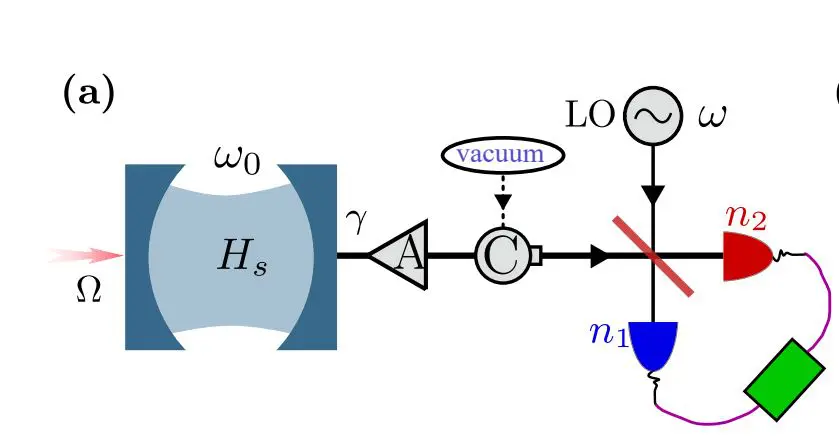
Dispersive readout, a crucial technique for extracting information from quantum systems, receives a significant boost from new theoretical advances presented by Ming Li, JunYan Luo from Zhejiang University of Science and Technology, Gloria Platero from the Instituto de Ciencia de Materiales de Madrid ICMM-CSIC, and Georg Engelhardt. The team develops a comprehensive framework for analysing dispersive readout, employing full-counting statistics to directly calculate key measurement characteristics, even in complex, nonlinear systems. This approach overcomes limitations of conventional methods and reveals a remarkable sensitivity to squeezed light, demonstrating an exponential increase in the Fisher information, a measure of measurement precision. The resulting streamlined and computationally efficient framework promises to accelerate the development of advanced quantum technologies reliant on continuous measurement.
Full-counting statistics and quantum information of dispersive readout with a squeezed environment Researchers investigate dispersive readout, a technique for measuring quantum systems without directly observing them, when used with a squeezed environment. This work focuses on understanding how squeezing, a reduction in quantum noise, affects the precision and reliability of measurements. The team calculates full-counting statistics, which provide a detailed description of the probability of different measurement outcomes, to characterise the readout performance. By analysing these statistics, scientists gain insight into the quantum information obtained during the measurement and how it is influenced by the squeezed environment. The calculations reveal that employing a squeezed environment enhances the signal-to-noise ratio and improves the fidelity of the readout process, ultimately leading to more accurate and efficient quantum measurements.
Full Counting Statistics for Dispersive Readout
Motivated by the importance of dispersive readout in quantum technology, the researchers study a typical dispersive readout setup probed by a squeezed vacuum. To achieve this, they developed a full-counting-statistics framework for dispersive readout and analysed its measurement information, accompanied by a generalized mean-field approach suitable for dealing with non-unitary dynamics. Unlike conventional input-output theory, their full-counting-statistics approach enables the direct calculation of higher-order correlation functions, providing a more complete description of the measurement process and its associated noise characteristics. The method involves modelling the quantum system and the readout resonator as coupled harmonic oscillators, and then tracing out the degrees of freedom of the readout resonator to obtain the effective dynamics of the quantum system. This allows for the calculation of the probability distribution of the measurement outcomes, which is then used to quantify the information gained from the measurement and to assess the performance of the readout scheme.
Full Counting Statistics and Quantum Fisher Information
This work details the mathematical derivations and justifications for the results presented in the main paper, focusing on the use of full counting statistics and the quantum Fisher information to characterise the precision of quantum measurements in a circuit QED system. The authors aim to demonstrate how to optimise measurement strategies to achieve the highest possible precision, using a combination of analytical calculations and approximations, specifically a mean-field approach, to derive key results. The document details the derivation of the master equation governing the dynamics of the system, including the resonator and transmission lines, under measurement, establishing a mathematically rigorous framework for describing the measurement process. The researchers introduce the mean-field approximation, a crucial simplification that allows them to obtain analytical results by replacing the complex interactions between photons and the qubit with an effective, averaged interaction.
This section explains how to calculate the cumulants of the photon number distribution and how these cumulants relate to the quantum Fisher information, connecting the theoretical framework to measurable quantities and quantifying the precision of the measurement. The document contains the step-by-step calculations for deriving the master equation, calculating the cumulants, and calculating the quantum Fisher information, utilising quantum operator algebra, perturbation theory, and numerical calculations. The authors demonstrate how to calculate the ultimate precision limit for estimating a qubit parameter using a specific measurement strategy and explore how to optimise the measurement strategy to achieve the highest possible precision. The use of full counting statistics provides a more complete characterisation of the measurement process than traditional approaches, and the mean-field approximation is a powerful tool for simplifying complex quantum calculations. The theoretical results can be directly compared to experimental measurements, offering a valuable framework for advancing quantum measurement techniques.
Squeezed States Enhance Quantum Measurement Precision
This work presents a new theoretical framework for analysing dispersive readout of quantum systems, employing a full-counting-statistics approach alongside a generalized mean-field theory. Researchers demonstrated that utilizing squeezed vacuum states significantly enhances the precision of measurements, with the cumulative Fisher information exhibiting exponential growth as the degree of squeezing increases. Importantly, this enhancement proves robust even in the presence of weak nonlinearities within the system, approaching the fundamental quantum limit imposed by the quantum-Cramer-Rao bound. The team’s approach overcomes limitations found in conventional input-output theory, offering a computationally efficient method suitable for analysing complex resonator systems.
Their microscopic treatment reveals that while Kerr nonlinearity can alter the resonator state, it ultimately diminishes the achievable precision, a finding that contrasts with previous investigations relying on linearized approximations. This research provides deeper insights into system dynamics through the analysis of higher-order cumulants of the photonic probability distribution and the corresponding Fisher information. The authors acknowledge that the detrimental effects of stronger Kerr nonlinearities represent a limitation of the current model. Future work could explore methods to mitigate these effects or investigate the framework’s applicability to systems exhibiting even more pronounced nonlinear behaviour, potentially uncovering novel features in dispersive readout.
🗞 Full-counting statistics and quantum information of dispersive readout with a squeezed environment
🧠 ArXiv: https://arxiv.org/abs/2512.02531