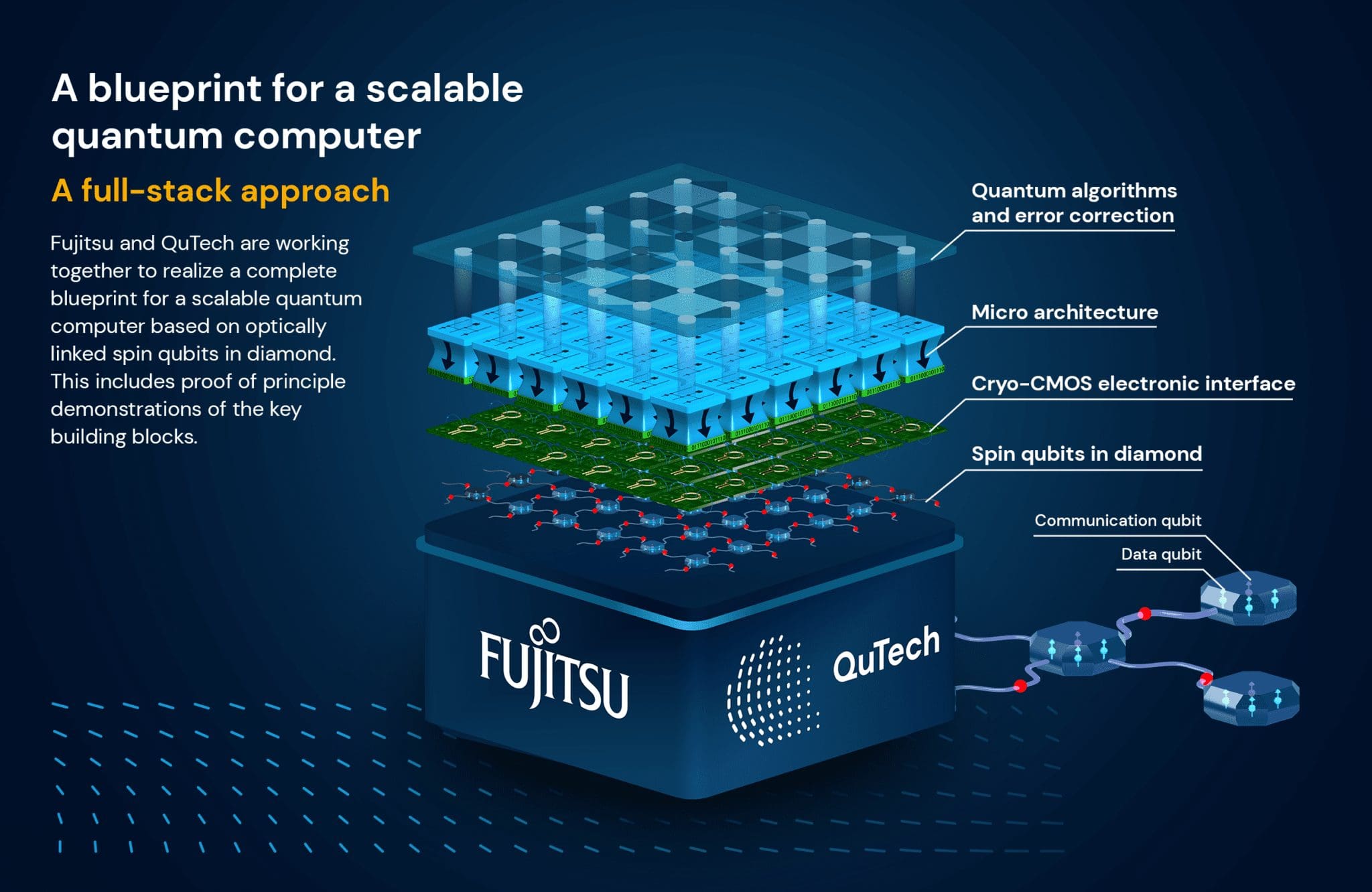
Researchers at QuTech, funded by Fujitsu, have achieved a breakthrough in quantum control with the development of the first cryogenic chip capable of directly managing both electron and nuclear spins in diamond-based quantum bits. This innovation integrates a cryo-CMOS system-on-chip with nitrogen-vacancy (NV) centers in diamond, overcoming a key hurdle to building scalable quantum computers. The integrated system achieved impressive quantum gate fidelities of 99.3% for electron spins and 99.8% for nuclear spins, with coherence times exceeding 50 milliseconds. “For diamond spin qubits, the electronics can easily become the bottleneck. What we’re showing here is a concrete way to bring precise control closer to the qubits at cryogenic temperatures, without making the system more complex than it needs to be,” summarises Fabio Sebastiano, a lead researcher on the project, with the results set to be presented at ISSCC in February 2026.
Cryogenic Cryo-CMOS Controller Enables Diamond Qubit Management
This innovation bypasses the limitations of previous systems reliant on room-temperature electronics and lengthy cabling, significantly improving scalability and reliability. The results of this project will be presented at the IEEE International Solid-State Circuits Conference (ISSCC) in February 2026, marking a pivotal moment in quantum computing development. The newly developed cryo-CMOS controller operates alongside the qubits at extremely low temperatures, generating the precise high-frequency signals necessary for manipulating both electron and nuclear spins with minimal power consumption and spatial footprint. Masoud Babaie affirms, “This work shows that cryogenic CMOS control can be designed to meet the stringent requirements of diamond spin qubits while remaining scalable.” This new controller digitally adapts to each qubit’s unique resonance frequency, removing the need for intricate magnetic field tuning and enabling parallel control of numerous qubits, a vital step for scaling beyond prototype devices.