QuTech and Fujitsu have collaborated to develop a blueprint for a scalable quantum computer. This ambitious project brings together experts from both organizations to tackle the complex challenge of building a large-scale quantum computer. The comprehensive approach encompasses everything from developing physical components to designing error-correction algorithms necessary to operate the computer.
At the heart of this research is the creation of high-quality qubits with extended coherence times and optical connections between qubit modules. The collaboration has already achieved significant scientific success, including demonstrating the fault-tolerant operation of a logical qubit. This project is co-funded by the Netherlands Enterprise Agency and marks an important step towards harnessing the power of quantum computing to solve complex problems significantly faster than classical computers.
Blueprint for Scalable Quantum Computing: A Collaborative Approach
The quest for scalable quantum computing has taken a significant leap forward with the collaboration between QuTech and Fujitsu. This joint effort aims to create a comprehensive blueprint for building a large-scale, fault-tolerant quantum computer. The approach is multifaceted, encompassing the development of physical components, error correction algorithms, and system engineering analysis.
At the heart of this research lies the creation of high-quality qubits with extended coherence times and optical connections between qubit modules. This requires a deep understanding of the underlying physics and materials science. The collaboration has already demonstrated significant scientific success, including the fault-tolerant operation of a logical qubit. This achievement underscores the potential of this approach to overcome the limitations of current quantum computing architectures.
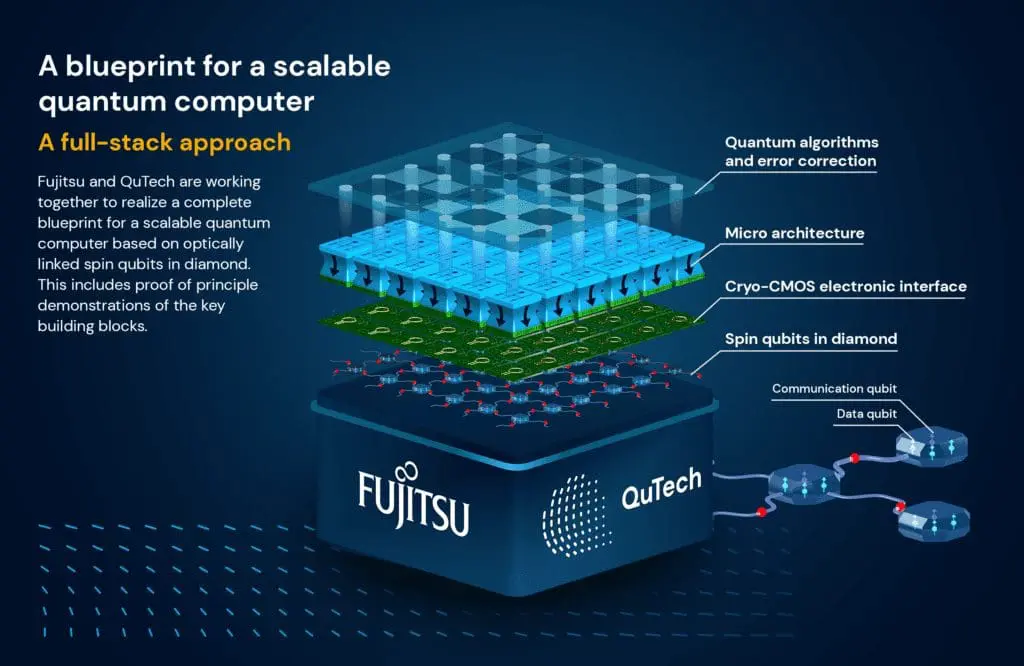
The full-stack approach adopted by QuTech and Fujitsu involves several key components. These include the realization of qubit modules, design of interface electronics and micro architecture, development of wafer-scale 3D integration and integrated optics, benchmarking of proof-principle quantum algorithms and error correction codes, and a system engineering analysis to combine these components into a complete blueprint.
Quantum Algorithms and Error Correction: The Top Layer
The top layer of the quantum computing stack consists of quantum error correction and algorithms implementing the quantum computational logic. This layer is responsible for counteracting the inherent instability of quantum states using error-correction codes. These codes enable the design of algorithms that can effectively leverage the qubits to solve complex problems significantly faster than classical computers.
Error correction is a critical component of large-scale quantum computing, as it allows for the mitigation of errors that inevitably occur during quantum computations. The development of robust error correction codes is essential for ensuring the fidelity of quantum computations. QuTech and Fujitsu’s collaboration has made significant progress in this area, paving the way for the development of practical quantum algorithms.
Micro Architecture: A Functional Abstraction
The microarchitecture provides a functional abstraction of the underlying electronic interface. This layer allows for the translation of quantum algorithms and error-correction codes into fine-grain digital control signals for the electronic interface. The microarchitecture serves as an intermediate layer, bridging the gap between the high-level quantum algorithms and the low-level electronic controls.
The design of the microarchitecture is crucial for ensuring the efficient execution of quantum algorithms. It requires a deep understanding of the underlying electronics and the ability to optimize the control signals for optimal qubit performance. QuTech and Fujitsu’s collaboration has developed a comprehensive microarchitecture that enables the seamless integration of the various components of the quantum computing stack.
Cryo-CMOS Electronic Interface: Enabling Low-Temperature Operation
The cryo-CMOS electronic interface is responsible for generating the magnetic fields to bias the qubits, operating on them, reading out photon detectors, and controlling photonic components. This interface exploits commercial semiconductor technology to fabricate integrated circuits that operate close to the qubits, at a similar cryogenic temperature.
The development of the cryo-CMOS electronic interface is critical for enabling low-temperature operation of the quantum computer. This requires the design of specialized electronics that can function reliably at temperatures near absolute zero. QuTech and Fujitsu’s collaboration has made significant progress in this area, demonstrating the feasibility of using commercial semiconductor technology to build cryogenic electronic interfaces.
Spin Qubits in Diamond: The Qubit Layer
The qubit layer consists of modules containing robust electron and nuclear spin qubits hosted in diamond. These 5-10 qubit modules are coupled to each other and to optical control fields via on-chip photonic integrated circuits, enabling modular scaling of the quantum processor.
Using diamond as a host material for spin qubits offers several advantages, including long coherence times and robustness against environmental noise. The development of high-quality spin qubits in diamond is critical for building a scalable quantum computer. QuTech and Fujitsu’s collaboration has made significant progress in this area, demonstrating the feasibility of using diamond-based spin qubits as the foundation for a large-scale quantum computer.
This collaborative project between QuTech and Fujitsu, co-funded by the Netherlands Enterprise Agency, represents a significant milestone in the quest for scalable quantum computing. The comprehensive blueprint developed through this collaboration has the potential to overcome the limitations of current quantum computing architectures, paving the way for the development of practical quantum computers that can solve complex problems significantly faster than classical computers.
External Link: Click Here For More