

Researchers from Fudan University, East China Normal University, and other institutions have made a fascinating discovery about the behavior of electrons in a material called CaAs3. Led by Professors Cheng Zhang, Faxian Xiu, and Xiang Yuan, the team found that CaAs3 exhibits strong electron coherence when approaching the Mott-Ioffe-Regel limit, a phenomenon first proposed by Nobel laureate Sir Mott in 1972.
This challenges conventional theory, which suggests that electrons should lose their coherence and behave erratically near this limit. Using advanced technologies such as quantum transport and magneto-infrared spectroscopy, the researchers could observe quantum oscillations and Landau quantization in CaAs3, even at extremely low temperatures and high magnetic fields.
The study, published in the National Science Review, was conducted in collaboration with several national high magnetic field facilities, including the Steady State High Magnetic Field Laboratory of Chinese Academy of Sciences and the National High Magnetic Field Laboratory of the United States.
Introduction to Quantum Oscillations Near the Mott-Ioffe-Regel Limit
The Mott-Ioffe-Regel (MIR) limit is a fundamental concept in physics that describes the transition from metallic to insulating behavior in materials. Proposed by Sir Mott in 1972, this limit occurs when the mean free path of a quasiparticle approaches the Fermi wavelength, leading to a loss of coherence and hopping transport under the Anderson localization picture. However, recent studies have challenged this conventional notion, revealing unconventional metallicity beyond the MIR limit. One such example is the observation of linear-in-temperature resistivity in cuprates. The study of unconventional metallic phases, including strange metals, has primarily focused on temperature-dependent resistivity, but the electronic coherent behavior near the MIR limit remains poorly understood due to the short mean free path.
The investigation of quantum oscillations near the MIR limit is crucial for understanding the underlying physics of these unconventional metallic phases. Quantum oscillations, such as Shubnikov-de Haas (SdH) oscillations, provide valuable information about the electronic structure and coherence of a material. Recently, a research team from Fudan University, East China Normal University, and other institutions collaborated to study the quantum transport and magneto-infrared spectroscopy of CaAs3, a material that exhibits anomalous strong electron coherence when approaching the MIR limit. Their findings, published in the National Science Review, reveal the observation of quantum oscillations near the Mott-Ioffe-Regel limit in CaAs3.
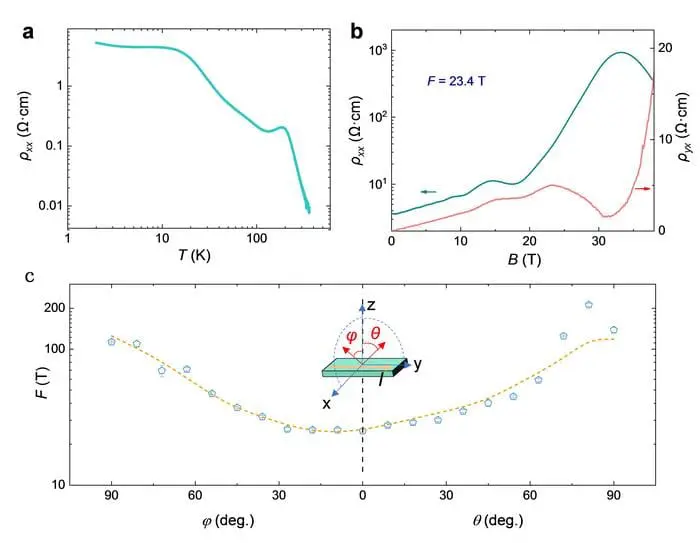
The research team employed multiple national high magnetic field facilities to realize quantum transport and magneto-infrared spectroscopy under extremely low temperature and high magnetic field conditions. By analyzing the resistivity, Hall coefficient, and Seebeck coefficient of CaAs3, they observed an insulator-like temperature dependence and anomalous sign reversal behavior at low temperatures. Furthermore, the SdH oscillation from the bulk was detected in magnetoresistance, indicating highly coherent band transport rather than hopping transport predicted by traditional theory.
The observation of quantum oscillations near the Mott-Ioffe-Regel limit in CaAs3 challenges the conventional theory of electron hopping transport behavior and opens up a new perspective on quasiparticle coherence for the study of metallicity near the MIR limit. The research team’s findings suggest that the electronic coherence behaviors, such as quantum oscillations, are mainly contributed by mobile electrons above the mobility edges, while the electrical resistance and Hall coefficient of the insulating state are dominated by localized electrons below the mobility edges.
Quantum Transport Experiments and Results
The research team grew high-quality CaAs3 single crystals and carried out quantum transport experiments under a strong steady-state magnetic field of up to 45.22T. The resistivity of CaAs3 presents an insulator-like temperature dependence and is close to the MIR limit at around 2K. Despite such a highly insulating state, the Shubnikov-de Haas oscillation from the bulk was observed in magnetoresistance, indicating that the carriers in CaAs3 form highly coherent band transport rather than hopping transport predicted by traditional theory.
The Hall and Seebeck coefficients of CaAs3 also show anomalous sign reversal behavior at low temperatures. This behavior is unexpected, as the conventional theory predicts a monotonic temperature dependence for these coefficients. The research team’s findings suggest that the interplay between the mobility edge and the van Hove singularity plays a crucial role in determining the electronic coherence behaviors of CaAs3.
The quantum transport experiments were complemented by magneto-infrared spectroscopy studies, which further confirmed the Landau quantization by the interband-Landau-level transitions. By comparing the effective mass and Fermi velocity obtained from the transport and magneto-infrared spectroscopy, a strong band renormalization is found near the Fermi level. This renormalization is indicative of the importance of electron-electron interactions in determining the electronic structure of CaAs3.
The research team’s results demonstrate that the observation of quantum oscillations near the Mott-Ioffe-Regel limit in CaAs3 is a consequence of the interplay between the mobility edge and the van Hove singularity. The electronic coherence behaviors, such as quantum oscillations, are mainly contributed by mobile electrons above the mobility edges, while the electrical resistance and Hall coefficient of the insulating state are dominated by localized electrons below the mobility edges.
Magneto-Infrared Spectroscopy and Landau Quantization
The research team carried out a magneto-infrared spectroscopy study on CaAs3 to further investigate the electronic structure and coherence of this material. The magneto-infrared spectroscopy experiments were performed under high magnetic fields, allowing the researchers to probe the interband-Landau-level transitions and confirm the Landau quantization.
The results of the magneto-infrared spectroscopy study reveal a strong band renormalization near the Fermi level, indicative of the importance of electron-electron interactions in determining the electronic structure of CaAs3. The effective mass and Fermi velocity obtained from the transport and magneto-infrared spectroscopy experiments are compared, providing valuable insights into the electronic coherence behaviors of CaAs3.
The observation of Landau quantization in CaAs3 is a direct consequence of the highly coherent band transport in this material. The interband-Landau-level transitions provide a sensitive probe of the electronic structure and coherence of CaAs3, allowing the researchers to investigate the underlying physics of the unconventional metallic phases.
The magneto-infrared spectroscopy study complements the quantum transport experiments, providing a comprehensive understanding of the electronic coherence behaviors of CaAs3. The research team’s findings demonstrate that the interplay between the mobility edge and the van Hove singularity plays a crucial role in determining the electronic structure and coherence of CaAs3.
Implications and Future Directions
The observation of quantum oscillations near the Mott-Ioffe-Regel limit in CaAs3 challenges the conventional theory of electron hopping transport behavior and opens up a new perspective on quasiparticle coherence for the study of metallicity near the MIR limit. The research team’s findings suggest that the electronic coherence behaviors, such as quantum oscillations, are mainly contributed by mobile electrons above the mobility edges, while the electrical resistance and Hall coefficient of the insulating state are dominated by localized electrons below the mobility edges.
The implications of this study are far-reaching, with potential applications in the development of new materials and devices that exploit the unconventional metallic phases. Further research is needed to fully understand the underlying physics of these phases and to explore their potential applications.
Future studies should focus on investigating the electronic structure and coherence of other materials that exhibit unconventional metallic phases. The use of advanced experimental techniques, such as magneto-infrared spectroscopy and quantum transport experiments, will be essential in probing the electronic coherence behaviors of these materials.
Theoretical models, such as the two-fluid-like model used by the research team, should be developed to describe the interplay between the mobility edge and the van Hove singularity. These models will provide a framework for understanding the electronic coherence behaviors of unconventional metallic phases and will guide the development of new materials and devices that exploit these phases.
External Link: Click Here For More


