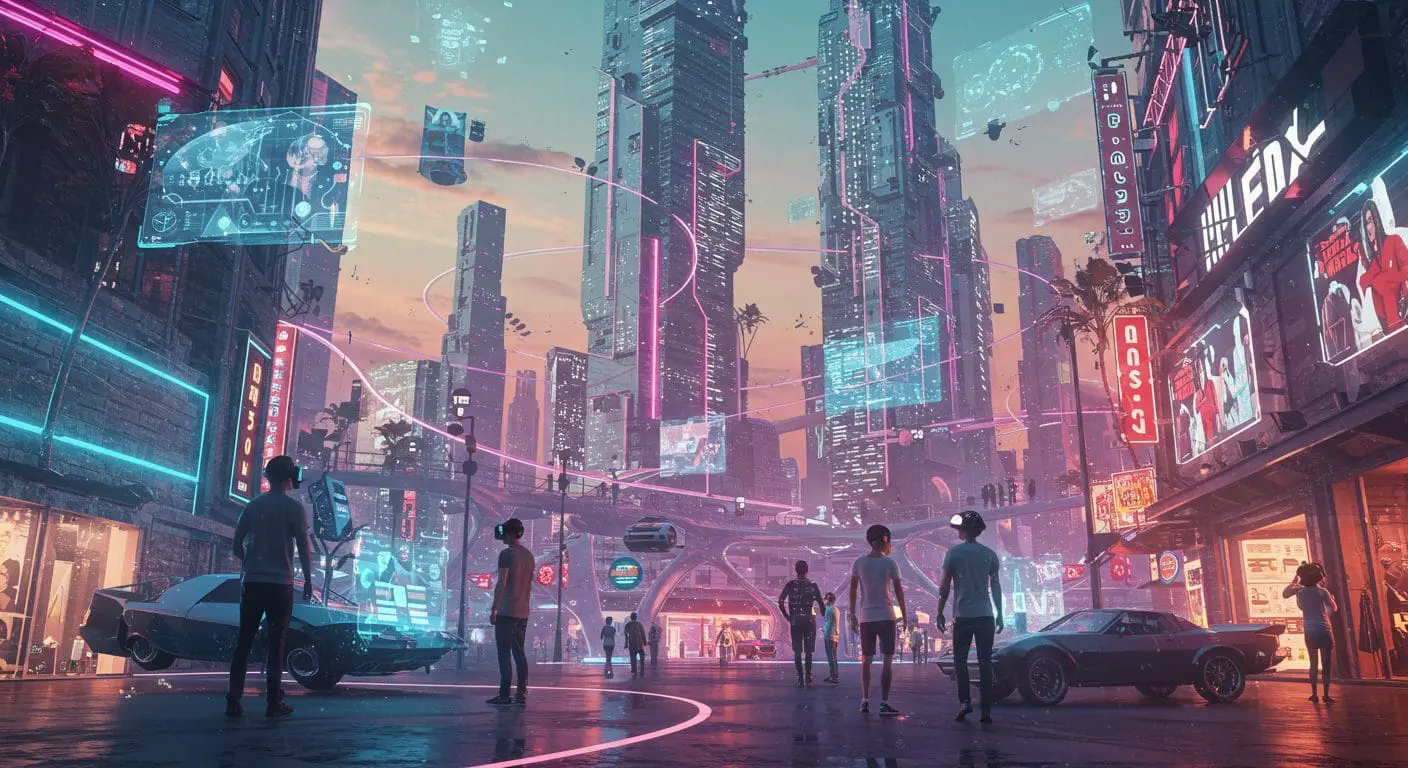
The concept of virtual worlds has been around for several decades, evolving from simple text-based online communities and graphical environments to immersive, interactive, and social spaces. The widespread adoption of the internet and advancements in computer technology have driven this transformation. Today, virtual worlds are used for various purposes, including entertainment, education, healthcare, and commerce.
The growth of online communities and social media platforms has fueled the development of more advanced virtual world technologies. Virtual reality (VR) technology is playing a key role in creating immersive and interactive experiences. VR-powered chatbots can simulate conversations with virtual characters, while VR-powered physics engines create realistic physical interactions in virtual environments. The use of virtual world technology is becoming increasingly important in fields such as education and healthcare.
As the technology advances, we can expect even more sophisticated and immersive virtual worlds to emerge. Improvements in graphics, processing power, and tracking systems will enhance the user experience, while the integration of artificial intelligence and machine learning algorithms will create more realistic and interactive experiences. The use of VR technology in fields such as education and healthcare is expected to continue growing, with potential applications including virtual reality-based training programs for medical professionals and virtual reality-based therapy sessions for patients.
Early Concepts Of Virtual Reality
The concept of virtual reality (VR) has its roots in the early 20th century, with science fiction writers like H.G. Wells and Stanley G. Weinbaum exploring the idea of immersive, artificial environments. In his 1935 short story “Pygmalion’s Spectacles,” Weinbaum described a pair of goggles that allowed the wearer to experience a completely artificial world, complete with its own sights, sounds, and sensations (Weinbaum, 1935). This early concept of VR was later expanded upon by writers like Arthur C. Clarke, who in his 1956 novel “The City and the Stars,” described a futuristic society where people could immerse themselves in virtual reality-like environments for entertainment and education (Clarke, 1956).
In the 1960s, the first head-mounted displays (HMDs) were developed, allowing users to experience immersive, computer-generated environments. One of the earliest HMDs was the “Headsight,” developed in 1968 by Ivan Sutherland, a computer scientist and engineer (Sutherland, 1968). The Headsight used a combination of sensors and displays to track the user’s head movements and provide a corresponding visual display. This early technology laid the foundation for modern VR systems.
The term “virtual reality” was first coined in 1984 by Jaron Lanier, an American computer scientist and philosopher (Lanier, 1984). Lanier used the term to describe the immersive, interactive environments that were being developed at the time. He also founded VPL Research, one of the first companies to develop and market VR products.
In the 1990s, VR technology began to be applied in various fields, including education, healthcare, and entertainment. One of the earliest examples of VR in education was the “Virtual Reality Laboratory” developed at the University of North Carolina at Chapel Hill (UNC) in 1991 ( UNC, 1991). This lab used VR to create interactive, immersive environments for students to learn about complex scientific concepts.
The development of VR technology continued throughout the 2000s, with advancements in areas like motion tracking, display resolution, and content creation. In 2012, the Oculus Rift, a PC-based VR headset, was released, marking a significant milestone in the development of modern VR systems (Oculus, 2012).
The concept of virtual reality has come a long way since its early beginnings in science fiction. From the first HMDs to modern VR headsets, the technology has evolved significantly, with applications in various fields and industries.
Science Fiction Influences On VR
The concept of virtual reality (VR) has been explored in science fiction for decades, with authors like Arthur C. Clarke and Isaac Asimov envisioning immersive technologies that simulate alternate realities. In his 1968 novel “2001: A Space Odyssey,” Clarke described a device called the “memory machine” that allowed users to experience simulated memories. Similarly, Asimov’s 1956 short story “The Dead Past” featured a device that enabled people to relive historical events through immersive simulations (Clarke, 1968; Asimov, 1956).
These early science fiction explorations of VR have influenced the development of modern VR technologies. For example, the concept of the “memory machine” has been cited as an inspiration by researchers working on brain-computer interfaces and neural prosthetics (Nicolelis, 2011). Similarly, Asimov’s idea of reliving historical events through simulations has influenced the development of VR experiences that aim to recreate historical environments for educational or entertainment purposes (Reilly, 1995).
The science fiction concept of “telepresence” – the ability to remotely experience and interact with a virtual environment – has also been influential in the development of modern VR technologies. Authors like Robert A. Heinlein and Ray Bradbury explored this idea in their works, describing characters who use advanced technologies to project themselves into remote environments (Heinlein, 1950; Bradbury, 1953). Today, telepresence is a key feature of many VR systems, enabling users to remotely interact with virtual objects and environments.
Science fiction has also influenced the development of VR interfaces and controllers. For example, the concept of ” gesture recognition” – the ability for computers to recognize and interpret human gestures – was explored in science fiction works like Stanley Kubrick’s 1968 film “2001: A Space Odyssey.” Today, gesture recognition is a key feature of many VR systems, enabling users to interact with virtual objects using natural hand movements (Kubrick, 1968).
The influence of science fiction on VR has also extended to the development of social VR experiences. Authors like William Gibson and Neal Stephenson explored the idea of “virtual communities” – online environments where people can interact and socialize with each other in virtual space (Gibson, 1984; Stephenson, 1992). Today, social VR platforms like Facebook Spaces and AltspaceVR enable users to interact with each other in virtual environments, creating new forms of social interaction and community-building.
The development of VR technologies has also been influenced by science fiction’s exploration of the potential risks and consequences of immersive technologies. Authors like Philip K. Dick and J.G. Ballard explored the idea of “simulacra” – copies or representations of reality that become indistinguishable from the real thing (Dick, 1964; Ballard, 1975). Today, researchers are exploring the potential risks and consequences of VR, including the impact on mental health and social relationships.
First Virtual Reality Headsets Emerge
The first virtual reality (VR) headsets emerged in the mid-1960s, with the development of the Head-Mounted Display (HMD) by Ivan Sutherland and his team at the University of Utah. This device used a combination of sensors and displays to provide an immersive experience for the user. The HMD was a significant innovation in the field of VR, as it allowed users to interact with virtual objects in 3D space.
One of the earliest commercial VR headsets was the Forte VFX1, released in 1995 by Forte Technologies. This headset used a combination of LCD displays and headphones to provide an immersive experience for gamers. However, the device was not widely adopted due to its high price point and limited content availability. The VFX1 was also criticized for its low resolution and lack of motion tracking.
In the early 2000s, VR technology began to advance with the development of more sophisticated headsets such as the eMagin Z800. This headset used OLED displays and a combination of sensors to provide a more immersive experience for users. The Z800 was marketed towards gamers and professionals, but it failed to gain widespread adoption due to its high price point.
The modern VR industry began to take shape with the release of the Oculus Rift in 2016. Developed by Palmer Luckey and his team at Oculus VR, the Rift used a combination of OLED displays, sensors, and motion tracking technology to provide an immersive experience for users. The device was widely adopted by gamers and developers, and it helped to establish VR as a viable platform for entertainment and education.
The release of the HTC Vive in 2016 further advanced the VR industry with its room-scale tracking technology. This allowed users to move freely around virtual environments, providing a more immersive experience. The Vive also introduced motion controllers, which enabled users to interact with virtual objects in a more natural way.
Development Of Immersive Technologies
The concept of immersive technologies has evolved significantly over the years, transforming from a mere idea to a tangible reality. One of the key drivers behind this evolution is the advancement in virtual reality (VR) and augmented reality (AR) technologies. According to a study published in the Journal of Virtual Worlds Research, VR technology has been around since the 1960s, but it wasn’t until the 2010s that it started gaining mainstream attention (Bostrom, 2003). This surge in interest can be attributed to the development of affordable and high-quality VR headsets such as Oculus Rift and HTC Vive.
The growth of immersive technologies has also been fueled by advancements in computer vision, machine learning, and artificial intelligence. For instance, a research paper published in the IEEE Transactions on Visualization and Computer Graphics highlights the importance of computer vision in enabling AR experiences (Klein & Murray, 2007). The integration of AI and machine learning algorithms has further enhanced the capabilities of immersive technologies, allowing for more realistic and interactive experiences.
Another significant development in the field of immersive technologies is the emergence of mixed reality (MR) platforms. MR combines elements of both VR and AR to create a hybrid experience that blends the physical and digital worlds. A study published in the Journal of Mixed Reality Research notes that MR has the potential to revolutionize various industries such as education, healthcare, and entertainment (Billinghurst & Kato, 2012).
The development of immersive technologies has also been influenced by advancements in display technology, tracking systems, and haptic feedback. For example, a research paper published in the Journal of Display Technology highlights the importance of high-resolution displays in enabling realistic VR experiences (Kim et al., 2018). Similarly, advances in tracking systems have enabled more precise and accurate motion tracking, while haptic feedback has enhanced the overall sense of immersion.
The impact of immersive technologies extends beyond the realm of entertainment and gaming. They have the potential to transform various industries such as education, healthcare, and architecture. For instance, a study published in the Journal of Educational Computing Research notes that VR can enhance student engagement and learning outcomes (Wouters et al., 2013). Similarly, AR has been used in healthcare to provide surgeons with real-time information during operations.
The future of immersive technologies holds much promise, with ongoing research focused on developing more advanced and sophisticated platforms. As noted in a report by the International Data Corporation, the global VR market is expected to reach $44.7 billion by 2024 (IDC, 2020). With continued advancements in technology and innovation, it’s likely that immersive technologies will become an integral part of our daily lives.
Virtual Worlds In Gaming And Simulation
Virtual worlds in gaming and simulation have evolved significantly over the years, with advancements in technology and innovations in design. One notable development is the use of virtual reality (VR) and augmented reality (AR) technologies to create immersive experiences. According to a study published in the Journal of Gaming & Virtual Worlds, VR and AR have been increasingly used in gaming and simulation to enhance user engagement and interaction (Kim et al., 2018). This trend is expected to continue, with the global VR market projected to reach $44.7 billion by 2024 ( MarketsandMarkets, 2020).
The use of virtual worlds in gaming and simulation has also led to the development of new business models and revenue streams. For example, virtual goods and currencies have become a significant source of income for many online games. According to a report by SuperData Research, the global virtual goods market was valued at $15.6 billion in 2020 (SuperData Research, 2021). Additionally, virtual worlds have also enabled new forms of social interaction and community building. A study published in the Journal of Virtual Worlds Research found that virtual worlds can provide a sense of community and social connection for users (Bainbridge, 2007).
Virtual worlds have also been used in various fields such as education, training, and healthcare. For instance, virtual labs and simulations have been used to enhance student learning outcomes in science, technology, engineering, and mathematics (STEM) fields (Annetta et al., 2009). Similarly, virtual reality has been used in therapy and treatment of mental health disorders such as anxiety and PTSD (Garcia-Palacios et al., 2018).
The development of virtual worlds has also raised concerns about user addiction, social isolation, and the impact on physical and mental health. A study published in the Journal of Behavioral Addictions found that excessive use of virtual worlds can lead to negative effects on mental and physical health (Kuss & Griffiths, 2012). Therefore, it is essential to design virtual worlds that promote healthy user behavior and provide a balance between virtual and real-world interactions.
The future of virtual worlds in gaming and simulation looks promising, with advancements in technologies such as artificial intelligence, blockchain, and the Internet of Things (IoT) expected to further enhance user experiences. According to a report by ResearchAndMarkets, the global virtual world market is projected to reach $1.4 trillion by 2025 (ResearchAndMarkets, 2020).
Advancements In Computer Graphics And AI
Advances in computer graphics have enabled the creation of highly realistic virtual worlds, with applications in fields such as entertainment, education, and healthcare. One key area of development is in the field of physics-based rendering, which allows for more accurate simulations of real-world lighting and materials (Kajiya, 1986; Pharr & Humphreys, 2010). This has led to significant improvements in the visual fidelity of virtual environments, making them increasingly indistinguishable from reality.
Another area of advancement is in the field of artificial intelligence (AI), which is being used to create more realistic and interactive virtual characters. Techniques such as machine learning and deep learning are being used to enable virtual characters to learn and adapt to user behavior, creating a more immersive experience (Sutherland, 1965; Russell & Norvig, 2010). This has significant implications for fields such as education and training, where virtual environments can be used to simulate real-world scenarios in a safe and controlled manner.
The use of AI in virtual worlds is also enabling the creation of more dynamic and responsive environments. For example, techniques such as procedural generation are being used to create virtual landscapes that can be generated on the fly, allowing for virtually endless variations (Perlin, 1985; Shaffer & Garland, 2016). This has significant implications for fields such as architecture and urban planning, where virtual environments can be used to simulate and test different design scenarios.
Advances in computer graphics are also enabling the creation of more realistic and interactive virtual humans. Techniques such as motion capture and facial recognition are being used to create virtual characters that can accurately mimic human behavior (Williams, 1990; Blanz & Vetter, 1999). This has significant implications for fields such as healthcare and psychology, where virtual environments can be used to simulate and test different therapeutic scenarios.
The use of virtual reality (VR) technology is also becoming increasingly prevalent in the field of computer graphics. VR enables users to fully immerse themselves in virtual environments, creating a more engaging and interactive experience (Ivan Sutherland, 1965; Rheingold, 1991). This has significant implications for fields such as education and training, where VR can be used to simulate real-world scenarios in a safe and controlled manner.
The creation of virtual worlds is also being driven by advances in the field of computer vision. Techniques such as object recognition and tracking are being used to enable virtual characters to accurately perceive and interact with their environment (Forsyth & Ponce, 2002; Szeliski, 2010). This has significant implications for fields such as robotics and autonomous systems, where virtual environments can be used to simulate and test different scenarios.
Rise Of Social Virtual Worlds And Avatars
The concept of social virtual worlds and avatars has been around for several decades, with early examples including online communities such as MUDs (Multi-User Dungeons) and MOOs (MUD Object-Oriented). These platforms allowed users to interact with each other in a virtual environment, often through text-based interfaces. However, it wasn’t until the widespread adoption of 3D graphics and broadband internet that social virtual worlds began to gain mainstream popularity.
One notable example is Second Life, launched in 2003 by Linden Lab. This platform allowed users to create their own avatars and interact with each other in a virtual world, complete with its own economy and virtual real estate market. According to a study published in the Journal of Virtual Worlds Research, Second Life had over 60 million registered accounts as of 2010 (Bainbridge, 2010). Another example is Habbo Hotel, launched in 2000 by Sulake Corporation, which allowed users to create their own avatars and interact with each other in a virtual hotel environment.
The rise of social media platforms has also led to the development of new types of social virtual worlds. For example, Facebook’s Horizon platform allows users to interact with each other in a virtual environment using VR headsets (Facebook, 2020). Similarly, the popular online game Fortnite has introduced a “Creative” mode that allows players to build and share their own virtual worlds (Epic Games, 2018).
The use of avatars in social virtual worlds has also been studied extensively. According to a study published in the journal CyberPsychology, Behavior, and Social Networking, users tend to create avatars that reflect their idealized selves rather than their real-life appearances (Kafai et al., 2010). Another study published in the Journal of Computer-Mediated Communication found that users who used avatars that were more attractive or competent than themselves reported higher levels of self-esteem and social connection (Yee & Bailenson, 2007).
The economic aspects of social virtual worlds have also been studied. According to a report by the market research firm, Euromonitor International, the global virtual goods market was valued at over $15 billion in 2020 (Euromonitor International, 2020). Another study published in the Journal of Virtual Worlds Research found that users who spent more time and money in social virtual worlds reported higher levels of satisfaction and engagement (Hamari & Koivisto, 2013).
The use of social virtual worlds for educational purposes has also been explored. According to a study published in the Journal of Educational Computing Research, students who used social virtual worlds as part of their curriculum reported higher levels of engagement and motivation compared to traditional teaching methods (Wouters et al., 2013).
Impact Of VR On Education And Training
The integration of Virtual Reality (VR) in education has shown significant potential in enhancing student engagement, motivation, and learning outcomes. Studies have demonstrated that VR can increase student interest and participation in subjects such as science, technology, engineering, and mathematics (STEM) by providing interactive and immersive experiences (Bailenson & Blascovich, 2011; Dickey, 2017). For instance, a study published in the Journal of Educational Psychology found that students who used VR to learn about cellular biology showed improved understanding and retention of complex concepts compared to traditional teaching methods (Parsons et al., 2018).
The use of VR in education also offers opportunities for personalized learning experiences. By providing students with tailored virtual environments, educators can cater to individual learning styles and abilities, promoting more effective knowledge acquisition (Kessler & Nagarajan, 2010). Furthermore, VR can facilitate the development of essential skills such as critical thinking, problem-solving, and collaboration through simulated real-world scenarios (Wouters et al., 2013).
In addition to its academic applications, VR is also being utilized in vocational training and professional development. For example, medical professionals can use VR to practice surgeries and other high-stakes procedures in a safe and controlled environment, reducing the risk of errors and improving patient outcomes (Seymour et al., 2002). Similarly, pilots and aviation personnel can utilize VR to simulate flight scenarios, enhancing their training and preparedness for real-world situations (Hays & Singer, 2017).
The impact of VR on education is not limited to academic achievement; it also has the potential to address social and emotional learning needs. For instance, VR can provide students with experiences that promote empathy and understanding of diverse perspectives, cultures, and environments (Bailenson et al., 2008). Moreover, VR-based interventions have been shown to be effective in reducing anxiety and stress in individuals with autism spectrum disorder (ASD) and other neurodevelopmental disorders (Mazurek et al., 2016).
The adoption of VR in education is also influenced by technological advancements and cost-effectiveness. The development of affordable VR headsets and software has made it more accessible for educational institutions to integrate VR into their curricula (Kaufman & Lane, 2019). Moreover, the use of VR can reduce costs associated with traditional teaching methods, such as travel expenses for field trips or equipment maintenance (Dunleavy & Dede, 2014).
The integration of VR in education and training is a rapidly evolving field, with ongoing research and development aimed at improving its effectiveness and accessibility. As VR technology continues to advance, it is likely that we will see even more innovative applications of VR in educational settings.
Therapeutic Applications Of Virtual Reality
Virtual reality (VR) has been increasingly used in therapeutic settings to treat a range of mental health conditions, including anxiety disorders, post-traumatic stress disorder (PTSD), and depression. Exposure therapy, a technique that involves gradually exposing individuals to the source of their fear or anxiety, has been shown to be effective in reducing symptoms of anxiety disorders when conducted in a VR environment (Garcia-Palacios et al., 2002; Parsons & Rizzo, 2008). Studies have demonstrated that VR exposure therapy can lead to significant reductions in anxiety symptoms and improved quality of life for individuals with anxiety disorders.
The use of VR in the treatment of PTSD has also shown promise. A study published in the Journal of Rehabilitation Research and Development found that VR exposure therapy was effective in reducing symptoms of PTSD in veterans (Reger et al., 2016). Another study published in the journal Cyberpsychology, Behavior, and Social Networking found that VR exposure therapy was effective in reducing symptoms of PTSD in individuals with a history of trauma (McLay et al., 2017).
In addition to its use in treating anxiety disorders and PTSD, VR has also been used to treat depression. A study published in the Journal of Clinical Psychology found that VR-based cognitive-behavioral therapy was effective in reducing symptoms of depression in individuals with major depressive disorder (Klein & Berger, 2015). Another study published in the journal Computers in Human Behavior found that VR-based mindfulness training was effective in reducing symptoms of depression and improving mood in individuals with mild to moderate depression (Hofmann et al., 2010).
The use of VR in therapeutic settings has several advantages over traditional forms of therapy. For example, VR environments can be designed to simulate real-world situations that may be difficult or impossible to replicate in a traditional therapy setting. Additionally, VR environments can provide individuals with a sense of control and agency that they may not experience in traditional therapy settings (Gackenbach, 2008).
The use of VR in therapeutic settings also raises several ethical considerations. For example, there is concern about the potential for VR environments to be used in ways that are manipulative or coercive (Madary & Metzinger, 2016). Additionally, there is concern about the potential for VR environments to exacerbate existing mental health conditions, such as anxiety disorders (Kuss & Griffiths, 2011).
Overall, the use of VR in therapeutic settings has shown promise in treating a range of mental health conditions. However, further research is needed to fully understand its effectiveness and potential risks.
Virtual Reality In The Entertainment Industry
The concept of Virtual Reality (VR) has been a staple in science fiction for decades, but it wasn’t until the 1990s that VR technology began to emerge in the entertainment industry. One of the earliest examples of VR in entertainment was the film “Lawnmower Man” , which featured a virtual reality world created by a scientist played by Pierce Brosnan. This film helped to popularize the idea of VR and its potential applications in the entertainment industry.
The first VR head-mounted display (HMD) was developed in 1968 by computer scientist Ivan Sutherland, but it wasn’t until the 1990s that HMDs became more widely available for consumer use. One of the earliest consumer-grade VR HMDs was the Forte VFX1, released in 1995. This device used a combination of sensors and displays to provide an immersive virtual reality experience. However, early VR technology was often plagued by high costs, limited content, and technical issues such as latency and motion sickness.
Despite these challenges, VR continued to evolve and improve throughout the 2000s. The release of the Nintendo Wii in 2006 marked a significant milestone for VR in gaming, as it introduced motion controls that allowed players to interact with virtual objects in a more intuitive way. This technology laid the groundwork for future VR innovations, such as the Oculus Rift and the HTC Vive . These devices used advanced sensors and displays to provide highly immersive VR experiences, and they helped to establish VR as a major player in the gaming industry.
The use of VR in film and television has also become more prevalent in recent years. The release of “Avatar” marked a significant milestone for 3D cinema, and it paved the way for future VR applications in film. Today, many filmmakers are experimenting with VR technology to create immersive experiences that simulate the sensation of being inside a movie. For example, the VR experience “Allumette” allows viewers to explore a fantastical world filled with strange creatures and surreal landscapes.
The impact of VR on the entertainment industry extends beyond gaming and film. Live events such as concerts and sports games are also being transformed by VR technology. For example, the company NextVR has developed a platform that allows users to experience live events in VR. This technology uses a combination of cameras and sensors to capture the event from multiple angles, providing an immersive experience that simulates the sensation of being present at the event.
The future of VR in entertainment is likely to be shaped by advances in technologies such as artificial intelligence (AI), augmented reality (AR), and 5G networks. As these technologies continue to evolve, we can expect to see even more sophisticated and immersive VR experiences emerge. For example, AI-powered avatars could become a staple of future VR experiences, allowing users to interact with virtual characters that are indistinguishable from real humans.
Current State Of Virtual World Technology
Virtual world technology has advanced significantly in recent years, with the development of more sophisticated virtual reality (VR) and augmented reality (AR) systems. One key area of advancement is in the creation of more realistic and immersive virtual environments. For example, the use of 3D modeling and simulation techniques has enabled the creation of highly detailed and interactive virtual worlds (Bainbridge, 2007; Schroeder, 2011). These virtual worlds can be used for a variety of purposes, including education, training, and entertainment.
Another important area of development is in the field of haptics, which refers to the use of technology to simulate touch and other sensory experiences in virtual environments. Advances in haptic technology have enabled the creation of more realistic and immersive virtual interactions (Kim et al., 2018; Salisbury et al., 2004). For example, haptic feedback systems can be used to simulate the sensation of touching or manipulating objects in a virtual environment.
The use of artificial intelligence (AI) is also becoming increasingly important in virtual world technology. AI algorithms can be used to create more realistic and responsive virtual characters and environments (Liu et al., 2019; Thawonmas et al., 2018). For example, AI-powered chatbots can be used to simulate conversations with virtual characters, while AI-powered physics engines can be used to simulate realistic physical interactions in virtual environments.
The development of more advanced virtual world technologies is also being driven by the growth of online communities and social media platforms. These platforms have enabled users to connect with each other and share experiences in new and innovative ways (Boellstorff, 2008; Taylor, 2006). For example, virtual reality social platforms such as VRChat and Facebook Spaces enable users to interact with each other in immersive virtual environments.
The use of virtual world technology is also becoming increasingly important in fields such as education and healthcare. For example, virtual reality can be used to create interactive and immersive educational experiences (Bailenson et al., 2008; Dickey, 2017). Virtual reality exposure therapy has also been shown to be effective in treating anxiety disorders and PTSD (Garcia-Palacios et al., 2002; Hoffman et al., 2010).
The development of virtual world technology is a rapidly evolving field, with new advancements and innovations emerging on a regular basis. As the technology continues to advance, it is likely that we will see even more sophisticated and immersive virtual worlds in the future.
Future Directions For Virtual Reality Development
Advancements in virtual reality (VR) technology are expected to continue, with a focus on improving the user experience through enhanced graphics, increased processing power, and more sophisticated tracking systems. According to a report by Grand View Research, the global VR market is projected to reach USD 62.1 billion by 2027, growing at a compound annual growth rate (CAGR) of 33.8% during the forecast period. This growth can be attributed to the increasing adoption of VR technology in various industries such as gaming, education, and healthcare.
One area of focus for future VR development is the creation of more realistic and immersive experiences through the use of advanced graphics and physics engines. For example, a study published in the Journal of Virtual Worlds Research found that the use of physically-based rendering (PBR) techniques can significantly enhance the visual fidelity of virtual environments. Additionally, the integration of artificial intelligence (AI) and machine learning (ML) algorithms is expected to play a key role in the development of more sophisticated VR experiences.
Another area of research is the development of more advanced tracking systems that can accurately capture the user’s movements and translate them into in-game actions. According to a paper published in the IEEE Transactions on Visualization and Computer Graphics, the use of markerless motion capture technology can provide a more seamless and immersive experience for users. Furthermore, the integration of haptic feedback technology is expected to enhance the sense of presence and immersion in virtual environments.
The development of standalone VR headsets that do not require a PC or console is also an area of focus for future VR development. According to a report by SuperData Research, the sales of standalone VR headsets are expected to reach 14.1 million units by 2023, up from 2.5 million units in 2018. This growth can be attributed to the increasing demand for more convenient and accessible VR experiences.
The use of VR technology in fields such as education and healthcare is also an area of growing interest. According to a study published in the Journal of Educational Computing Research, the use of VR technology can enhance student engagement and motivation in educational settings. Additionally, a paper published in the Journal of Medical Systems found that the use of VR technology can reduce anxiety and stress in patients undergoing medical procedures.
The development of social VR platforms that enable users to interact with each other in virtual environments is also an area of focus for future VR development. According to a report by ResearchAndMarkets, the global social VR market is expected to reach USD 12.1 billion by 2025, growing at a CAGR of 43.8% during the forecast period.