Quantum secret sharing offers a secure method for distributing confidential information among multiple parties, and researchers are continually seeking ways to improve its efficiency and scalability. Meritxell Cabrejo-Ponce, Carlos Sevilla-Gutiérrez, and colleagues at the Friedrich Schiller University Jena and the Fraunhofer Institute for Applied Optics and Precision Engineering have now demonstrated a new approach to this challenge. Their work introduces a technique called frequency subspace encoding, which allows multiple independent secret sharing sessions to occur simultaneously using a single source of entangled photons. By encoding information across different frequencies of light, the team overcomes limitations of previous methods that relied on applying phase modulation across the entire bandwidth, paving the way for resource-efficient, multi-user quantum communication networks and eliminating the need for numerous photon sources. The demonstrated high fidelity of these frequency channels, exceeding 90%, suggests the potential for significant expansion to accommodate many more users through wavelength multiplexing.
Quantum secret sharing (QSS) is a multi-party quantum communication protocol that allows a secret to be distributed among several parties. This research presents a new approach to QSS, utilizing a single source of entangled photons and encoding information across different wavelengths of light. This innovative technique offers a pathway towards building more scalable quantum communication networks, overcoming limitations found in traditional methods.
Multi-Party Quantum Secret Sharing Protocol Development
This work focuses on developing advanced quantum communication protocols, specifically quantum secret sharing and quantum key distribution, to create secure communication methods leveraging quantum mechanics. A key emphasis is on building practical, scalable quantum networks that address limitations of current systems. Quantum secret sharing allows a secret to be divided among multiple parties, requiring their cooperation to reconstruct it, while quantum key distribution securely distributes cryptographic keys, alerting parties to eavesdropping attempts. These protocols rely on entangled photon sources, pairs of photons whose quantum states are linked regardless of distance, generated through spontaneous parametric down-conversion.
Wavelength-division multiplexing, a technique for transmitting multiple signals over a single fiber, is crucial for scaling these networks. Researchers are also exploring high-frequency, pulsed sources to increase data rates and high-dimensional encoding to increase channel capacity, alongside photonic integrated circuits to miniaturize quantum components and stabilization techniques to compensate for environmental noise. Experiments involve generating entangled photon pairs, transmitting them through optical fibers and free space, and employing high-speed modulation and wavelength-division multiplexing. Multi-party QSS and conference key agreement protocols are demonstrated and tested, resulting in the development of a high-speed entangled photon source, a wavelength-division multiplexed quantum network, and successful implementation of these protocols.
Progress has also been made in developing photonic integrated circuits and stabilization techniques, improving the scalability of quantum networks. Challenges remain, including signal loss in optical fibers, decoherence, and the difficulty of scaling quantum networks. Future research will focus on developing quantum repeaters to overcome signal loss, implementing quantum error correction to protect against decoherence, and exploring advanced modulation techniques to increase data rates. Combining different quantum technologies and developing standardization protocols are also important goals, ultimately aiming to enable secure data transmission, secure cloud computing, and distributed quantum computing.
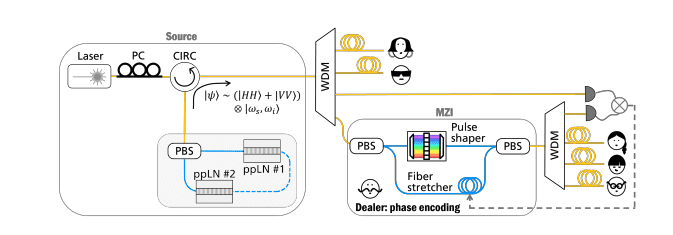
of correlated frequency channels. The other elemenents in the figure are: circulator (CIRC), polarization beam splitter (PBS), polarization controller (PC), periodically-poled Lithium niobate waveguide (ppLN).
Single-Source Quantum Secret Sharing via Wavelengths
Researchers have developed a new approach to quantum secret sharing that utilizes a single source of entangled photons and encodes information across different wavelengths of light. This innovative technique offers a pathway towards building more scalable quantum communication networks, overcoming limitations found in traditional methods. The core innovation lies in encoding secret information within individual frequency channels, effectively creating independent QSS sessions for multiple users from a single source, akin to creating multiple secure communication lines within a single fiber optic cable. The system allows a secret owner and two users to share a secret, and can be extended to support many more users simultaneously.
Demonstrations achieved high-fidelity states, exceeding 90%, across pairs of channels within the standard 200 GHz grid used in telecommunications, crucial for practical applications. Furthermore, the researchers indicate the potential to expand this to over 40 independent frequency channels, paving the way for highly connected quantum networks. This approach bypasses the limitations of previous methods, which struggled with scalability due to the difficulty of generating and managing complex entangled states or the need for numerous individual sources. The team’s method is compatible with existing telecommunications infrastructure, utilizing spectral shaping tools already employed in the field, simplifying implementation and lowering the barrier to adoption. By encoding information in a way that leverages the natural properties of light and existing technology, this research offers a promising pathway towards practical, scalable quantum secret sharing and more secure communication networks.
Frequency-Correlated Photons Enable Efficient Secret Sharing
This research demonstrates a new approach to quantum secret sharing that utilizes frequency correlations within entangled photon pairs, enabling multiple users to share a secret from a single source. By encoding information through frequency-dependent phase modulation, the system creates independent QSS sessions across different frequency channels, significantly improving resource efficiency compared to traditional methods. The team achieved state fidelities exceeding 90% for a pair of channels within a standard wavelength grid, suggesting scalability to potentially forty or more frequency bins. These findings extend the capabilities of wavelength-multiplexed networks beyond quantum key distribution, opening possibilities for more advanced quantum cryptographic applications. While the current implementation serves as a proof-of-principle demonstration using commercially available components, the authors acknowledge limitations related to factors like fiber distance and noise, which impact key rates. Future work could focus on optimizing system parameters and exploring advanced modulation techniques to improve performance and address these challenges.
👉 More information
🗞 Frequency subspace encoding for multiplexed quantum secret sharing
🧠 ArXiv: https://arxiv.org/abs/2508.03295