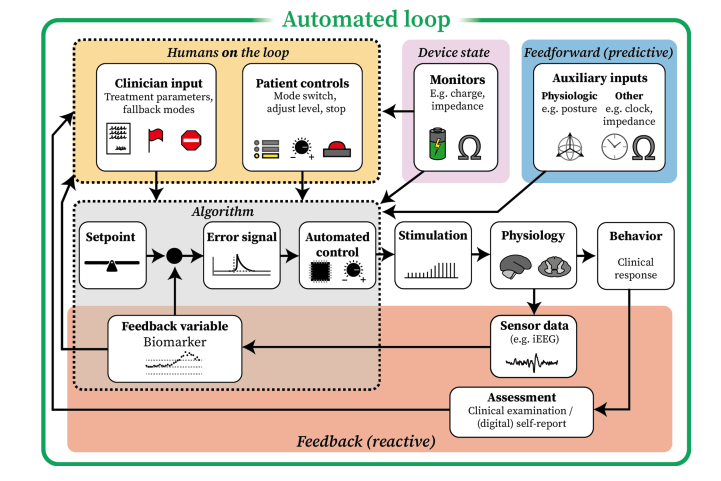
Neuromodulation, which uses devices to alter nervous system activity, is rapidly evolving towards closed-loop systems that respond directly to a patient’s needs, but this increased complexity demands careful consideration of safety and optimisation. Victoria S. Marks from the University of Oxford, Joram van Rheede also from the University of Oxford, and Dean Karantonis from Saluda Medical, alongside a large collaborative team, present a unifying framework for understanding and developing these physiological closed-loop controllers (PCLCs). This work systematically maps current and future PCLCs, integrating technical considerations for medical devices with physiological control principles, and categorising biomarkers used for both reactive and predictive control. By establishing a standardised approach to nomenclature and outlining a rigorous development process, the research provides essential guidance for the field, aiming to mitigate risk and accelerate the safe and effective implementation of advanced neuromodulation therapies.
Closed-Loop Systems for Adaptive Therapies
Researchers are increasingly focused on closed-loop systems, which automatically adjust therapies based on a patient’s real-time physiological state. This approach promises more personalised and effective treatments, particularly in areas like neuromodulation and diabetes management. These systems rely on sensors to gather information, algorithms to process that data, and actuators to deliver the appropriate therapy, creating a dynamic feedback loop. The development of these systems is driven by the need for therapies that adapt to individual patient needs and respond to changing conditions. In neuromodulation, this translates to devices that automatically adjust brain or nerve stimulation, while for diabetes, it means automated insulin delivery systems, often called artificial pancreases.
The field is experiencing growth in interoperability and open-source communities, such as those developing DIY artificial pancreas systems, which are accelerating innovation, alongside a competitive landscape with both collaboration and competition between medical device companies. Regulatory bodies, like the Food and Drug Administration, are adapting to the challenges of approving these complex, adaptive devices. New guidance, such as Good Machine Learning Practice, is being developed to ensure the safety and effectiveness of AI/ML-based medical devices. Predetermined Change Control Plans allow for software updates and algorithm improvements without requiring new regulatory submissions, fostering continuous innovation.
Neuromodulation System Design, Safety and Efficacy
Researchers have established a comprehensive framework for designing and evaluating closed-loop neuromodulation systems, devices that automatically adjust brain stimulation based on a patient’s physiological state. This work addresses the increasing complexity of these devices and provides guidance for ensuring both efficacy and safety, aligning with recent recommendations from regulatory bodies. The framework categorises biomarkers, indicators of brain activity, as either reactive or predictive, and integrates principles from control systems theory to optimise device performance. This standardised approach aims to mitigate risks associated with these increasingly sophisticated therapies.
The system employs a hierarchical control structure with three layers: an embedded layer within the implant, and two external layers managed by clinicians. The implant automatically detects abnormal brain activity and delivers stimulation, acting as a rapid response system, while the external layers provide monitoring and allow for adjustments to the stimulation parameters. This layered approach enables both immediate intervention and long-term optimisation of therapy, with the potential for artificial intelligence to further refine algorithms based on data collected from multiple patients. A key feature of the system is its robust safety design, incorporating multiple safeguards against potential hazards.
The device includes a manual override, allowing patients to temporarily suspend therapy if needed, and automatically limits the duration and frequency of stimulation to prevent overstimulation. Furthermore, automated fallback modes are implemented to ensure patient safety in the event of device malfunctions, such as low battery voltage or internal errors, transitioning the device to a safe, non-therapeutic state. Early implementations, such as the RNS® System, demonstrate clinical viability and potential for ongoing improvement. The system can store detailed recordings of brain activity and stimulation parameters, enabling clinicians to analyse data, refine detection algorithms, and personalise therapy for individual patients. While current devices have limitations, such as uneven charge distribution across stimulation contacts, they represent a significant step forward, paving the way for more effective and safer brain therapies. The ability to collect and analyse data from a population of patients through a secure cloud-based system offers the potential for continuous learning and optimisation of these devices, ultimately improving outcomes for individuals with neurological disorders.
Standardizing Closed-Loop Neuromodulation Controller Development
This work establishes a unified framework for understanding and developing physiological closed-loop controllers (PCLCs) in neuromodulation, aligning with recent guidance from regulatory bodies and established standards for medical devices. The research integrates concepts from control systems theory with the specific demands of neuromodulation, offering a systematic approach to biomarker classification, distinguishing between reactive and predictive signals, and risk management. By providing standardized nomenclature and outlining a rigorous development process, the authors aim to improve the safety, predictability, and efficacy of these increasingly complex therapies. The framework serves as a valuable resource for all stakeholders involved in PCLC development, from researchers and engineers to clinicians and patients. While acknowledging the growing sophistication of control algorithms and the potential of artificial intelligence, the authors emphasize the importance of a systematic and standardized approach to device development and testing. The research highlights the need for continued innovation in biomarker identification and predictive modelling, particularly as the field moves towards truly personalised and adaptive therapies, but also stresses the importance of adhering to established safety and regulatory guidelines.
🗞 Principles of Physiological Closed-Loop Controllers in Neuromodulation
🧠 ArXiv: https://arxiv.org/abs/2508.11422