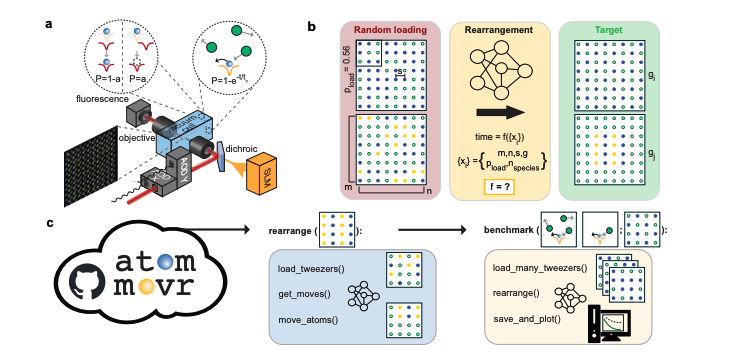
Rearranging individual atoms into desired configurations represents a critical challenge in building powerful neutral atom-based quantum processors, yet developing efficient algorithms for this task remains surprisingly difficult. Nikhil Harle, Bo-Yu Chen, and colleagues at the University of Chicago now present atommovr, an open-source simulation framework designed to accelerate progress in this field. This tool allows researchers to develop, compare, and benchmark algorithms for atom rearrangement under realistic conditions, addressing a significant gap in the current landscape where no such publicly available resource exists. By using atommovr, the team not only establishes fundamental limits on how quickly atoms can be rearranged, but also demonstrates a new algorithm capable of achieving high-fidelity rearrangement with a promising degree of success, ultimately lowering the barrier to entry for researchers exploring this exciting area of quantum information science.
Efficient atom rearrangement is essential because it enables the creation of arbitrary qubit connectivity, a significant challenge in neutral atom quantum computing. Therefore, developing faster and more efficient rearrangement techniques represents a critical step towards building scalable and practical neutral atom quantum processors.
Atom Rearrangement Algorithms for 2D Arrays
Researchers have explored algorithms for rearranging atoms within a two-dimensional array, relevant to applications like quantum simulation and materials science. One approach, the Parallel Hungarian Algorithm, builds upon a well-known optimization technique to find the best way to move atoms to their target locations. This algorithm calculates the cost of each move and attempts to move multiple atoms simultaneously to speed up the process, though it can become less effective when atoms block each other’s paths. Another algorithm, the InsideOut Algorithm, takes a layer-by-layer approach, starting from the center of the array and working outwards.
This method systematically removes obstacles and rearranges atoms within each layer, preventing blockages and simplifying the rearrangement process. Key concepts underpinning these algorithms include the Hungarian algorithm itself, the use of cost matrices to represent movement costs, and techniques for parallelizing atom movements. Researchers also employ strategies for obstacle avoidance and utilize greedy algorithms, which make locally optimal choices at each step to improve efficiency.
Atom Rearrangement Benchmarks and Lower Bounds
Researchers have developed a new open-source framework for studying atom rearrangement, a crucial step in building neutral atom-based processors. This framework allows for the development, comparison, and benchmarking of algorithms designed to reposition atoms within an array, incorporating realistic sources of experimental noise. A key finding is the determination of lower bounds for the time required for optimal atom rearrangement. By solving a complex mathematical problem, the researchers established a benchmark against which existing algorithms can be measured, revealing that some algorithms scale poorly with increasing numbers of atoms, while the theoretical lower bound scales more favorably, suggesting room for improvement in algorithm design.
The team also developed a new algorithm, termed ‘InsideOut’, specifically designed for rearranging arrays containing multiple atomic species. This algorithm avoids blockages by working layer-by-layer, preparing the center of the array and expanding outwards, achieving a near-perfect success rate in preparing arbitrary target configurations. Furthermore, the researchers improved upon existing algorithms by adding move parallelization to the Hungarian algorithm, demonstrating that even incremental improvements can yield significant performance gains. The new framework and algorithms promise to accelerate progress in neutral atom computing by providing a common platform for research and lowering the barrier to entry for new experimental groups.
Atom Rearrangement Framework and Algorithm Performance
This work introduces a new open-source framework designed to facilitate the development, comparison, and benchmarking of algorithms for rearranging neutral atoms in optical tweezers. The researchers addressed a significant gap in the field by providing a tool to explore rearrangement protocols under realistic and customizable noise conditions, lowering the barrier to entry for new experimental groups. Using this framework, they numerically established lower bounds for the time required for optimal rearrangement and compared these to existing algorithms, revealing that while some algorithms minimize distance travelled, they lack the move parallelization needed for efficient scaling. The researchers acknowledge that their current framework focuses on a specific type of atom displacement. Future work could investigate the impact of different noise sources and explore algorithms that more closely approach the theoretical limits of rearrangement speed, ultimately contributing to the advancement of neutral atom-based quantum processors.
🗞 atommovr: An open-source simulation framework for rearrangement in atomic arrays
🧠 ArXiv: https://arxiv.org/abs/2508.02670