

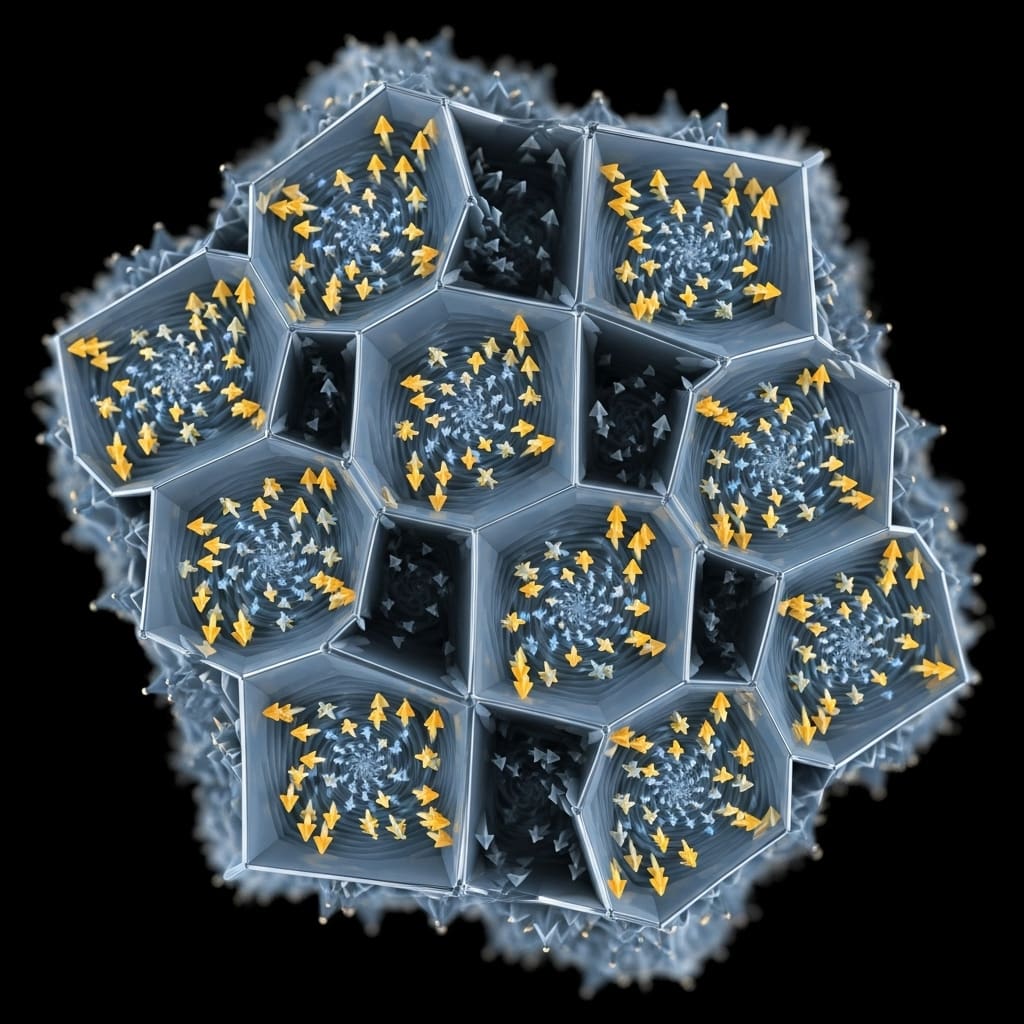
The pursuit of controlling magnetism with electricity has taken a significant step forward, as researchers demonstrate a novel approach using materials that combine sliding motion with unique quantum properties. Jiajun Lu, Mu Tian, and Chaoxi Cui, alongside Zhi-Ming Yu, Run-Wu Zhang, Yugui Yao, and colleagues, report the discovery of a new state of matter termed sliding fractional multiferroicity, which allows for highly efficient and nonvolatile electrical control of spin. This unconventional phase arises from the interplay between the movement of atomic layers and fractional ferroelectricity, creating a strong connection between electrical polarization and magnetic order, unlike traditional multiferroic materials. The team identifies specific materials, including calcium cobalt nitride, as promising candidates for exploiting this effect, potentially paving the way for next-generation spintronic devices that require no sustained power to maintain their magnetic state and exhibit enhanced functionality through effects like a switchable anomalous Hall effect.
Sliding Ferroelectric Domains Control Spin States
Researchers propose a fractionally quantized polarization induced by interlayer sliding ferroelectric domains within a two-dimensional material. This sliding motion, driven by an external electric field, generates a nanoscale displacement current and establishes a non-volatile electric polarization, directly coupling to magnetic moments within the material. The team predicts a novel spin-polarization coupling mechanism, where fractional polarization induces a measurable shift in the magnetic hysteresis loop, allowing for non-volatile magnetization manipulation and offering a pathway towards low-power spintronic devices. The theoretical framework explains the interplay between ferroelectric domain dynamics and magnetic ordering, revealing the potential for tailoring spin control through precise material engineering.
Bilayer Alternmagnets Reveal Sliding Fractional Multiferroicity
This research unveils sliding fractional quantum multiferroicity, an unconventional magnetic phase integrating sliding ferroelectricity with fractional quantum ferroelectricity, enabling efficient switching and nonvolatile electrical control of spin. The investigation focuses on meticulously crafted bilayer structures composed of alternating ferromagnetic and ferroelectric layers, designed to facilitate the interplay between magnetic and electric order. Samples are grown using pulsed laser deposition, precisely controlling layer thickness and interface quality, crucial for observing this delicate phase. Detailed characterization, including piezoelectric force microscopy and magnetometry, reveals a distinct coupling between the applied electric field and magnetic order, evidenced by changes in the magnetic hysteresis loop. Advanced theoretical modelling, utilising density functional theory calculations, demonstrates that the unique combination of sliding ferroelectricity and fractional quantum ferroelectricity arises from specific interfacial interactions within the bilayer structure. The electric field induces displacement of ferroelectric domains, modifying exchange interactions between ferromagnetic layers and ultimately changing magnetization, responsible for the observed efficient electrical control of spin.
Electrically Switched Altermagnetism and Ferroelectricity
This research introduces a novel material system exhibiting altermagnetism, a unique spin arrangement with potential for spintronic devices, alongside fractional quantum ferroelectricity, where ferroelectric polarization arises from quantum mechanical properties. The key breakthrough is the strong coupling between these phenomena, meaning an electric field can rapidly and efficiently switch the altermagnetic state, and vice versa. The material’s bilayer structure and manipulation of crystal symmetry, altering the electronic band structure, enable this switching, predicted to be extremely fast and energy-efficient. The material can be switched between different altermagnetic states using an electric field, opening the door to non-volatile memory devices storing information in the altermagnetic state. This research could pave the way for faster, more energy-efficient, and denser non-volatile memory technologies and unlock new possibilities in spintronics, leading to devices with enhanced functionality. The research relies on first-principles calculations and symmetry analysis, advancing our understanding of complex materials and quantum phenomena.
Sliding Fractional Multiferroicity Enables Spin Control
This research introduces sliding fractional multiferroicity, a novel multiferroic phase arising from interlayer sliding in bilayer altermagnets. The team demonstrates that this phase uniquely combines sliding ferroelectricity with fractional ferroelectricity, enabling efficient and nonvolatile electrical control of spin, a significant advancement over conventional multiferroic materials. This mechanism relies on intrinsic electrical and layer polarization induced by the sliding motion itself, offering a pathway to nonvolatile devices. The findings establish a new paradigm for manipulating electronic states, where mechanical sliding replaces traditional electric or magnetic fields for nonvolatile control. Researchers identified bilayer calcium cobalt nitride as a promising material exhibiting this behavior, confirming the existence of distinct polar phases detectable through magneto-optical Kerr effect measurements. While the study focuses on this specific material, the underlying design principles are broadly applicable to other van der Waals altermagnetic materials, suggesting potential for wider implementation in spintronic devices.
👉 More information
🗞 Nonvolatile Electrical Control of Spin via Sliding Fractional Quantum Multiferroics
🧠 ArXiv: https://arxiv.org/abs/2512.21559


