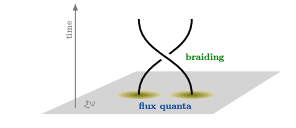
Research demonstrates a new mathematical framework describing anyons in fractional quantum Hall systems. This utilises advanced cohomology theories to translate physical observables into algebraic analysis of local Hilbert spaces, potentially aiding the search for and development of topologically protected quantum computing hardware.
The pursuit of robust quantum computation necessitates exploring physical systems inherently resistant to environmental noise. Fractional Quantum Hall (FQH) systems, exhibiting exotic states of matter governed by anyons – particles that behave differently from bosons or fermions – represent a promising avenue. These anyons possess topological order, potentially enabling the creation of stable quantum bits (qubits) and gates. However, a complete theoretical understanding of their behaviour has remained elusive. Now, Hisham Sati and Urs Schreiber, both of New York University, alongside collaborators, present a novel mathematical framework for describing FQH anyons, detailed in their article “Fractional Quantum Hall Anyons via the Algebraic Topology of Exotic Flux Quanta”. Their work leverages advanced concepts in algebraic topology – specifically 2-Cohomotopy theory – to directly relate observable properties of FQH systems to the underlying geometry of quantized magnetic flux, potentially informing experimental investigations into topological quantum hardware.
A Novel Topological Framework for Fractional Quantum Hall Anyons
Fractional quantum Hall (FQH) systems present a compelling route towards realising robust quantum computation. Their potential lies in the existence of anyons – quasiparticles exhibiting exotic exchange statistics – which can serve as topologically protected qubits, minimising decoherence. However, a complete theoretical understanding of these complex systems remains a significant challenge, impeding progress towards functional quantum technologies. This work introduces a new theoretical framework for describing anyonic behaviour within FQH systems, potentially positioning these materials as fundamental building blocks for future quantum computers and deepening our understanding of emergent quantum phenomena.
The research presents a non-Lagrangian effective description of FQH anyons, achieved through a rigorous quantization of effective topological flux. This utilizes the mathematical framework of 2-cohomotopy theory – a branch of algebraic topology concerned with the classification of 2-dimensional objects up to continuous deformation. This approach moves beyond conventional Lagrangian field theory, which often struggles to accurately capture the intricate quantum properties inherent in FQH systems. Lagrangian methods describe physics in terms of energy, while this new approach focuses on the topology of the system – its properties that remain unchanged under continuous deformations.
The study directly translates key FQH system characteristics – observables, states, symmetries, and measurement channels – into an algebro-topological analysis. This translation centres on local Hilbert spaces defined over the quantized flux moduli spaces. A moduli space describes the set of all possible configurations of a system, and by mapping physical phenomena onto this purely mathematical framework, precise calculations and predictions become possible.
The central hypothesis is that appropriate effective flux quantization within FQH systems occurs within the framework of 2-cohomotopy theory. This sophisticated mathematical construct captures subtle topological properties not readily accessible through conventional methods. Detailed calculations and analysis support this hypothesis, suggesting a specific mechanism for how topological flux is quantized, resolving previously elusive aspects of FQH behaviour. Topological flux can be understood as a measure of the ‘twistedness’ of the system, and its quantization is crucial for the emergence of anyonic behaviour.
The rigorously derived results may inform laboratory searches for novel anyonic phenomena in FQH systems and accelerate the development of topological hardware for quantum computation. This framework provides a pathway for connecting theoretical predictions with experimental observations, enabling researchers to design and interpret experiments more effectively.
This work distinguishes itself by offering a mathematically rigorous approach to understanding FQH anyons, addressing long-standing challenges in the field and providing a solid foundation for future research. The approach allows for systematic and controlled exploration of FQH system behaviour, uncovering new insights and guiding the development of novel quantum technologies.
The framework provides a rigorous derivation of results based on the hypothesis that 2-cohomotopy theory accurately describes the effective flux quantization within FQH systems, offering a potential resolution to previously elusive aspects of their behaviour. This demonstrates that this mathematical framework can accurately capture the essential physics of FQH systems, providing a consistent and predictive description of their properties.
The proposed connection to 2-cohomotopy theory offers a specific, testable hypothesis for future research, enabling experimentalists to verify the theoretical predictions and refine our understanding of FQH systems. A series of experiments are outlined that can be used to test this hypothesis, providing a clear roadmap for future research.
Ultimately, this work aims to facilitate the realization of robust, error-protected quantum computation based on the unique properties of FQH systems, offering a potential pathway towards building fault-tolerant quantum computers. FQH systems possess the necessary ingredients for building topologically protected qubits and performing quantum operations, offering a promising platform for realising practical quantum computation.
👉 More information
🗞 Fractional Quantum Hall Anyons via the Algebraic Topology of Exotic Flux Quanta
🧠 DOI: https://doi.org/10.48550/arXiv.2505.22144