

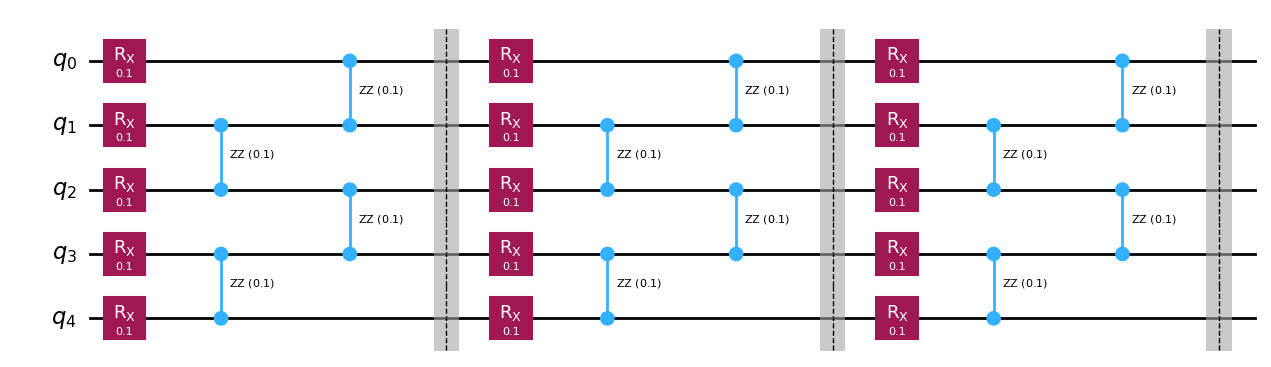
Fractional Quantum Gates or “fractional gates” are a new type of gate that can significantly reduce the complexity of quantum circuits. This innovation allows for more efficient execution of certain types of quantum operations, leading to faster processing times and reduced error rates. The development is particularly significant for utility-scale workloads, where the reduction in gate depth can have a major impact on performance.
Researchers simulated the dynamics of a transverse field Ising model using IBM’s Qiskit platform to demonstrate the power of fractional gates. By leveraging fractional gates, they were able to reduce circuit depth and execution time compared to traditional methods. The new technology is supported by select backends, including IBM’s ibm_torino backend, which can be accessed through the QiskitRuntimeService. While there are some limitations to the use of fractional gates, researchers believe this innovation has the potential to accelerate progress in quantum computing.
The main idea is that fractional gates can significantly reduce the circuit depth of quantum algorithms, which becomes crucial when scaling up to 100+ qubits. The authors demonstrate this by comparing the decomposition of two gates: X and RZZ(θ).
The X gate, a simple Pauli-X operation, has a relatively low overhead when decomposed into more basic gates. However, the RZZ(θ) gate, which is used in many quantum algorithms, requires multiple CZ gates (controlled-Z operations) and single-qubit rotations, leading to a much larger increase in circuit depth.
The solution lies in using fractional gates, which allow for direct execution of these single- and two-qubit rotations. This approach avoids the issue of increasing circuit depth and can lead to significant speedups.
To illustrate this, the authors provide an example based on the Ising model, a simple quantum system that simulates the dynamics of a transverse field Ising model. They construct a circuit using Qiskit, a popular open-source quantum development environment, and demonstrate how to use fractional gates by specifying a backend that supports them.
The results show a significant reduction in scheduled circuit time when using fractional gates compared to not using them. However, the authors also highlight some limitations of fractional gates, including:
- Not all backends support fractional gates.
- They cannot be used with dynamic circuits or primitive-based error mitigation methods like PEC, ZNE with PEA, or Pauli twirling (at least for now).
- They can be used alongside dynamical decoupling and the T-REx method.
The article concludes by encouraging readers to experiment with fractional gates and providing resources for further guidance on their usage.
Overall, this is an exciting development in quantum computing, as reducing circuit depth can lead to significant speedups and improved fidelity in large-scale quantum computations.
External Link: Click Here For More


