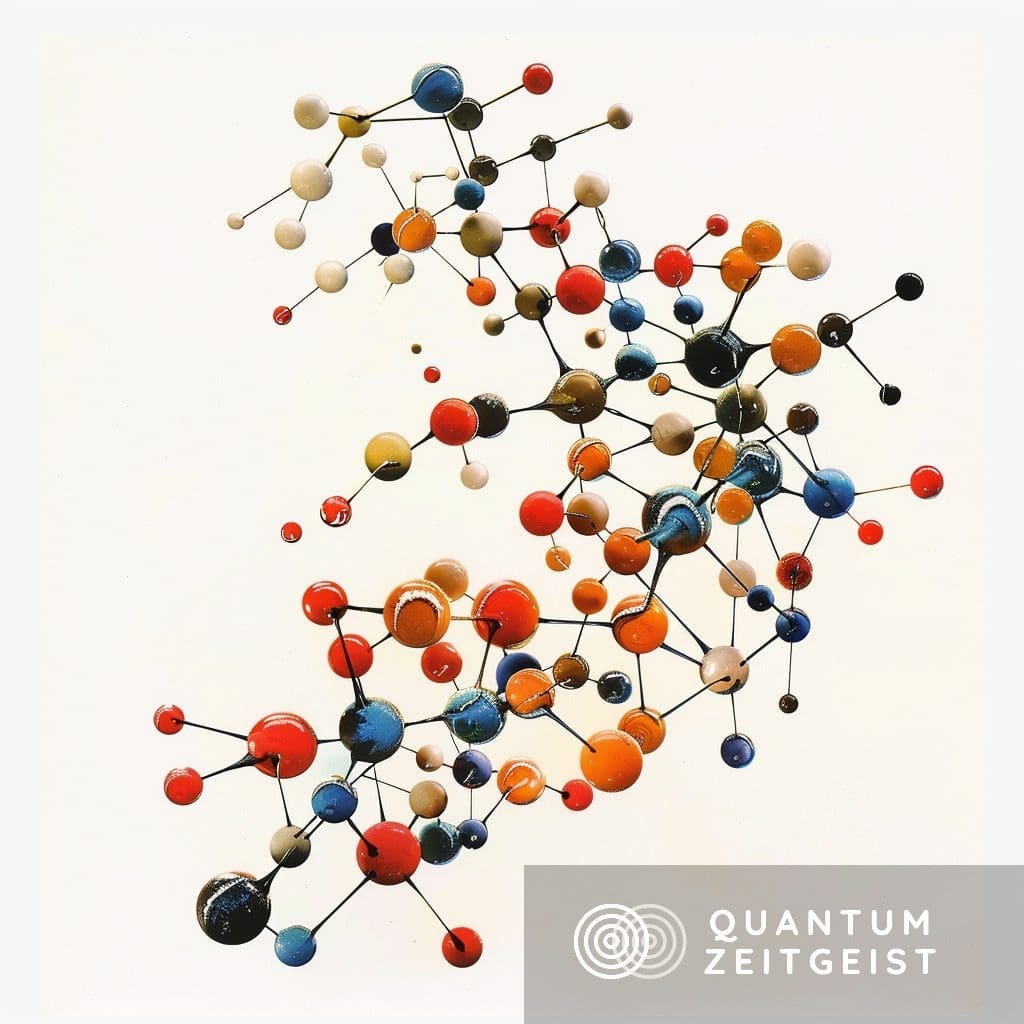
The Fractional Extended Diffusion Theory (FEDT) is a recent advancement in molecular simulations, providing a more comprehensive understanding of molecular dynamics. It is a generalization of the Extended Diffusion Theory (EDT), a tool used to recover dynamic properties from biased and accelerated molecular simulations (BAMS). FEDT adapts EDT’s calculation methods to capture non-exponential character observed in molecular relaxation. It has been applied to study molecular dynamics and interpret NMR spin-lattice relaxation experiments. FEDT’s significance lies in its ability to capture long time correlations compatible with subdiffusive regimes, making it valuable in recovering dynamics from BAMS in both regular and anomalous diffusion regimes.
What is the Fractional Extended Diffusion Theory?
The Fractional Extended Diffusion Theory (FEDT) is a recent development in the field of molecular simulations. It is a generalization of the Extended Diffusion Theory (EDT), which is a revision of the classical diffusion theory. The EDT has been shown to be a powerful tool for recovering dynamic properties from biased and accelerated molecular simulations (BAMS). BAMS are a type of simulation aimed at obtaining fast and thorough exploration of the system conformational space. They are necessary to observe relevant molecular processes when they occur on time scales unreachable by standard molecular dynamics (MD) simulations.
In these theories, the molecule is described in terms of beads connected by bond vectors, and the surroundings in terms of a continuous medium providing hydrodynamic effects on the molecular motions. The Smoluchowski equation is transformed into a generalized eigenvalue problem (GEP) by expressing the eigenfunctions of the Smoluchowski operator as linear combinations of suitable basis functions. The matrices involved in the GEP do not depend on the dynamical properties of the system but are functions of the beads friction coefficients and equilibrium averages (EAs) of appropriate dynamical variables.
How does the Fractional Extended Diffusion Theory work?
The Fractional Extended Diffusion Theory works by adapting the calculation methods of the EDT to capture the non-exponential character observed in the relaxation of intramolecular distances and molecular radius of gyration. These dynamics depend on internal molecular motions only. The matrices involved in the GEP can be built from the trajectories of any kind of molecular simulation that allows for the calculation of static properties, even if it violates the physical dynamics, as it happens in BAMS.
Through the EAs, such matrices contain all the information about the atomic interaction potentials as provided by the simulation. The theory transfers this detailed information to the predicted dynamics. Within DT and EDT, the dynamics are obtained by projection of the target variables over the eigenfunctions of the Smoluchowski operator. They are yielded in terms of time correlation functions (TCFs) expressed in the form of a weighted combination of time-exponentially decaying functions.
What are the applications of the Fractional Extended Diffusion Theory?
The Fractional Extended Diffusion Theory has a wide range of applications in the field of molecular simulations. It has been successfully applied to the study of molecular dynamics in terms of vector and second order tensor orientational TCFs. It has also been used in the interpretation of 13C or 15N NMR spin-lattice relaxation experiments.
However, in its present form, neither DT nor EDT can treat cases involving anomalous diffusion where relaxation shows a slow and markedly non-exponential character at long times, at variance with regular Brownian diffusion regimes. These situations are very common in proteins and peptides and they are observed in both experiments and simulations. Various studies have indicated that subdiffusion is caused by either the depth distribution of traps on the energy landscape or by the presence of long-lived conformational substates.
What is the significance of the Fractional Extended Diffusion Theory?
The significance of the Fractional Extended Diffusion Theory lies in its ability to capture the actual dynamical behavior which exhibits persistent long time correlations compatible with the so-called subdiffusive regimes. This makes it a tool of practical value in recovering dynamics from BAMS to be used in general situations involving both regular and anomalous diffusion regimes.
The FEDT is a significant advancement in the field of molecular simulations. It provides a more accurate and comprehensive understanding of the dynamics of molecular systems. This can have important implications for the development of new drugs and therapies, as well as for the design of new materials and technologies.
Publication details: “Fractional Extended Diffusion Theory to capture anomalous relaxation from biased/accelerated molecular simulations”
Publication Date: 2024-02-28
Authors: Arnaldo Rapallo
Source: The Journal of Chemical Physics
DOI: https://doi.org/10.1063/5.0189518