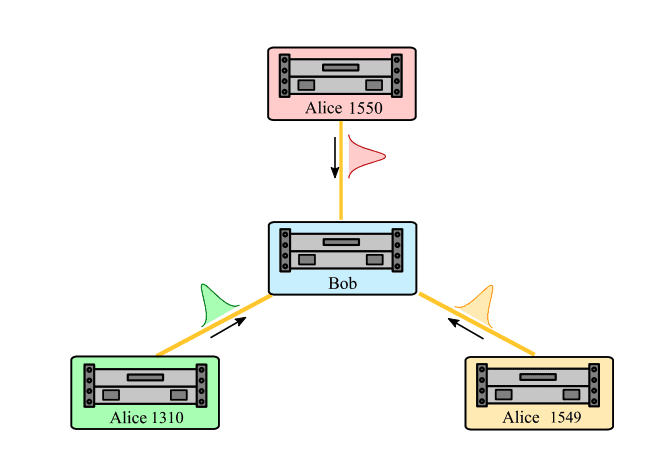
The demand for unconditionally secure communication continues to grow alongside advances in quantum key distribution (QKD) technology, and practical network implementations are essential for widespread adoption. Researchers at the University of Padova, led by Davide Scalcon, Matteo Padovan, and Paolo Villoresi, now demonstrate a four-node QKD network that significantly reduces costs and increases efficiency. Their system employs wavelength-division multiplexing, allowing it to distribute secure keys simultaneously across multiple channels in the O and C bands, and crucially, shares key decoding components between links. This innovative approach, which streamlines the central receiver node, represents a substantial step towards building practical and scalable quantum communication networks for future telecommunications.
Wavelength-Division Multiplexing for Practical Quantum Communication Networks
Researchers are actively developing Quantum Key Distribution (QKD) technologies and integrating them with classical communication networks to enhance security and capacity.
Core QKD technologies include polarization encoding, decoy state protocols to mitigate photon number splitting (PNS) attacks, and wavelength division multiplexing (WDM) for increasing key rates. Alternative approaches involve continuous-variable QKD, entanglement-based QKD, and the use of single-photon detectors and FPGA-based architectures for real-time processing.
A major focus is creating hybrid networks that combine the security of QKD with the bandwidth and reach of classical networks. Key techniques for coexistence include WDM, time division multiplexing (TDM), frequency division multiplexing (FDM), software-defined networking (SDN), and dense Wavelength Division Multiplexing (DWDM). Exploration also extends to underwater communication applications.
Researchers continually strive to improve QKD system performance by increasing key generation rates through parallelization, fast detectors, and optimized signal processing. Extending transmission distances involves trusted nodes and the development of quantum repeaters. Miniaturization, resource-effective designs, and fast qubit-based synchronization are also key areas of development.
Maintaining the security of QKD systems is paramount, with ongoing efforts to address PNS attacks, perform finite-key analysis, and counter side-channel attacks. Rigorous security proofs are essential to validate the security of QKD protocols.
Applications of QKD extend to secure time transfer, and initiatives like the European Quantum Communication Infrastructure (EuroQCI) and the OpenQKD platform are driving research and development.
The field is rapidly evolving, with researchers overcoming technical challenges to integrate QKD into existing communication infrastructure, increasing key rates, extending transmission distances, improving security, and reducing costs to make QKD a practical and widely deployable technology.
👉 More information
🗞 Versatile Wavelength-Division Multiplexed Quantum Key Distribution Network Operating Simultaneously in the O and C Bands
🧠 DOI: https://doi.org/10.48550/arXiv.2507.11175