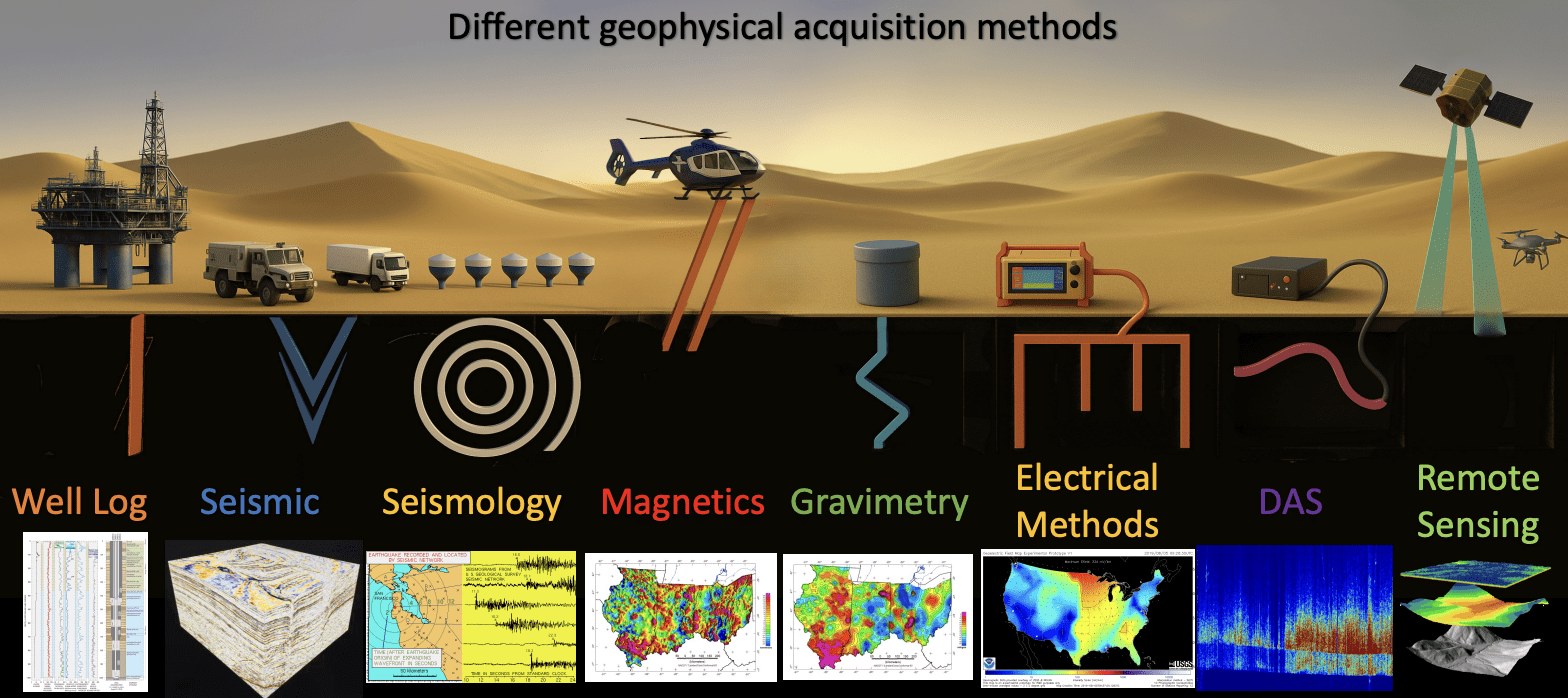
On April 24, 2025, researchers published a detailed framework for integrating foundation models into geophysics, addressing challenges like data complexity and leveraging transfer learning opportunities to enhance analysis efficiency.
This paper presents a comprehensive framework for integrating foundation models with geophysical data, addressing challenges in data diversity, complexity, and physical consistency. It explores techniques from data collection to model deployment, emphasizing transfer learning to reduce reliance on labeled data and enhance computational efficiency while incorporating physical constraints. The work provides practical guidance for applying foundation models in geophysical analysis, advancing innovation in the field.
Artificial intelligence (AI) is driving transformative changes in geophysics, offering innovative solutions to complex data analysis and modeling challenges. By integrating advanced AI techniques, researchers are enhancing traditional methods, leading to more accurate predictions and deeper insights into Earth’s processes.
One significant advancement lies in the application of deep learning to inversion problems, which are crucial for constructing seismic velocity models. Traditionally laborious and computationally intensive, these models now benefit from methods like those developed by Yang and Ma. Their approach leverages deep learning to invert seismic data more efficiently, resulting in faster and more precise velocity models. This innovation not only accelerates research but also improves the accuracy of subsurface imaging, essential for oil exploration and earthquake risk assessment.
In urban areas, ambient noise often hinders accurate earthquake monitoring. Lei Yang and colleagues have addressed this challenge with deep learning models that suppress noise effectively. Their method enhances signal clarity, enabling better detection of seismic activities in noisy environments. This breakthrough is vital for improving early warning systems in densely populated regions, potentially saving lives and reducing infrastructure damage.
Zhang et al. have integrated foundation models into geoscience, creating a versatile AI system capable of handling diverse tasks. These models, trained on extensive datasets, can adapt to various geophysical problems, from analyzing satellite imagery to predicting geological formations. This flexibility opens new research avenues and streamlines data processing across different domains within geophysics.
GPT-style models are making waves in geospatial tasks through applications like GeoGPT and RockGPT. GeoGPT assists in processing large geospatial datasets, aiding in environmental monitoring and resource management. Meanwhile, RockGPT reconstructs 3D rock structures from 2D slices, a critical tool for understanding subsurface geology without invasive drilling. These models exemplify how AI can enhance both exploration and conservation efforts.
The integration of AI into geophysics is driving significant advancements, from improving data analysis efficiency to enabling new research possibilities. As these technologies evolve, they promise to deepen our understanding of Earth’s dynamics, aiding in resource management, disaster mitigation, and environmental protection. The future of geophysics looks promising, with AI at the forefront of innovation.
👉 More information
🗞 On the workflow, opportunities and challenges of developing foundation model in geophysics
🧠 DOI: https://doi.org/10.48550/arXiv.2504.17384