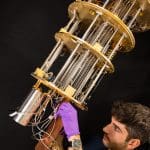
Forget painstakingly recreating ultra-cold, high-magnetic-field environments – a new era in precision measurement may be dawning thanks to research at Forschungszentrum Jülich. Scientists have demonstrated that memristors – tiny devices originally designed for next-generation computing – can serve as a remarkably stable and fundamentally-defined standard for electrical resistance. This breakthrough offers a simpler, more accessible path to tracing electrical units back to the immutable laws of physics, moving beyond the limitations of current methods reliant on complex quantum phenomena. By linking resistance directly to universal constants, this innovation promises to democratize precision metrology, potentially impacting everything from scientific research to industrial calibration.
Redefining Standards- Linking Resistance to Constants
The implications of linking resistance standards to fundamental constants through memristor technology extend far beyond simplified laboratory procedures – it represents a potential paradigm shift in metrological accessibility. Currently, maintaining the global standard for electrical resistance relies heavily on the quantum Hall effect, a method demanding costly, complex infrastructure – supercooled environments and powerful magnetic fields – limiting precise calibration to a select few national institutes. Memristors, however, bypass these limitations by directly manifesting quantized resistance levels rooted in Planck’s constant (h) and the elementary charge (e). Forschungszentrum Jülich’s recent demonstrations showcase stable conductance states of 1·G₀ and 2·G₀ – discrete resistance values – achieved reproducibly at room temperature and in air, a feat previously unattainable. Initial collaborative measurements across multiple European research institutions reveal promising precision – a deviation of only 3.8 percent for 1·G₀ and 0.6 percent for 2·G₀ – suggesting the technology is already nearing practical usability. This “electrochemical polishing” process, refining the conductive nanofilaments within the memristor with atomic precision, ensures stable, quantized conductance. Ultimately, this democratization of precision metrology could streamline industrial calibration processes, enhance the reliability of scientific experiments across diverse fields, and potentially unlock new advancements in areas reliant on highly accurate electrical measurements.
Memristors- A Novel Resistance Technology
Memristors, initially conceived as components for next-generation computing, are rapidly emerging as a disruptive force in precision metrology, offering a fundamentally new approach to defining and maintaining electrical resistance standards. Unlike the current reliance on the quantum Hall effect – a method demanding costly and complex infrastructure – memristors leverage the inherent properties of nanoscale conductive filaments to directly manifest quantized resistance levels linked to Planck’s constant (h) and the elementary charge (e). This isn’t merely a simplification of existing techniques; it’s a paradigm shift enabling resistance calibration outside the confines of a handful of specialized national institutes. The Forschungszentrum Jülich team has successfully demonstrated stable conductance states of 1·G₀ and 2·G₀ – discrete resistance values – at room temperature and in air, a feat previously unattainable.
The underlying mechanism involves manipulating conductive nanofilaments – comprised of individual silver atoms – within the memristor using a process termed “electrochemical polishing,” akin to fine grinding to achieve atomic precision. This allows for the creation of stable, quantized resistance levels. Collaborative measurements across multiple European research institutions have already yielded promising results, with deviations of only 3.8 percent for 1·G₀ and 0.6 percent for 2·G₀, indicating a level of precision nearing practical usability. Beyond simplifying calibration procedures, this technology promises to democratize access to precise electrical measurements, impacting fields ranging from materials science and fundamental research to industrial calibration and quality control.
Current Limitations- Quantum Hall Effect Challenges
While the quantum Hall effect has long served as the bedrock for defining electrical resistance, its inherent limitations pose significant challenges to widespread, accessible metrology. The requirement for maintaining temperatures near absolute zero – colder than outer space – and generating magnetic fields far exceeding those used in medical imaging creates a substantial barrier to entry. Only a handful of national metrology institutes globally possess the infrastructure and expertise to reliably perform these measurements, creating a bottleneck for precise calibration and traceability. This dependence concentrates the ability to define a fundamental unit within a limited number of facilities, hindering broader scientific advancement and industrial precision. Furthermore, the complexity of the setup introduces potential sources of error and requires constant, meticulous monitoring. The fragility of these cryogenic and magnetic systems also necessitates substantial upkeep and carries the risk of disruption. In contrast, the emerging memristor technology offers a pathway to bypass these obstacles, promising a more democratic and robust standard by grounding resistance directly in the immutable laws of physics – specifically, Planck’s constant and the elementary charge – at room temperature and ambient conditions. This shift isn’t merely about convenience; it’s about fundamentally reshaping the landscape of precision measurement, potentially unlocking new levels of accuracy and accessibility across diverse fields.