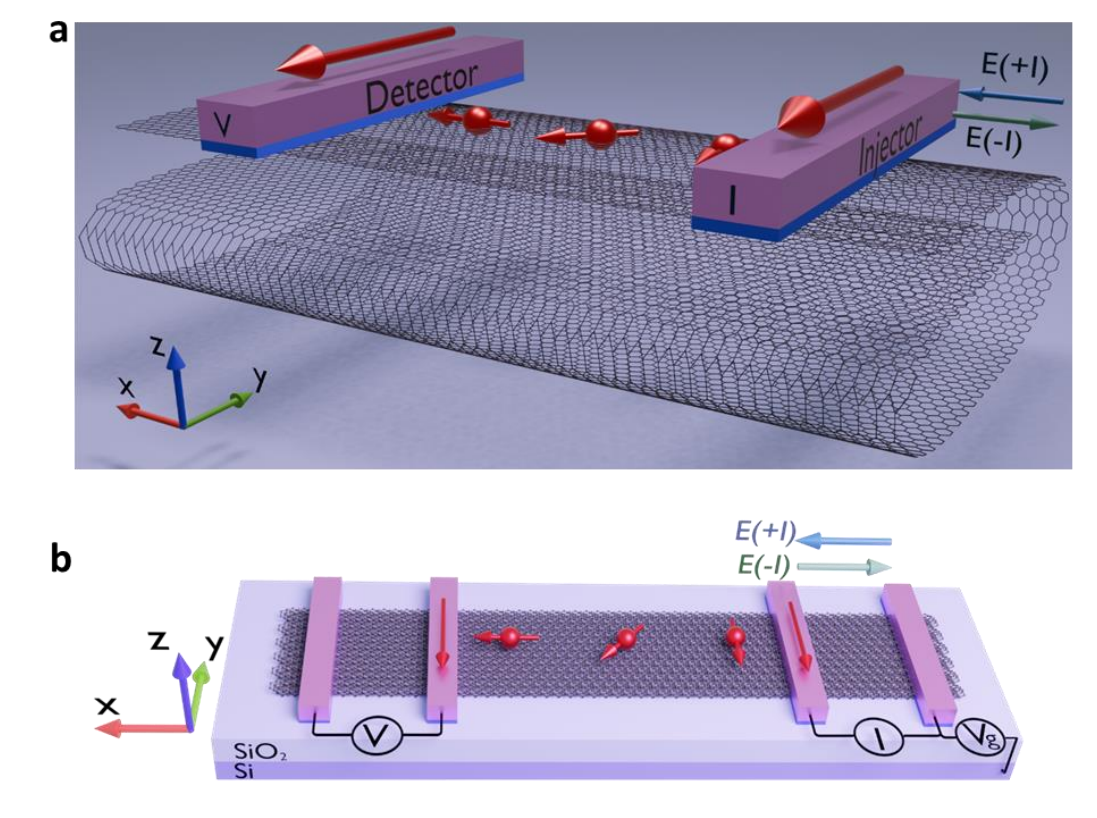
Graphene’s potential as a platform for future spintronic devices, including non-volatile memory and logic, hinges on creating components that not only transport spin efficiently but also actively manipulate it. Md. Anamul Hoque, Zoltán Kovács-Krausz, and Bing Zhao, alongside colleagues from Chalmers University of Technology, Budapest University of Technology and Economics, and the University of Manchester, now demonstrate a significant step towards this goal. The team fabricated a novel device using folded-bilayer graphene and reports exceptionally large spin signals, reaching several millivolts, alongside a pronounced spin-rectification effect. This achievement, which generates a substantial spin accumulation and a spin-diode effect exceeding ten-fold asymmetry, arises from the strong interplay between accumulated spin and applied electric fields, paving the way for ultrathin, active spintronic devices based on two-dimensional materials.
Graphene Spintronics and Magnetic Proximity Effects
Scientists are pioneering new spintronic devices using graphene, a two-dimensional material with exceptional electronic properties. Recent research focuses on manipulating spin, an intrinsic quantum property of electrons, within graphene structures to create devices with enhanced performance and functionality, promising breakthroughs in data storage, processing, and sensing technologies. Researchers engineered a novel spin-valve device using folded-bilayer graphene to achieve remarkably large spin signals and pronounced spin-rectification effects. The device was fabricated from exfoliated folded-bilayer graphene with ferromagnetic tunnel contacts, carefully optimizing the channel geometry to achieve ideal spin impedance matching.
A non-local measurement technique, separating current injection and voltage detection, ensured reliable detection of pure spin signals, and optical, scanning electron, and atomic force microscopy confirmed the structure of the folded graphene channel. The experimental approach involved applying a charge current, creating a non-equilibrium spin density within the graphene, which diffused through the channel and was detected as a non-local voltage. Systematic measurements, applying a perpendicular magnetic field, revealed spin precession and allowed for the extraction of spin-transport parameters. By sweeping an in-plane magnetic field, scientists observed switching in the non-local resistance, confirming the spin-valve functionality.
The team achieved a maximum spin-precession signal amplitude of 2. 65 millivolts and a corresponding non-local resistance of 88. 5 ohms, demonstrating efficient spin injection and transport. Further investigation revealed a significant spin-diode effect, where negative bias current generated a higher spin signal compared to positive bias current, demonstrating asymmetric spin accumulation. Researchers calculated a large spin accumulation exceeding 20 millielectronvolts, facilitated by the folded graphene channel’s high contact resistance and moderate channel resistance, creating ideal spin impedance matching conditions.
This innovative device surpasses recent advancements, achieving spin signals exceeding those observed in graphene with various tunnel barriers. This research demonstrates a significant advance in spintronic devices through the fabrication and characterisation of a folded-bilayer graphene spin-valve. The team achieved remarkably large non-local spin signals, alongside pronounced spin-rectification effects, arising from a substantial spin accumulation within the graphene channel, measured at approximately 20 meV. The subsequent nonlinear interaction between this accumulation and applied electric fields results in a spin-diode effect exceeding an order of magnitude difference between forward and reverse bias.
The large spin signal and spin-diode effect are attributed to optimal impedance matching between the ferromagnetic tunnel contacts and the folded graphene channel, coupled with carrier drift dynamics enhancing spin accumulation. While previous work demonstrated diode behaviour in bilayer graphene, this study reports a considerably larger spin accumulation and signal amplitude. Researchers acknowledge that achieving reproducible device performance remains a challenge, requiring precise control over multiple parameters, and future work, including the fabrication of rolled graphene, may further enhance chirality-induced spin selectivity and contribute to the development of practical spintronic circuits. This work establishes folded graphene as a promising platform for active, ultrathin two-dimensional spintronics, potentially enabling novel device functionalities through nonlinear spin-dependent electron transport.
🗞 Large spin signal and spin rectification in folded-bilayer graphene
🧠 ArXiv: https://arxiv.org/abs/2511.01627