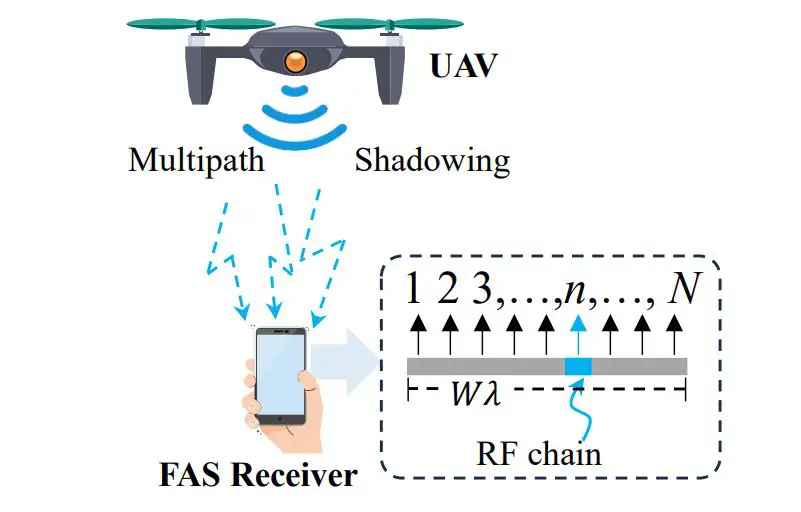
Unreliable communication links pose a significant challenge for the widespread adoption of unmanned aerial vehicles (UAVs) in future networks, particularly in environments where signals suffer from severe fading and shadowing. To address this, Xusheng Zhu, Kai-Kit Wong, and Qingqing Wu, alongside Hyundong Shin and Yangyang Zhang, present a detailed analysis of a UAV-to-ground communication system employing a novel fluid antenna system. This research introduces a method for accurately predicting the performance of such a system in challenging double-shadowing conditions, delivering new insights into signal reliability and data transmission rates. By developing tractable mathematical models, the team demonstrates that this system achieves a significant improvement in communication robustness, effectively multiplying the inherent channel diversity and paving the way for more dependable UAV operations.
This work focuses on enhancing communication links between UAVs and ground stations, addressing the challenges of complex, shadowed environments. The team developed a detailed statistical model of the communication channel, accurately capturing the multipath fading and shadowing effects inherent in air-to-ground links. Experiments reveal that the FAS receiver, equipped with multiple antenna ports, effectively boosts signal diversity within a compact form factor.
By treating the antenna as a reconfigurable resource, the system selects the port that maximizes signal strength, improving communication performance. The researchers derived new analytical expressions for key performance indicators, including the cumulative distribution function and probability density function of the signal-to-noise ratio. These expressions accurately predict the system’s behavior under challenging double-shadowing fading conditions, providing a powerful tool for system design and optimization. The study delivers exact integral expressions for outage probability, average bit error rate, and average channel capacity, providing a comprehensive understanding of system performance.
Furthermore, scientists derived tractable closed-form solutions for the average bit error rate and capacity for a practical dual-rank system, simplifying performance analysis and enabling efficient system evaluation. A key analysis demonstrates that the system achieves a multiplicative diversity order, directly proportional to both the number of antenna ports and the inherent diversity of the communication channel. This confirms that increasing antenna density and optimizing channel characteristics both contribute to improved communication reliability. Monte Carlo simulations validate the accuracy of the theoretical framework, confirming its ability to accurately predict system performance. These findings pave the way for more reliable and efficient UAV communication systems, crucial for a wide range of future applications.
Fluid Antenna Systems Boost UAV Communication
This research presents a novel analytical framework for understanding the performance of unmanned aerial vehicles (UAVs) communicating with ground stations utilizing a fluid antenna system (FAS). By employing an eigenvalue-based approximation, scientists derived new expressions defining signal-to-noise ratio statistics, including cumulative distribution functions and probability density functions, allowing for precise calculations of outage probability, average bit error rate, and channel capacity. The team’s approach accurately models the complex interactions between the UAV and the ground station, providing a realistic assessment of communication performance. This detailed model allows for optimization of system parameters to maximize reliability and efficiency.
Importantly, the team demonstrated that the system achieves a multiplicative diversity order equal to the product of the FAS spatial rank and the inherent channel diversity, confirming a predictable relationship between system design and performance. This finding simplifies the design process and allows for targeted optimization of key parameters. The researchers further developed closed-form solutions for average bit error rate and capacity applicable to practical systems with a limited number of antenna ports, and comprehensively validated their theoretical predictions against Monte Carlo simulations. These simulations confirmed the accuracy of the FAS approximation in challenging fading channels, and quantified the trade-offs between antenna density and physical aperture, providing valuable insights for realistic FAS design in UAV networks.
The authors acknowledge that the approximation’s accuracy is highest in full-rank systems, and may exhibit optimistic bias when constrained by a limited number of antenna ports. This transparency highlights the limitations of the model and guides future research efforts. This work builds upon existing research into fluid antenna systems and UAV communications, offering a robust analytical tool for optimizing wireless links in future networks.
🗞 Fluid Antenna System-Enabled UAV-to-Ground Communications
🧠 ArXiv: https://arxiv.org/abs/2511.17416