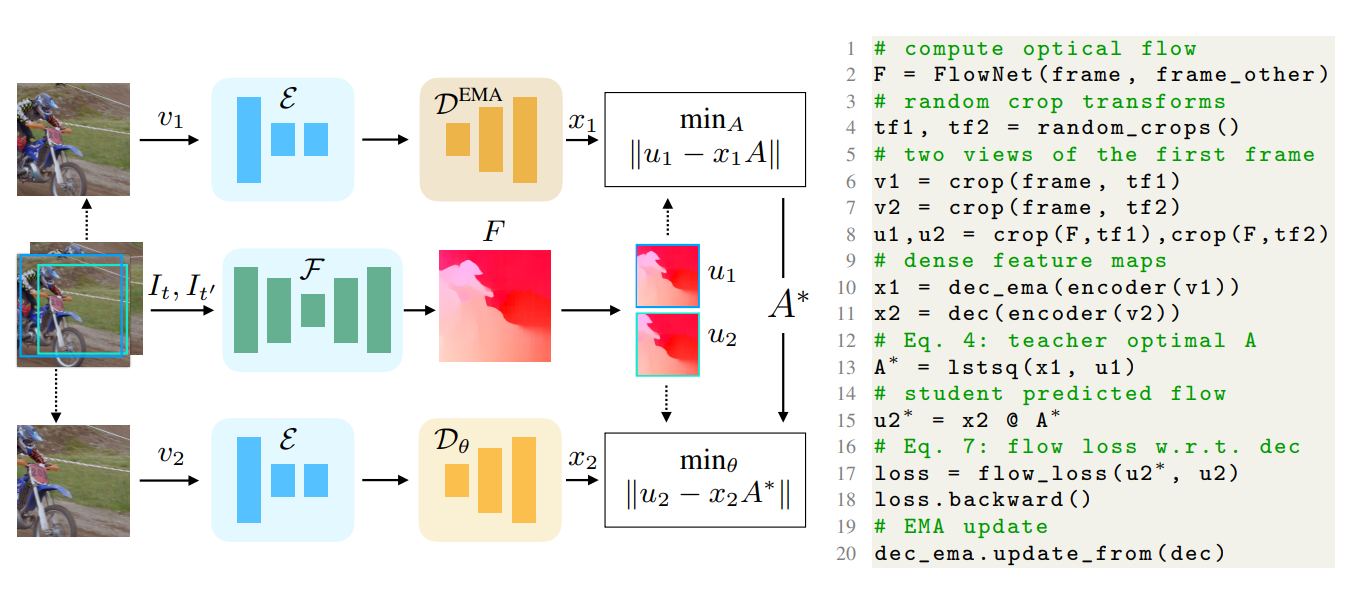
The demand for detailed and versatile image understanding drives innovation in computer vision, yet current systems often struggle to deliver the high-resolution data needed for precise analysis. Nikita Araslanov, Anna Sonnweber, and Daniel Cremers from TU Munich present FlowFeat, a new approach to creating remarkably detailed image representations. This system overcomes limitations in existing technology by embedding a range of possible motions within images, effectively capturing how objects appear to move. The researchers demonstrate that FlowFeat significantly improves performance across a variety of demanding tasks, including video object segmentation, depth estimation, and semantic segmentation, offering a substantial step towards more reliable and versatile computer vision systems.
Motion Augmentation Improves Visual Feature Extraction
This research introduces FlowFeat, a new method for extracting visual features from images and videos that incorporates motion information to improve performance on tasks like semantic segmentation, depth estimation, and video object segmentation. FlowFeat enhances standard visual features, derived from models like DINOv2, by adding motion-based features calculated from optical flow. The team demonstrates that this combination consistently outperforms existing methods on multiple benchmarks, achieving faster processing speeds thanks to its efficient architecture. Detailed analysis reveals that FlowFeat generalizes well with different visual feature extractors and scales effectively with larger models, offering a compelling balance between computational complexity, runtime performance, and implementation simplicity. Experiments demonstrate significant performance gains, establishing FlowFeat as a valuable tool for computer vision applications.
FlowFeat Enables High-Resolution Image Representations
This research presents FlowFeat, a new method for creating high-resolution and versatile image representations, crucial for dense prediction tasks like video object segmentation, semantic segmentation, and depth estimation. FlowFeat addresses the limitation of current networks, which often produce low-resolution feature grids, by introducing a distillation technique that embeds a distribution of plausible apparent motions, or motion profiles. This approach leverages flow networks and diverse video data to statistically approximate apparent motion, resulting in remarkably detailed spatial and temporal consistency within the encoded features. Experiments demonstrate that integrating FlowFeat significantly enhances the representational power of existing image encoders.
The team trained FlowFeat on YouTube-VOS and Kinetics-400, and evaluated performance on video object segmentation, achieving substantial improvements in segmentation scores compared to baseline models. A focal gradient matching term improves the sharpness of feature maps, promoting flow consistency at motion boundaries and resulting in finer details in semantic masks. The training process is computationally inexpensive and robust to inaccuracies in flow estimation.
Motion-Aware Image Representations for Enhanced Vision
Researchers have developed FlowFeat, a novel approach to creating dense image representations that significantly enhances performance across multiple vision tasks. The core of this work lies in a new distillation technique which embeds distributions of plausible apparent motions, or motion profiles, into the image representation. By leveraging flow networks and extensive video data, the team created a self-supervised training framework that statistically approximates these motion patterns, resulting in a representation with remarkable spatial detail and strong temporal consistency. Experiments demonstrate that FlowFeat consistently improves the representational power of existing image encoders when applied to video object segmentation, depth estimation, and semantic segmentation. Notably, the method exhibits particular strength in segmenting moving objects, suggesting an enhanced ability to discern dynamic elements within scenes. Future work may explore the application of FlowFeat to more complex tasks such as image-based 3D reconstruction and object tracking, potentially leading to more robust and versatile vision systems.
🗞 FlowFeat: Pixel-Dense Embedding of Motion Profiles
🧠 ArXiv: https://arxiv.org/abs/2511.07696