Superconductors represent a promising platform for simulating Majorana fermions, elusive particles with unique quantum properties, but their potential has long been limited by strict symmetry constraints that dictate the behaviour of these particles. Ming-Jian Gao and Jun-Hong An, from Lanzhou University, now demonstrate a method to overcome these limitations, revealing a pathway to engineer exotic superconducting states. The researchers achieve this breakthrough by employing periodic driving, a technique known as Floquet engineering, to break the symmetry-imposed constraints on phases within the superconducting material. This innovative approach not only generates a wealth of Majorana modes, but also creates hybrid-order superconductors exhibiting both boundary and corner modes within the same energy gap, significantly expanding the possibilities for designing and fabricating advanced superconducting materials and unlocking new avenues for quantum computation.
Floquet Phases and Periodic Driving Systems
This body of work represents a comprehensive exploration of Floquet topological phases of matter, investigating how periodically driven systems can exhibit novel quantum properties. Researchers are actively exploring and realizing these phases in diverse physical systems, building upon the foundational principles of Floquet theory. This theory provides the framework for understanding the behavior of systems subjected to time-periodic forces. Investigations focus on defining and calculating topological invariants, such as Chern numbers, which characterize these phases and predict the existence of protected states at the material’s boundaries.
Scientists are particularly interested in understanding the connection between these bulk properties and the robust edge states that emerge in periodically driven systems. Research also delves into the role of chiral symmetry and the emergence of higher-order topological phases, characterized by states localized at corners or hinges. This research is remarkably interdisciplinary, bringing together condensed matter physics, photonics, atomic physics, and quantum information science. Researchers are attempting to realize Floquet topological phases in a wide range of platforms, including graphene, topological insulators, photonic crystals, ultracold atoms, acoustic systems, and superconducting qubits. The potential for building robust quantum computers drives much of this work, particularly the search for Majorana fermions and other topological states.
Overcoming Constraints Using Floquet Topological Engineering
Floquet Engineering Breaks Symmetry Constraints in Superconductors
Scientists have developed a novel technique to overcome limitations in controlling Majorana modes within topological superconductors, materials considered promising for topological quantum computing. Their work focuses on creating and manipulating Majorana fermions, particles with unique quantum properties ideal for fault-tolerant quantum computing. This research pioneers the use of Floquet engineering, involving the application of periodic driving, to circumvent symmetry-imposed constraints on topological phases. The study focused on a two-dimensional p-wave topological superconductor, a system conventionally prohibited from hosting first-order topological phases.
Generating Novel First-Order Majorana Boundary Modes
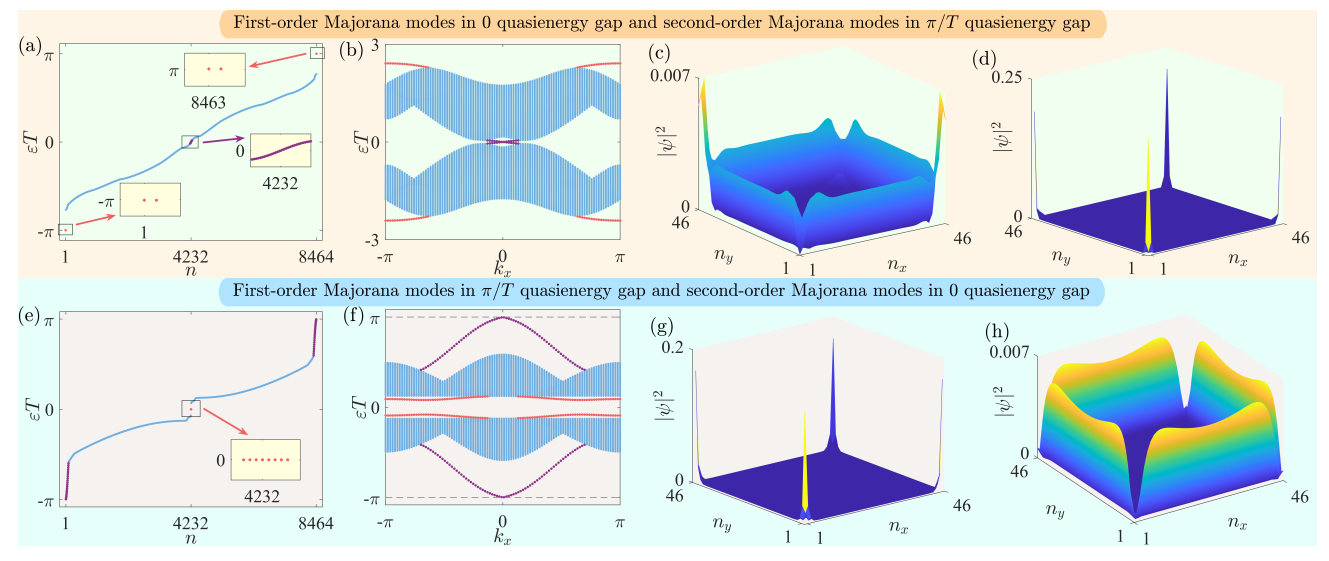
Researchers applied a carefully designed periodic drive to this system, effectively manipulating its topological properties without altering its inherent symmetries. This innovative method generates rich first-order Majorana boundary modes, previously unattainable within the constraints of the static system, and facilitates the emergence of exotic hybrid-order topological superconductors. These newly created superconductors exhibit a unique combination of first-order Majorana boundary modes and second-order Majorana corner modes, appearing simultaneously in both the zero and π/T quasienergy gaps. Measurements confirm the existence of four-fold degenerate Majorana zero modes, characterized by their unique probability distributions indicative of their corner-state nature. This work provides a valuable method for exploring exotic topological phases and potentially relaxes the practical difficulties of controlling topological phases in real materials, paving the way for further applications in quantum technologies.
Floquet Engineering Creates Majorana Boundary Modes
Breakthrough for Topological Quantum Computing Architectures
Scientists have demonstrated a new method for creating and controlling Majorana modes in superconducting materials, overcoming limitations imposed by fundamental symmetry constraints. This research introduces a Floquet-engineering technique, involving the application of periodic driving, to circumvent these constraints and generate first-order Majorana boundary modes in systems where they would not normally exist. The team discovered that this periodic driving not only creates Majorana modes but also allows for the emergence of exotic hybrid-order superconductors, featuring both first-order boundary modes and second-order corner modes, and importantly, these modes can coexist within a single energy gap. This challenges the conventional classification of topological superconductors based on symmetry and expands the range of materials suitable for hosting these sought-after modes. This achievement builds upon recent advances in simulating Majorana modes across various platforms, including condensed matter systems and cold atom experiments, providing strong support for the feasibility of their approach. Future work may focus on exploring alternative driving schemes and realizing these Floquet Majorana modes in experimental setups such as superconducting qubits and cold atom systems, potentially unlocking new avenues for manipulating and applying these unique quantum states.
🗞 Breakdown of symmetry constraint in Floquet topological superconductor
🧠 ArXiv: https://arxiv.org/abs/2509.19992