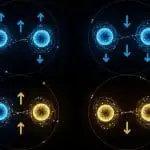
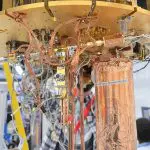
A team of researchers has proposed a novel approach to quantum computing using floating electrons, a method first theorized 25 years ago. The technique involves creating qubits from electrons floating above liquid helium or solid neon, which could significantly increase the coherence times of qubits, reducing the number required for universal quantum computation. A recent achievement of a world record 100 microseconds coherence time for charge qubits by a floating-electron-on-solid-neon qubit has reignited interest in this approach. The researchers believe this method could play a significant role in the future of quantum computing.
Can Floating Electrons Revolutionize Quantum Computing?
Quantum computing, a field gaining significant traction recently, is on the brink of a potential breakthrough. A recent review by Asher Jennings, Xianjing Zhou, I Grytsenko, and E Kawakami proposes a novel approach to quantum computation using floating electrons. This method, first theorized 25 years ago, involves creating qubits from electrons floating above liquid helium or solid neon. The researchers believe this could significantly increase the coherence times of qubits, thereby reducing the number of qubits required for universal quantum computation.
The concept of floating-electron-based qubits is not new. However, the recent achievement of a world record 100 microseconds coherence time for charge qubits by a floating-electron-on-solid-neon qubit has reignited interest in this approach. The researchers predict that a spin qubit could reach around 1 second of coherence time, significantly improving current technologies.
The review by Jennings and his team is aimed at anyone interested in quantum computing, particularly those who are exploring alternative methods. The authors believe that considering different possibilities for building a quantum computer is crucial, as current technologies may not be sufficient, or a hybrid system may be required. They hope that their work will inspire other scientists to explore the potential of floating-electron-based qubits.
How Can Existing Knowledge Contribute to Quantum Computing Advancements?
The development of floating-electron-based qubits is not an isolated endeavor. Many theories and proposals in this field borrow ideas from other, more developed qubit systems and scientific fields. For instance, the scientists who discovered the world-record-setting floating-electron-based neon qubit leveraged their knowledge of superconductor physics to control and read the qubit.
According to Xianjing Zhou, one of the authors of the review, the technologies researchers are trying to use for floating-electron-based qubits are not very different from those used for other qubits. This means that existing devices or techniques could potentially be applied to electrons on helium or neon. Furthermore, covering something with liquid helium or solid neon is not a particularly challenging task, which could make this approach more accessible.
The authors of the review hope that their work will inspire other scientists to think of new ideas to realize floating-electron-based qubits. They believe that the potential of this approach is significant and that it could contribute to the advancement of quantum computing.
What Does the Future Hold for Quantum Computing?
The field of quantum computing is still in its early stages, and there is much that remains unknown. However, the recent advancements in floating-electron-based qubits suggest that this approach could play a significant role in the future of quantum computing.
The review by Jennings and his team provides a comprehensive overview of the potential and challenges of quantum computing using floating electrons on cryogenic substrates. They believe that this approach could enable long coherence times, which would reduce the number of qubits required for universal quantum computation.
However, the authors also acknowledge that there are challenges to overcome. For instance, the technologies required for floating-electron-based qubits are not very different from those used for other qubits, but they are not yet widely used. Furthermore, while covering something with liquid helium or solid neon is not particularly challenging, it is not a trivial task either.
Despite these challenges, the authors remain optimistic about the potential of floating-electron-based qubits. They believe that their work could inspire other scientists to explore this approach and contribute to the advancement of quantum computing. As the field continues to evolve, it will be interesting to see how these theories and proposals are put into practice.
Publication Date: 2024-03-18
Authors: Alane Lim
Source: Scilight
DOI: https://doi.org/10.1063/10.0025432